Israel: America’s Third Aircraft Carrier in the Middle East
Click here to download the JINSA Insight
Amid a substantial buildup of U.S. forces in and around the Middle East, the U.S. Air Force (USAF) deployed roughly a dozen F-22 stealth aircraft to Ovda Air Base in Israel. This move is the first step in fulfilling JINSA’s recommendation in a recent report that the United States base forces at Ovda. Indeed, a JINSA delegation of retired USAF generals inspected Ovda Air Base in 2025 and found that it offers unique access, freedom of action, and resilience for U.S. forces in the region and beyond.
In the context of current tensions, where Tehran has not stepped back from brinkmanship with Washington, the first-ever combat deployment of U.S. aircraft to Israel sends a clear signal of capability and resolve to Iran, and it gives the United States far more striking power than our entire buildup at other airbases throughout the region. Israel has long been referred to as “the largest American aircraft carrier in the world that cannot be sunk.” Deploying F-22s to Ovda now gives the United States a third aircraft carrier in the region to confront Iran. It should be the first of many such U.S. deployments to benefit from Ovda’s unique advantages.
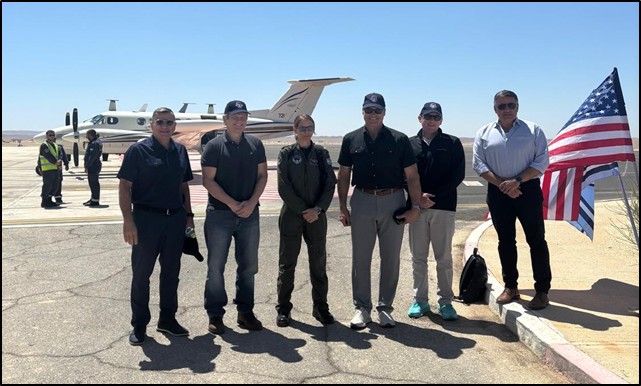
JINSA task force on U.S. basing options in Israel visits Ovda Air Base in September 2025.
Built to U.S. Specifications
As JINSA’s delegation discovered first-hand when we visited last year, Ovda airbase, in Israel’s far south, is particularly well-suited for potential U.S. operations against Iran, and for America’s strategic and operational needs more generally. Israel’s Air Force (IAF) maintains high standards for its own U.S.-made aircraft and supporting activities at its facilities—training, maintenance, and logistics—which means that much of Ovda’s infrastructure already comports with USAF requirements. The base’s plug-and-play infrastructure can support immediate, intense, and sustained U.S. operations against Iran, without entailing a large or complex footprint. This helps reduce the overall strains on U.S. forces that come with the largest regional military buildup in decades.
The base meets the de facto U.S. gold standard, having been built to American specifications in the early 1980s to implement the Camp David Accords. As part of the contingency planning preceding the 12-Day War, certain additional features were added to the base to meet potential U.S. requirements. The most costly and crucial infrastructure already is on-site in abundance, including shelters, parking ramps, hardstands, fuel bunkers, ammunition dumps, storage facilities, housing, and a dedicated terminal for U.S. use. It has two main runways that can accommodate the largest USAF tanker and transport aircraft. As a backup base for IAF tankers, these aircraft can support U.S. operations and reduce further the footprint for U.S. forces.
Reliable Access
Ovda is more than just a good base, however. It is the right base for projecting power against Iran.
Coupled with the 12-Day War last summer, ongoing events underscore serious limits in America’s Middle East basing architecture. It embodies outdated priorities from the Cold War and Global War on Terrorism, concentrated in small numbers of large sites along the Arab side of the Gulf. Many host nations there restrict U.S. overflights and operations, particularly against Iran and its threat network. Similar constraints have been imposed by Turkey, Britain (through its base at Diego Garcia in the Indian Ocean), and other countries across the broader region.
And while well-built, these bases are poorly protected from Iran’s mass precise salvos of short-range projectiles. These concerns became clear in the 12-Day War, and amid recent tensions, as U.S. forces evacuated Qatar’s Al Udeid airbase multiple times in response to threats of Iranian attack. Accordingly, even as U.S. airpower surges into these countries, Saudi, Emirati, and Jordanian officials say they will not allow the United States to use their bases for anything other than defense against Iranian attacks.
By contrast, Israel understands that supporting America’s freedom of action enables both countries to do more against shared Iranian and other threats. Since before the 12-Day War, Israel has encouraged the United States to rotate assets into and through the country without restrictions, projecting power and conducting operations as we see fit. Last summer’s Operation Midnight Hammer was so tactically impressive because American planners were not prepared to utilize Israeli bases, and access restrictions prevented them from using bases in nearby host nations. In a looming fight with Iran, coordinating strategic bombers, submarines, strike aircraft, and large numbers of tankers across multiple continents and oceans could quickly become prohibitively costly and complex. As Israel demonstrated in Operation Rising Lion last summer, however, U.S.-made combat aircraft can reliably reach Iran from Israeli bases with in-air refueling or external fuel tanks.
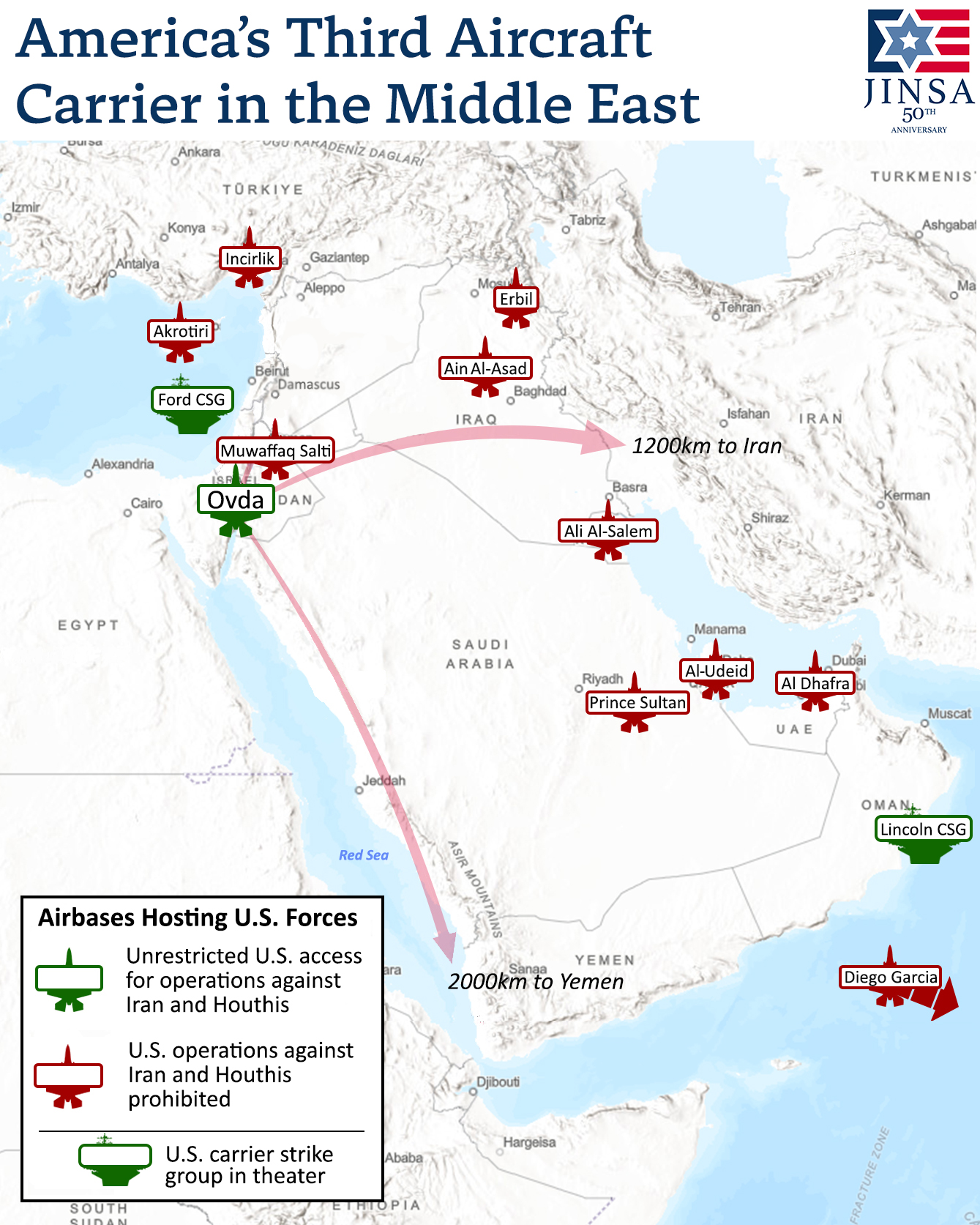
The first-ever operational deployment of U.S. combat aircraft to Israel offers unrestricted access and unique freedom of action for U.S. operations against Iran, as well as more resilient defenses than bases in the Gulf. The eleven F-22 stealth fighters at Ovda airbase effectively give the United States a third aircraft carrier in the Middle East.
Greater Resilience, Less Risk
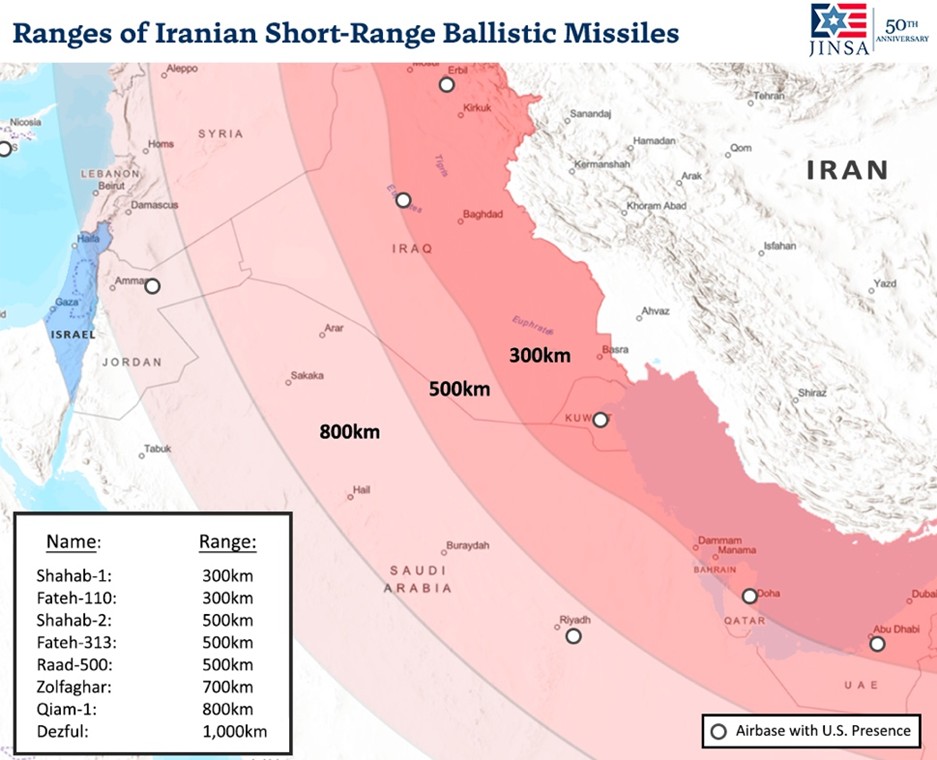
U.S. basing options in Israel offer the most defendable operating environment in the region, thanks to favorable geography and robust defenses. Iran’s formidable short-range ballistic (SRBM), cruise missiles, and drones hold U.S. installations in the Gulf at significant risk from large bolt-from-the-blue barrages. The short flight times for these projectile salvos, and the paucity of air and missile defenses around those bases, greatly compress early warning and severely complicate U.S.-led efforts to defeat such attacks.
Israel’s greater distance from Iran puts it beyond range of these capabilities (see map). It also provides enhanced early warning of incoming Iranian medium-range ballistic missiles (MRBM) and drones. Compared to other bases in the region that host U.S. forces, moreover, Ovda is well-defended by Israel’s layered air and missile defense architecture. Integration between Israeli and U.S. defensive systems further strengthens this protection. Joint air defense operations during the 12-Day War demonstrated the ability to defeat Iranian missiles and drones under sustained pressure. And as one additional basing option in the region, Ovda bolsters U.S. strategic depth and resilience by helping disperse our assets away from vulnerable concentrations along the Gulf.
Going Forward
By signaling America’s trust in Israel as an anchor of stability, and by enabling closer operational coordination between the two countries, the F-22 deployment to Ovda enhances shared deterrence and both countries’ freedom of action. Ovda’s ample capacity for on-site expansion to meet U.S. needs is an apt metaphor for deepening bilateral cooperation going forward—both in the immediate crisis with Iran and over the longer term. The United States should rotate additional combat and support aircraft through Ovda in the near term, and explore options for joint prepositioning of critical munitions to support U.S. and Israeli operations.
Click here to download the JINSA Insight.