After Ankara: Lifting CAATSA Doesn’t Unlock the F-35 for Turkey
Click here to download the JINSA Insight
Sitting beside Turkish President Recep Tayyip Erdoğan prior to the 2026 NATO summit in Ankara on July 7, President Donald Trump announced that the United States would lift the Countering America’s Adversaries Through Sanctions Act (CAATSA) sanctions imposed on Turkey over its purchase of the Russian S-400 air defense system—“we don’t want to sanction friends,” he said—and signaled that he would consider selling Ankara the F-35. In a statement that was half accurate, he called Turkey “much more loyal than other countries” and the aircraft “the best plane by far.” Erdoğan—who appeared visibly surprised at Trump’s declaration—replied that the jets had been “promised” and that “Mr. Trump always keeps his promises.” Except in this case he might not be able to, legally, and he certainly should not, strategically.
The president can begin lifting the CAATSA sanctions on his own authority, subject to congressional review, but he cannot lawfully hand Turkey the F-35 while the S-400 remains on Turkish soil—and no creative redefinition of what it means to “possess” the Russian system changes that. Nor should the S-400 be the only barrier to Turkey’s return to the F-35 program. As JINSA argued in its April 2025 report, Flight Risk: Turkey and the F-35, and again in a more recent Insight after Secretary of State Marco Rubio’s June testimony, the S-400 is merely the legal trigger for Turkey’s exclusion. Even its genuine removal would leave a long list of reasons Erdoğan’s Turkey should not fly America’s most advanced fighter.
What Trump Said in Ankara
Relations between the United States and Turkey have warmed tremendously under the current Trump administration following a cool four years under the Biden administration. The improvement has been driven in large part by Trump’s man in Ankara—Ambassador Tom Barrack—and his near-daily pro-Turkey pronouncements. And while Trump has flattered Erdoğan with praises of being a “good leader” and “great ally,” he has yet to move forward on any potential F-35 sale, despite Erdoğan raising the prospect repeatedly since Trump returned to the White House.
Trump’s most recent comments changed that dynamic. He waved off the S-400 problem—“I have no concerns about anything having to do with Turkey”—and cast a sale as a matter of rewarding a loyal ally. Vice President JD Vance had previewed the effort a week earlier, disclosing that the Pentagon was studying how the United States could sell F-35s to Turkey despite its possession of the Russian system, while conceding that “there are certain things that we have to certify have happened … in order to comply with American law.” That concession is the crux. The administration is not claiming the law permits a sale today, meaning it could be looking for a way to certify around it.
On CAATSA
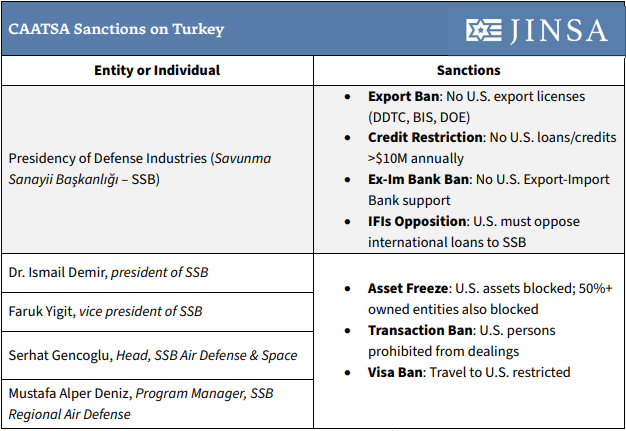
Two separate statutes stand in the way of Turkey’s return to the F-35 program, and lifting the first does not affect the second. CAATSA, originally enacted in 2017, placed sanctions on Turkey’s defense-procurement agency, the Presidency of Defense Industries (SSB), in December 2020. The sanctions package on SSB, which is the state institution responsible for military procurement, included:
- A ban on all U.S. export licenses and authorizations to SSB;
- Asset freezes on key SSB officials, including its president, İsmail Demir;
- Visa restrictions on senior personnel; and
- Prohibition of U.S. loans or credits exceeding $10 million to SSB.
The significance of the SSB sanctions lies in what SSB is. The agency is the body through which Turkey buys its foreign weapons. Sanctioning it does more than freeze a few officials’ assets—it effectively bars the U.S. government from selling Ankara major arms at all. Lifting the SSB sanctions is therefore a precondition for any F-35 transfer. But it is only that—a precondition, not authorization.
Those measures on SSB are what Trump can temporarily or permanently take off the table. He has the authority to begin waiving or terminating the SSB sanctions—but CAATSA does not let him do it by decree. Under the law’s congressional-review provisions, the president must first submit a report to the relevant congressional committees and leadership laying out the proposed action and his reasons for it. For waivers or sanctions, the president must certify that the waiver is in the national security interests of the United States. For terminations, the president must submit both a justification and notice that the person or entity is not engaging in the same activity that was the basis for the sanctions—or has taken significant verifiable steps toward stopping the activity. In both cases, a mandatory review period then follows, during which the president cannot lift the sanctions unless Congress passes a joint resolution of approval during the review period. That period normally runs 30 days. But the statute doubles it to 60 for any report submitted between July 10 and September 7 due to Congress’s summer recess.
That review period is where Congress’s leverage lies. Lawmakers can respond with a joint resolution of disapproval, and if one is enacted, the president is barred from easing the sanctions. However, because Trump would veto a resolution overturning his own decision, blocking him de facto requires two-thirds of both the House and Senate to override. Congress can stop the president here, but only if bipartisan opposition to rewarding Ankara runs deep enough to clear that bar. That high bar, not the president’s willingness, is the real test. When the first Trump administration moved to lift CAATSA sanctions on Russian oligarch Oleg Deripaska’s companies in 2019, Congress forced a disapproval vote under these same expedited procedures. The resolution passed the House 362–53 but fell three votes short in the Senate, where it drew 57 of the 60 needed to advance.
On NDAA Provisions
But the sale of F-35s to Turkey itself is barred by a different provision: Section 1245 of the FY2020 National Defense Authorization Act (NDAA), which prohibits any transfer of the aircraft unless the Secretaries of State and Defense jointly certify to Congress that:
- Turkey “no longer possesses” the S-400 system or associated personnel and equipment;
- Turkey has provided “credible assurances” that it would not in the future accept delivery of such systems from Russia; and
- Turkey had not, since July 2019, “purchased or accepted” other Russian defense hardware that might compromise the F-35’s systems.
That bar rests on a single word—“possesses”—and the administration should not be allowed to work around defining what that means. The workarounds already floated, from “boxing up” the S-400 to relocating it to a secure or U.S.-frequented facility such as Incirlik, share the same fatal flaw: they leave the system inside Turkey, under Turkish ownership and control. A crated S-400 is still possessed by the government that owns it and can uncrate it; a battery moved to Incirlik—a base on sovereign Turkish territory—is no less in Turkey’s hands than one deployed outside Ankara. Possession is a question of custody, not of whether the radar is switched on or which Turkish base hosts it, and the statute’s reference to “associated personnel and equipment” only reinforces the point.
The only credible way to meet the requirement is to remove the system from the country altogether—by transferring it to a third party, which, above all, cannot be Russia. A transfer to Moscow would indeed mean Turkey no longer “possesses” the system while defeating its purpose twice over: Russia could redeploy the system against Ukraine, and nothing would stop Russia from simply handing the S-400 back to Turkey once the United States has delivered the F-35s. Finding a suitable destination might prove tricky, but India—which already operates the S-400—could serve as a final destination acceptable to Washington, Ankara, and Moscow. Anything less than a transfer away from Turkish territory is unsatisfactory.
The S-400 Is Only the First Problem
While Turkey has balked at removing the S-400 in the nearly six years after being sanctioned, let’s suppose Turkey did surrender the system outright. The case against giving it the F-35 would still stand. Given Turkey’s continued dealings with Russia and China, entrusting it with the F-35’s crown-jewel technology would also invite the same intellectual-property risk that led Washington to freeze an F-35 sale to the far friendlier United Arab Emirates.
Erdoğan threatens fellow NATO member Greece and America’s growing partner, Cyprus; presses a military expansion in post-Assad Syria; and has gutted democratic institutions at home, jailing his chief rival, Istanbul Mayor Ekrem İmamoğlu, and moving against the main opposition Republican People’s Party (CHP). He has a long record of turning NATO alliance decisions into leverage—holding NATO defense plans for Poland and the Baltic states hostage, extracting F-16s as the price of Sweden’s accession—and has even threatened to give U.S. troops in Syria an “Ottoman Slap.” He has called for Israel’s destruction, backed Hamas, and severed ties with Jerusalem. More recently, Erdoğan has accused Israel of being “war-addicted,” and his foreign minister, Hakan Fidan, called Israel “a burden that humanity can no longer bear.”
Israel has said as much, publicly and at the highest level. Prime Minister Benjamin Netanyahu urged Trump directly not to proceed, warning that a sale would “destroy the power balance in the Middle East” and noting pointedly that the F-35 “doesn’t make Turkey a friendly state.” Handing the jet to a government that openly threatens the region’s only other F-35 operator would erode Israel’s Qualitative Military Edge (QME) and raise the prospect of two U.S. partners meeting over Syria or the Eastern Mediterranean as adversaries.
Bottom Line
Trump can extend Erdoğan a warm welcome and even potentially lift the CAATSA sanctions on Turkey’s procurement agency. What he cannot do is deliver the F-35 by executive fiat, and Congress should say so plainly: the NDAA’s bar holds until Turkey removes the S-400 from its territory—not boxes it, not parks it at Incirlik, but gives it up—and no certification should paper over a system that stays in Turkish hands. Even then, removal should mark the start of a longer test of Turkish conduct toward Israel, Greece, Cyprus, and its own citizens, not an automatic path to the flight line.
Congress can make that logic durable. It should require that any high-end arms sale to Turkey—the F-35 above all—be subject to the same Qualitative Military Edge review that already governs sales to Israel’s neighbors, ensuring no transfer erodes Israel’s military advantage. Extending QME scrutiny to Ankara would formalize what the S-400 debate only implies: that Turkey’s conduct, not merely its hardware, is what should determine its access to America’s most sensitive weapons.
The handshake in Ankara was a gesture. The law, and the strategic logic behind it, still say no.