Don’t Let Iran Kick Out U.S. Troops, but Move them to Israel
Click here to download the JINSA Insight
Iran’s missile and drone attacks over the past week against U.S. forces, seven Arab nations, and commercial shipping confirmed it remains an active aggressor, not a deterred ceasefire participant. Tehran’s escalation despite the United States maintaining most of its bolstered wartime posture—including two carrier strike groups, roughly 200 fighter aircraft, more than 100 aerial refueling tankers, and thousands of additional troops—highlighted the far greater danger Iran would pose without that presence. Yet, the memorandum of understanding (MOU) that the United States and Iran signed on June 17 to halt the war commits the United States to pull those forces back from the “proximity” of Iran within 30 days of a final deal. In response to Iran’s attacks, President Donald Trump declared on July 8 that the MOU and ceasefire are “over,” though he said negotiators could “keep talking if they want,” leaving that requirement’s fate unresolved.
The long-term future of America’s force posture in the Middle East depends on how the Trump administration decides to interpret this vague requirement and whether negotiators seek to clarify it. Even if tensions de-escalate, with Iran repeatedly refusing to fully reopen the Strait of Hormuz as it committed to do under the MOU, the Trump administration should not withdraw any military assets from the region. The escalation this week showed how quickly fighting can resume, and any withdrawal would leave the United States, its regional partners, and global commerce exposed to Iran’s next escalation. Sustaining a U.S. force posture in the Middle East with the capacity and capabilities to conduct largescale strikes and air defense remains the only leverage that could push Tehran to comply and end its attacks.
Iran will likely push for a broad interpretation of the proximity requirement as part of its effort to drive the U.S. military out of the region. A maximum reading would pull American forces out of the Gulf entirely and leave the Gulf states to face Iran alone, pushing them to hedge toward Tehran and to lean on Chinese arms. A narrower reading would require only the removal of the ships, aircraft, and air defenses that the United States surged to the Gulf for the war. Regardless, these conditions would leave the United States weaker against an Iran that, with the ceasefire declared over and fighting resumed, is already escalating threats against shipping in the Strait of Hormuz, holding Gulf nations at risk, and pressing the Gulf states to distance themselves from Washington.
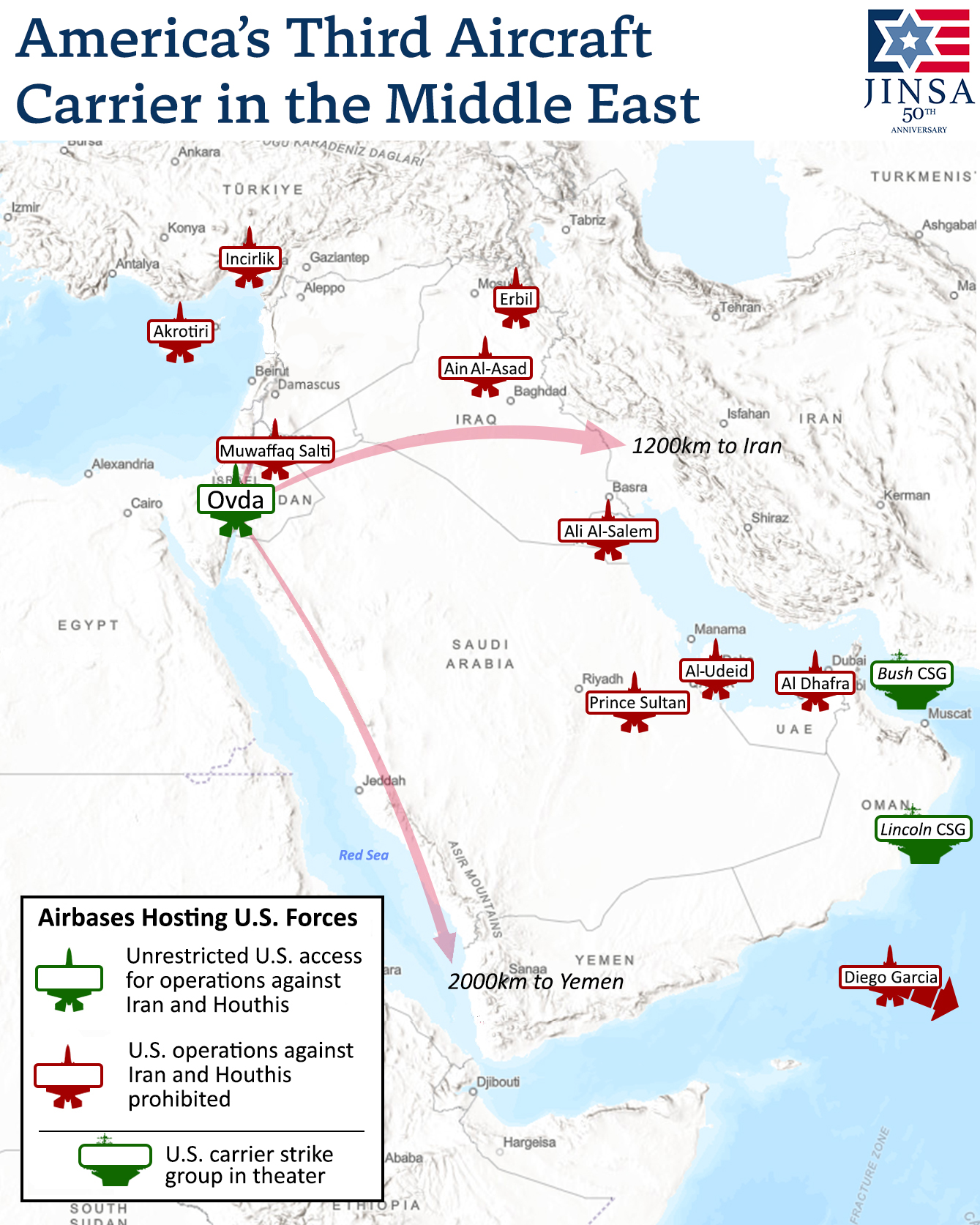
Underscoring these risks, Iran’s strikes during the war demonstrated that the United States can no longer count on operating from its Gulf bases. Their proximity puts them within minutes of Iranian missiles and drones, faster than defenses can react, and the war left bases across the Gulf severely damaged. In contrast, basing in Israel offers a more defensible and productive alternative. Its air defenses are the most capable in the region, its distance from Iran gives the warning time the Gulf bases lack, and it places no limits on U.S. operations against Iran, unlike several Gulf nations.
Regardless of how negotiations with Iran proceed, the Trump administration should avoid withdrawing military assets from the region and instead redeploy within it, turning the redeployments the MOU requires into a more sustainable posture that satisfies the deal while strengthening deterrence. Iran has yet to fully reopen the Strait of Hormuz more than three weeks after signing the MOU, showing Tehran will hold shipping hostage unless the United States keeps enough forces nearby to compel compliance. The Pentagon should hold the wartime force in the Middle East until Iran verifiably meets its nuclear obligations and draw down only gradually after a deal, keeping the capabilities to reopen the Strait of Hormuz and blunt a sudden Iranian strike if necessary. Over time, the United States should maintain basing presence in the Gulf to reinforce support for America’s partners, while anchoring a sustainable posture in the western Middle East on a permanent U.S. presence at Ovda Air Base in Israel and a guided-missile destroyer homeported at Haifa.
Bolstered Force Posture Remains Necessary
Starting in late January 2026, the United States assembled its largest Middle East buildup since the 2003 invasion of Iraq. The buildup transformed a thin pre-war presence into a wartime force of thousands of troops, hundreds of aircraft, and dozens of ships. Amid the ceasefire, the United States has already started pulling forces from the region, sending home two of the fifteen destroyers deployed in the region in June. Despite these redeployments, the Pentagon indicated that it intends to hold that posture through the negotiations that follow the signing of the MOU. U.S. Central Command (CENTCOM) sent the USS Abraham Lincoln and the USS George H.W. Bush aircraft carriers into the Gulf of Oman on July 10, and President Trump announced on July 13 that the United States would reinstate the naval blockade on Iranian ports. As the ongoing escalation has demonstrated, a bolstered force posture in the Middle East remains critical because the war neither disarmed Iran nor ended its appetite for confronting the United States and its partners.
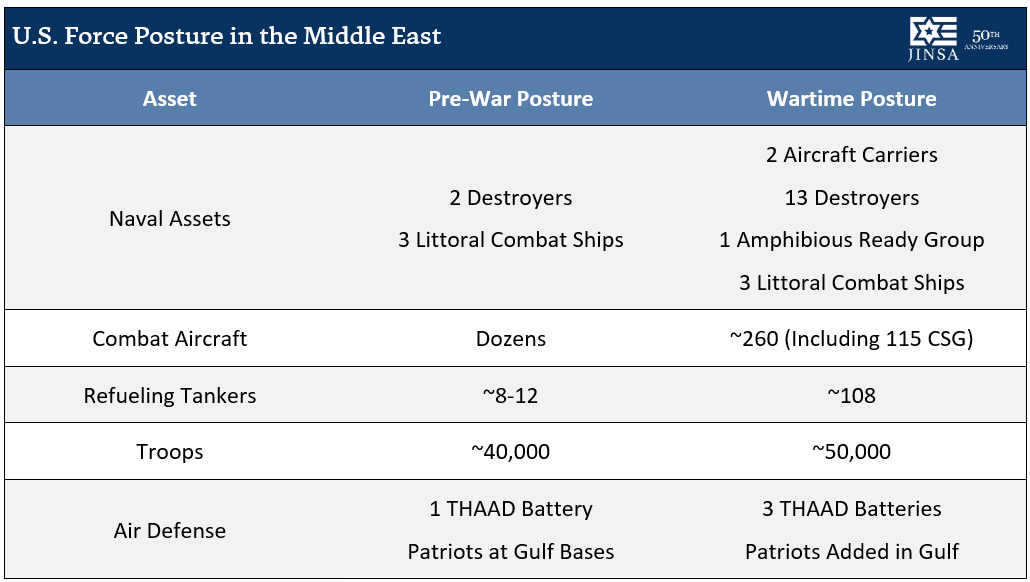
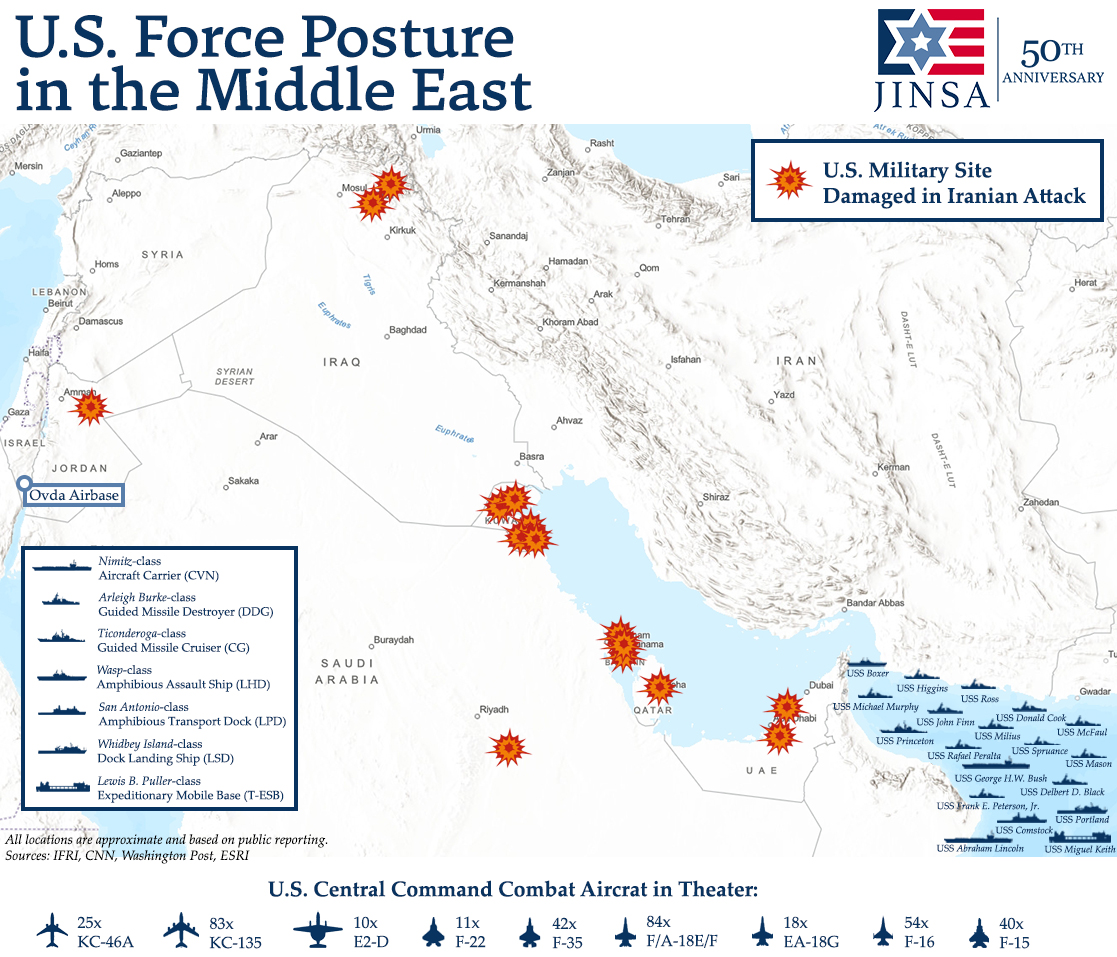
For most of the four months before the war, no U.S. aircraft carrier operated in the Middle East. Two carrier strike groups now operate in the northern Arabian Sea, with combat and refueling aircraft flying from runways across Israel and the Gulf. Days before the war, the United States deployed F-22 stealth fighters to Ovda Air Base in southern Israel—as JINSA had recommended in November 2025—the first time it had ever based combat aircraft on Israeli soil. The United States also deployed dozens of refueling tankers and combat aircraft at other sites in Israel, including Ben Gurion airport. While the United States had been drawing down refueling aircraft from the region amid the ceasefire, it paused its withdrawal of tankers from Ben Gurion when Iran renewed its attacks and even added four more that had evacuated from Gulf bases under Iranian attack. The United States also reinforced missile defense systems at bases hosting U.S. forces in the Gulf, which proved critical to defending against the over 4,650 drones and 2,300 ballistic missiles that Iran fired at targets throughout the region, helping already in place air defenses intercept more than 90 percent of the missiles and drones Iran fired. Beyond the forces inside CENTCOM, the United States simultaneously amassed hundreds of combat and refueling aircraft in Europe.
Iran Wants to Force the United States Out of the Middle East
Since the withdrawal language in the MOU sets no distance, no list of bases, and no test for what qualifies as “proximate,” Tehran will press for a maximum definition and treat every concession as the floor for the next demand. A broad reading of the MOU requirement for the United States to withdraw its forces from proximity to Iran would help Iran fulfill its strategic objective of driving a U.S. military presence out of the Middle East but even a narrow interpretation could encourage further Iranian aggression. In either scenario, the United States would be withdrawing all or nearly all of its aircraft carriers, fighter aircraft, and refueling tankers from the region. A decision to leave bases in the Gulf would also remove the majority of U.S. troops in the region.
A maximum reading of proximity would remove the U.S military presence from the Gulf entirely, ending its ability to help ensure freedom of navigation through the Strait of Hormuz and leaving the Gulf states to face Iran alone. Gulf governments reading that signal would hedge toward Tehran to avoid becoming its next target, and several would deepen their reliance on Chinese arms and Chinese security guarantees as American protection proved conditional.
A withdrawal to the pre-war baseline would undo a buildup that took months to assemble, returning the region to the carrier-less, thinly defended posture it held before. Rebuilding it would take weeks that the next crisis may not allow, and a weaker U.S. posture would free Iran to threaten shipping in the Strait of Hormuz, hold U.S. bases and Gulf nations at risk, and press regional states to distance themselves from Washington.
Iran Demonstrated America’s Pre-War Basing Was Unsustainable
Regardless of how the Trump administration interprets the proximity clause and chooses to posture their forces, the bases in the Gulf would remain dangerously close to Iran. Iran’s ability to hit bases hosting U.S. forces and assets throughout the Gulf because of their close proximity demonstrated that the United States can no longer count on operating from them in a war with Iran.
The forward position that makes the Gulf bases useful for striking Iran also makes them difficult to defend. As former CENTCOM commander General Frank McKenzie warned in his 2024 JINSA report, “the United States will not be able to maintain these bases in a full-throated conflict, because they will be rendered unusable by sustained Iranian attack.” U.S. bases in the Gulf sit close enough that Iranian missiles arrive in roughly five minutes, too little warning for air defenses to find, identify, track, and neutralize projectiles before missiles and drones can reach targets.
Over the course of Operation Epic Fury, Iran’s strikes reached U.S. bases and infrastructure across six Gulf states, and over a dozen American bases sustained severe damage. Satellite imagery verified by The Washington Post shows Iranian strikes damaged or destroyed at least 228 structures and pieces of equipment, hangars, barracks, fuel depots, aircraft, and radar, communications, and air defense systems, across 15 U.S. military sites in Kuwait, Bahrain, Qatar, Jordan, Saudi Arabia, and the United Arab Emirates. One U.S. official even indicated that Fifth Fleet operations may have to move to MacDill Air Force Base in Florida. The U.S. military is now reportedly weighing whether to relocate assets from the Gulf bases westward, including to Israel.
The Comparative Advantage of Basing in Israel
Unlike Gulf nations, Israel offers the United States freedom of action, security, and support. Gulf governments have limited American use of their bases and airspace for strikes on Iran, limiting the ability of CENTCOM to conduct operations. Israel sets no such limits and leaves the United States free to plan and fly against Iran on its own judgment. While the bases across the Gulf suffered strikes that put key facilities out of action, American aircraft operated from Ovda in southern Israel throughout the fighting without interruption and without any casualties, shielded by Israel’s air defenses and held beyond much of Iran’s shorter-range fire.
Israel’s distance from Iran, combined with its more advanced multi-tiered air defense architecture, allows for superior defense than in the Gulf. Israel layers Arrow against ballistic missiles, David’s Sling against cruise missiles, and Iron Dome against drones and short-range rockets. This architecture held up against Iranian barrages during the war, enabling U.S. and Israeli aircraft to continue flying out of Israeli bases. Its distance from Iran reinforces those defenses, providing more warning to find, track, and neutralize threats than Gulf nations.
A Calculated Shift to a Sustainable Posture
Rather than succumbing to the Iranian maximalist angle on the proximity clause, Washington should refuse to vacate any base and instead reposition a limited number of assets on its own terms. Pulling forces back because the MOU demands it would concede to Iran an ability to dictate where American forces deploy. Maintaining a posture near Iran, while repositioning forces toward a more sustainable western posture would satisfy the MOU but on terms favorable to the United States and bolster deterrence against Iran. To transition the wartime buildup into a posture that can maintain pressure on Iran, the United States should:
- Hold the full wartime posture in place throughout negotiations and until Iran completely and verifiably meets every nuclear obligation in the final deal.
- Ensure force posture changes within the 30-day window after a final deal includes only gradual movement of a small number of assets that the United States sent to the region before the war and does not decrease the normal U.S. posture.
- Retain the long-term naval, strike, and air defense capacity in the Middle East necessary to reopen the Strait of Hormuz and the forward radar and interceptor coverage to blunt any potentially sudden Iranian strike.
- Prioritize redeploying forces within the region rather than withdrawing them, enabling CENTCOM to reposition assets inside its area of operations instead of withdrawing them entirely.
- Anchor a sustainable posture farther from Iran than the exposed Gulf bases in the western area of the Middle East by expanding basing in Israel, particularly at Ovda Air Base.
- Turn the wartime presence at Ovda Air Base into a permanent base, exploiting runways, hardened shelters, and munitions storage built to U.S. specifications that would cut the time and cost of expansion compared to any other alternative site.
- Homeport a guided-missile destroyer at Haifa, keeping a surface combatant that can reach the Gulf faster than one sailing from outside the region, while splitting Fifth Fleet headquarters functions between Bahrain and Israel to deny Iran a single decisive target.
Click here to download the JINSA Insight.