How the MOU’s “Nuclear Status Quo” Negates a Good Iran Deal
Click here to download the JINSA Insight
Status Check?
In the U.S.-Iran memorandum of understanding (MOU), Iran agrees to “maintain the current status quo of its nuclear program,” pending the outcome of follow-on talks for a final deal. But the MOU text does not spell out what that status quo actually is, making it hard to know what is required of Iran and whether it is complying. It is even possible that the United States does not fully know what the nuclear “status quo” actually entails—both at Iran’s declared facilities targeted by military action and at its suspected undeclared nuclear sites—because so much of its infrastructure and activities are denied to inspectors.
Maintaining this “status quo” involves no real Iranian concessions in exchange for the upfront sanctions relief it receives from the United States. Many of Iran’s known nuclear activities appear to have been halted by military action in June 2025 and earlier this year. Therefore, Tehran does not give anything up by leaving its declared nuclear facilities in their destroyed or damaged states, or by continuing operations at its safeguarded nuclear power plant and research reactor. And it can keep asserting its self-proclaimed “right” to enrich, which underpins its redlines and intransigence in negotiations with America.
Further, the “status quo” covers only the fraction of this enterprise officially acknowledged by Iran, since much of its nuclear weapons program is covert and illicit. Many of its facilities and activities—including its extensive weaponization project—have been off-limits to inspectors since last summer’s conflict, and in key respects for many years before that. Maintaining the status quo thus could mean Iran continues to prevent inspections, and could perpetuate multiple blind spots about the true state of Tehran’s nuclear program. This poses major problems for preventing a nuclear Iran with or without a final deal.
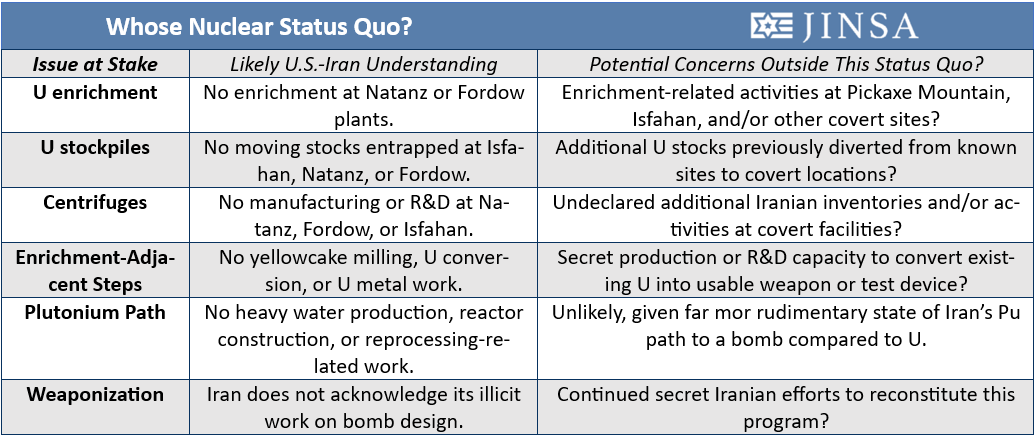
Status of Iran’s Declared Nuclear Program
This list provides the best known or presumed statuses of Iran’s declared nuclear program, as well as key concerns with regard to uncertainties or potential changes in this status quo.
- Uranium Enrichment
Known status quo: Iran is not known to be enriching uranium at any of its declared enrichment sites, namely the aboveground Pilot Fuel Enrichment Plant (PFEP) at Natanz and the belowground Fuel Enrichment Plants at Natanz (FEP) and Fordow (FFEP). Each of these facilities is presumed to be destroyed or at least rendered inoperable in the wake of U.S.-Israeli military strikes in June 2025 and/or February-March 2026.
Uncertainties and concerns about the status quo:
- Assessing the current status of these facilities, particularly the subterranean FEP and FFEP, is complicated by Iran’s June 2025 eviction of International Atomic Energy Agency (IAEA) inspectors from all enrichment-related sites.
- In addition to these declared sites, Iran has deeply-buried, potentially enrichment-related plants at “Pickaxe Mountain” and Isfahan. Neither of these sites has been visited by IAEA inspectors or appears to have suffered wartime attacks. Satellite imagery showed increased construction activity at Pickaxe between the 2025 and 2026 wars.
- Enriched Uranium Stockpiles
Status quo: Iran’s known enriched uranium stockpiles are believed largely to be entrapped—and currently inaccessible—in several underground sites, each of which was hit by U.S.-Israeli airstrikes.
- The most concerning stockpile, some 10-12 bombs’ worth of 60 percent highly enriched uranium (HEU), is assessed largely to be trapped in storage tunnels at the Isfahan complex after the entrances were collapsed in Operation Midnight Hammer in June 2025. Other amounts are believed to be at PFEP and/or FFEP.
- Iran’s roughly two bombs’ worth of 20 percent HEU, only slightly less concerning than 60 percent, is believed to be inside FFEP and Isfahan. Its stocks of low-enriched uranium (LEU), which could provide several additional bombs’ worth of fissile material with further enrichment, are likely inside FEP and Isfahan.
Uncertainties and concerns about the status quo: assessing the current status of these stockpiles is complicated by Iran’s June 2025 eviction of inspectors from declared enrichment-related sites, including uranium stockpile storage sites, and by its preceding years of safeguards non-compliance at these locations. The IAEA has warned for years, and especially since June 2025, that it cannot account for all of Iran’s enriched uranium.
- Enrichment Centrifuges
Status quo: Iran is not known to be actively manufacturing centrifuges or their parts, nor is it known to be actively using centrifuges for enrichment or research and development (R&D).
- Its known enrichment cascades and centrifuge R&D lines are enclosed, and widely assumed to be damaged or destroyed, in the rubble of PFEP, FEP, and FFEP.
- Its known centrifuge manufacturing and storage sites at Natanz, Karaj, Tehran, and Isfahan each were hit by airstrikes in the past year.
Uncertainties and concerns about the status quo: the IAEA has warned for years that it lacks a proper accounting of Iran’s centrifuges and parts, including for more advanced and efficient machines capable of enriching a bomb’s worth of HEU in sites with smaller footprints than Iran’s declared facility at FFEP. The 2015 Joint Comprehensive Plan of Action (JCPOA) nuclear deal notably failed to inventory and set a baseline for Iran’s centrifuge infrastructure.
- Other Enrichment-Related Activities
Status quo: Iran is not known to be actively conducting other enrichment-adjacent steps for producing fissile material, including milling uranium ore into yellowcake, converting yellowcake into uranium hexafluoride gas for enrichment, or fabricating uranium metal.
- Relevant declared facilities at the Isfahan nuclear complex and Ardakan were struck, and believed to be damaged or destroyed, by Israeli airstrikes.
- Separately, Iran’s light water reactor power plant at Bushehr and research reactor at Tehran (TRR), both of which utilize non-Iranian fuel sources, continue to operate under IAEA safeguards.
Uncertainties and concerns about the status quo: Iran could retain an undeclared capability to fabricate enriched uranium into metal for an explosive device. Prior to the 12-Day War, Iran reportedly researched creating such a device using its 60 percent HEU.
- Plutonium Track
Status quo: Iran is not currently producing heavy water, operating nuclear reactors outside of IAEA safeguards, reprocessing spent fuel, or building relevant facilities or reactor cores. All declared infrastructure for these purposes, including its then-under-construction heavy water reactor at Arak, were damaged or destroyed by several airstrikes within the last year.
Uncertainties and concerns about the status quo: Iran’s plutonium pathway to a bomb currently is far less concerning than its uranium pathway, which was and possibly still could be much more advanced and expansive.
- Weaponization
Status quo: Iran does not acknowledge any program to produce a nuclear explosive device.
Uncertainties and concerns about the status quo:
- IAEA data, assessments from Western intelligence communities, and secret Iranian archives seized by Israel indicate that Iran’s weaponization program operated for decades and accelerated in the years prior to the 12-Day War, during which multiple suspected sites and key military and scientific personnel were targeted. Other suspected weaponization-related sites were struck in October 2024 and March 2026.
- Iran’s consistent history of stonewalling IAEA inquiries about its bombmaking, including lying during JCPOA implementation about such efforts, all but ensures that it will resist any attempts to address this unacknowledged program in a final nuclear deal.
- Monitoring and Verification
Status quo: IAEA inspectors lack access to Iran’s declared enrichment-related facilities, secret facilities at Pickaxe and Isfahan, and suspected weaponization-related sites and personnel. Iranian officials insist that current negotiations do not alter this state of affairs.
Uncertainties and concerns about the status quo: Iran’s serial and systematic violations of its nonproliferation safeguards, including building undeclared enrichment-related facilities and pursuing a weapon, raise real concerns that it could advance its nuclear program in secret during follow-on negotiations and under any final deal.
Implications and Recommendations
These concerns should inform and guide American policymakers by raising red flags, both for Iranian attempts to alter the status quo and for any U.S. attempts to reach a final deal. Any of the following actions by Iran should be interpreted as violations of the status quo:
- Any Iranian activity at or around its declared facilities pertaining to uranium enrichment, stockpiling, centrifuges, and related activities.
- Such activity around these sites, as was observed after the 12-Day War, could indicate attempts to harden their entrances, assess wartime damage, retrieve sensitive materials, and/or inform future attempts to resume such activities.
- Any restriction or eviction of inspectors from Bushehr or TRR, possibly as negotiating leverage, raises the risk of Iran accessing alternative sources of enriched uranium.
Separately, Iran’s extensive illicit nuclear activities raise serious concerns that, while the U.S. appreciation of the “nuclear status quo” could be limited to Iran’s declared facilities, Tehran’s de facto definition could include any ongoing (undeclared) enrichment-related work at Pickaxe, the new Isfahan plant, and/or other covert sites. There are parallel concerns that this “status quo” applies only to Iran’s known stockpiles buried at its declared facilities, but not to any potential secret stocks at Pickaxe, the undeclared Isfahan site, and/or elsewhere—including material possibly diverted by Iran before or during the 12-Day War. The same goes for its centrifuge-related activities and inventories at undeclared sites. It also means that any negotiations based on this double standard for a status quo will risk producing a deal that repeats the JCPOA’s failure to fully account for, let alone block, Iran’s covert enrichment infrastructure or its progress toward a nuclear weapon.
Accordingly, American negotiators must insist, as preconditions for even proceeding with nuclear negotiations, on Iran’s restoration of access for IAEA inspectors, at all of its declared enrichment-related facilities, in full conformity with its safeguards obligations. As an additional precondition, Iran must provide full and verifiable transparency with the IAEA regarding all of the following elements of its nuclear enterprise:
- Activities and plans at Pickaxe, the new Isfahan site, and any other currently undeclared enrichment facilities;
- The locations, sizes, and enrichment levels of all of its uranium stockpiles, both enriched and unenriched; and
- The storage, manufacturing, and deployment of its entire centrifuge inventory, particularly advanced models.
Such transparency would be in keeping with Iranian officials’ repeated insistences that talks proceed on the basis of confidence, trust, and concrete and actionable guarantees. It also should form the groundwork, as a core and non-negotiable element of any final deal, for genuine and enforceable “anytime, anywhere” access for IAEA inspectors at any suspected undeclared nuclear-related sites inside Iran.
Click here to download the JINSA Insight.