Iran Escalates Before U.S. Midterm Elections
Click here to download the JINSA Insight
Iran is attacking ships more frequently than at any point in the war, just as President Donald Trump has ruled out U.S. strikes on Iran before the midterm elections. Iran’s escalation threatens to undermine a U.S. naval campaign that had largely broken Iran’s attempt to close the Strait of Hormuz while restoring Gulf crude exports to prewar levels.
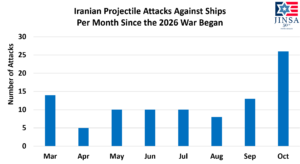
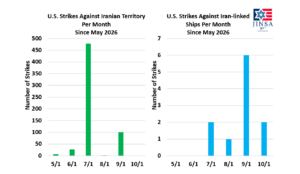
Weeks of U.S. strikes in July produced a lull in Iranian attacks on shipping, but a single day of U.S. strikes on roughly 100 Iranian coastal targets on September 1 failed to produce a similar decrease. Instead, Iran’s strikes on commercial vessels rose in the weeks that followed, showing that one round of bombing could not suppress Iran’s capacity to mount attacks or to reconstitute lost capacity. U.S. strikes eliminated Iranian radars on its coast and islands that tracked tankers, but Iran adapted by sending spotters in small boats to find targets and by concentrating its fire on the vessels conducting ship-to-ship transfers, which are now responsible for most of the crude still crossing Hormuz. This has allowed the regime to conduct 26 attacks against ships so far in October, compared with 13 in all of September. Iran has also pushed its campaign beyond the Hormuz corridor, and two ships it struck have sunk.
Trump’s October 8 pledge not to attack Iran before the November 3 midterm elections has removed the threat of U.S. strikes on those coastal forces and given Iran more time to rebuild before potentially facing them again. To bolster deterrence and protect the gains of its naval campaign, the United States should strike Iranian assets along the coast if attacks on shipping continue, target the small boats Iran has used to identify commercial ship locations, extend naval protection to ships further inside the Gulf, alternate and relocate tanker transfer points away from Iran, continuously monitor Iran’s coastal radar, missile battery, and small-boat capabilities, strike any attempt to rebuild them, and publicly warn that further attacks will bring a forceful U.S. response.
U.S. Operations Blunted Iran’s Attempted Closure of Hormuz
U.S. naval operations have turned Iran’s attempt to blockade Gulf shipping against Iran itself. U.S. Central Command (CENTCOM) has cleared mines from the strait’s main shipping lanes, and U.S. military escorts have accompanied vessels that Iran continues to threaten. Those escorts have used a southern corridor along Oman’s coast, which lets tankers avoid the northern lanes through Iranian waters that Iran has demanded all ships use. Smaller tankers have carried crude through the corridor, reportedly in nighttime convoys covered by U.S. helicopters, fighter jets, and surface drones. CENTCOM reported that thousands of commercial ships had passed safely through the cleared lanes. By securing the route through the strait, U.S. forces kept Gulf exports moving despite Iran’s campaign against shipping.
Gulf oil producers and shipping companies have restructured their export routes around U.S. protection, allowing them to keep crude flowing despite Iran’s attempt to shut the strait. At least 16.5 million barrels per day of crude and condensate left the Gulf from September 1 to 28, matching the prewar average excluding Iran. Producers now send 40 percent of that crude out through Saudi and Emirati pipelines that bypass Hormuz, up from 17 percent before the war.
The U.S. blockade has cut Iran out of the trade moving through the strait it claims to control. CENTCOM has redirected 138 commercial vessels since resuming the blockade on July 14, disabled four that refused to comply, and destroyed 10 that violated the blockade or belonged to Iran-linked shipping networks over the past 12 weeks. The most recent came two days after Trump pledged on October 8 not to attack Iran before the midterm elections, when a U.S. fighter jet disabled the cargo ship Ocean Molica in the Gulf of Oman after its crew ignored warnings and tried to run the blockade from an Iranian port.
Iran’s crude loadings fell to zero in September, and at least 50 laden Iranian tankers have remained stranded along Iran’s coast. Iran reportedly still sent at least eight cargoes of liquefied petroleum gas and one of jet fuel past the blockade since mid-July by hiding them among the Gulf’s ship-to-ship transfers off Oman, so the transfer system that sustains Gulf exports also gives Iran some cover to evade U.S. enforcement. The Treasury Department sanctioned 17 more vessels on October 8, claiming that the action targeted most of Iran’s remaining shadow fleet.
Iran Accelerated Its Attacks After U.S. Strikes
Iran has intensified its campaign against shipping since the September 1 U.S. operation, a campaign that retaliatory U.S. strikes on Iranian tankers have not slowed. After that operation, a U.S. official predicted the strikes would buy at least a month of lower threat to commercial ships. Instead, Iran has adapted to the loss of most of the radars on its coast and islands that tracked ships in the southern corridor along Oman, widened the area of its attacks, and threatened the export routes that keep Gulf crude moving.
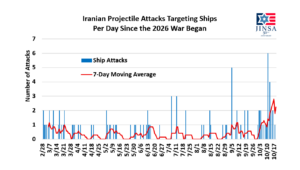
Iran carried out 13 attacks on ships in September, 63 percent more than the eight attacks in August and the most of any month to that point since March. The September 1 campaign failed to repeat the lull that followed the July strikes, because a single day of strikes left Iran’s forces time to recover where more than three weeks of strikes from July 7 to 30 had not. Iran attacked only one ship from July 22 to August 5 as U.S. strikes continued through July 30, according to JINSA data, but attacked five ships four days after the September 1 strikes. The pace of Iranian attacks only accelerated in October.
On October 14, Iran reached an average of at least two attacks against ships per day for the first time in the war, and, since the start of October, it has more than tripled its rate of attacks on shipping. Iran has already launched 100 percent more attacks on ships from October 1 to 19 than in all of September, carrying out 26 attacks this month. Iran then set a new seven-day high of 15 attacks from October 10 to 16, surpassing the 14 attacks it carried out from October 8 to 14. Iran struck six ships on October 11 alone, the most on any single day, then struck six more combined on October 13 and 14. Iran sank two ships, the container ship GFS Pride on October 13 and the bulk carrier Cape Dao, which it hit on September 23, making them the second and third vessels lost since the war began.
Following those strikes, Iranian forces began using unarmed spotters in small boats to identify targets, including U.S. warships, because they retained only a few functioning radars on Iran’s coast and islands able to track ships in the southern corridor. Iranian forces were still using spotters more than a month later, allowing Iran to keep finding ships despite its radar losses, and on October 6 U.S. forces destroyed an Iranian-linked dhow in the Gulf of Oman that CENTCOM said was conducting surveillance and targeting U.S. Navy ships.
Iran appears to have adapted to U.S. protection of Gulf exports by focusing its attacks on the ship-to-ship transfers that carry most of the crude still crossing the Strait of Hormuz. Senior Iranian officials have claimed Iran changed the type and pace of its attacks in early October to keep oil prices high and sway the U.S. midterm elections. Ship-to-ship transfers accounted for more than 70 percent of the crude crossing the strait in August to other tankers off Fujairah and Sohar in the Gulf of Oman, making the anchorage locations where these occur a vulnerable link in the Gulf’s export system. Iran appears to have conducted most of its October attacks with single drones, which depend less on fixed radar and do not require the missile launch sites U.S. strikes targeted, with 27 of the 28 projectiles it fired at ships from October 1 to 19 hitting their targets, according to JINSA data.
Iran also extended its attacks deep inside the Persian Gulf and along the coast of Oman, threatening tankers far from the strait. On October 7, several projectiles struck the tanker Acers north of Qatar’s Madinat ash Shamal, the first attack in that area in more than six months. Two days later, a drone hit the fully laden supertanker GEM NO.2 while it sat at anchor off Sharjah in the United Arab Emirates. Iran then declared it would pursue ships anywhere in the region that use routes it has not authorized and would target all vessels of companies it accuses of cooperating with the United States. On October 11, a drone struck a Nicaragua-flagged tanker anchored off Sohar, Oman, setting it on fire and leaving two Indian crew members missing. On October 16, Iranian attacks northeast of Al Jubail, Saudi Arabia, hit the supertanker ST3 with a projectile that set it on fire, and a small boat then fired a rocket-propelled grenade at a second tanker.
Iran’s surge in attacks has cut into the crude flows that U.S. escorts restored through Hormuz. Crude exports through Hormuz averaged 8.5 million barrels per day from October 1 to 7, about 40 percent below the prewar level, and reached only 9.4 million barrels per day, about 70 percent of prewar levels, from October 8 to 14, as Iran’s attacks intensified. Total Middle East shipments stayed within 10 percent of prewar volumes from October 1 to 7, only because exports from the Gulf of Oman and Red Sea made up part of the shortfall. A steady stream of single hits could deter the shipowners that rely on U.S. escorts and cleared lanes to move crude through the strait.
Signaling Restraint Encourages Iranian Aggression
Despite U.S. naval operations keeping Gulf exports moving and halting Iran’s exports, Trump’s pledge to avoid strikes before the midterms removed the threat of attacking Iranian coastal forces responsible for escalating attacks on shipping. The Trump administration had reportedly begun preparing strike options for use before the midterm election, so the pledge converted an open U.S. option into a public guarantee and diminished the uncertainty Iran faced over whether U.S. strikes would come before November 3. Instead, Trump has confined the U.S. response to Iran’s attacks on shipping to enforcement and defense at sea, at least until the election. The pledge has weakened U.S. deterrence of Iranian attacks on shipping and given Iran an extended period to replenish its coastal forces without risk of U.S. strikes. The administration has also signaled a willingness to loosen its economic pressure by weighing whether to let previously sanctioned shadow fleet tankers, including vessels that carried Iranian oil, haul other cargoes out of the Gulf to cut record freight rates before the midterm elections.
Iran has widened its attacks even with two U.S. carriers stationed near its coast. The USS George Washington and USS George H.W. Bush carrier strike groups are operating in the Arabian Sea alongside the Boxer Amphibious Ready Group, giving CENTCOM the aircraft necessary to strike Iranian coastal forces on short notice. Iran nonetheless struck ships off the United Arab Emirates, Oman, and Saudi Arabia after Trump’s October 8 pledge not to attack before the midterms.
By election day, Iran will have had 63 days since the September strikes to rebuild the radars and launchers U.S. forces destroyed. Iran has escalated through September and October despite those losses. A post-election campaign would confront a coastal force that has demonstrated an ability to sustain fire and has had more than two months to recover. The U.S. military has reportedly drawn up new strike plans that include the Massive Ordnance Air Blast bomb, the largest nonnuclear bomb in the U.S. arsenal, but the reported plans center on Iranian energy infrastructure and nuclear sites instead of the radars, launchers, and boats that attack ships.
Recommendations
The United States should strike Iran’s coastal forces if Iranian attacks on shipping continue, regardless of the midterm elections. President Trump should also direct CENTCOM to strengthen the defense of commercial vessels in the Persian Gulf and nearby waters, disperse ship-to-ship transfers away from Iran’s coast, and publicly warn Iran that further attacks at any time will bring a U.S. military response.
Strike Iranian Anti-Ship Forces
If Iranian attacks on commercial shipping persist, CENTCOM should strike Iranian coastal radars, anti-ship missile launchers, drone launch sites, and small-boat bases before November 3. Each round should include hitting the small boats Iranian forces have used as spotters to locate ships. CENTCOM should repeat those strikes if the attacks continue, with an emphasis on preventing Iran’s repair and replacement of destroyed systems. U.S. forces should also expand the frequency and quantity of strikes on Iran-linked tankers in response to each Iranian attack on U.S. warships or commercial vessels.
Strengthen Shipping Protection
CENTCOM should strengthen protection for vessels loading and waiting further within the Persian Gulf and anchorages where ship-to-ship transfers occur in the Arabian Sea. U.S. naval and air assets should increase air and missile defense coverage, maritime patrol, and surveillance over those waters. U.S. patrols should track Iranian small boats operating near the shipping corridor and the anchorages so CENTCOM can strike spotters before Iranian forces launch at the ships they find.
Alternate and Disperse Ship-to-Ship Transfer Locations
CENTCOM should work with shipping companies to move ship-to-ship transfers to anchorages farther from Iran. Shipping companies should spread those transfers across more anchorage sites and change the locations on an irregular schedule. CENTCOM should align U.S. naval patrols and air defense coverage with each new transfer location.
Signal a Forceful Response
President Trump and administration officials should state publicly that continued Iranian attacks on shipping will bring an increasingly forceful U.S. military response, including within Iranian territory. Any further statements ruling out or delaying military action against Iran would directly undermine this message and any deterrent value of ongoing limited military operations because Iran would not fear further escalation. Senior officials should make clear that the United States will hold Iran responsible for attacks on vessels anywhere in the Gulf, including waters beyond the Strait of Hormuz. CENTCOM should continue publicizing its interceptions of Iranian drones and missiles and its enforcement of the blockade.