Strengthening U.S. Force Posture at Israeli Bases
Click here to download the JINSA Insight.
Israel’s reported offer for the United States to relocate certain Middle East bases to Israel builds on JINSA’s November 2025 report recommending U.S. basing options at Ovda Airbase in that country. This recommendation became reality with the first-ever operational deployment of U.S. combat aircraft to Ovda just days before Operation Epic Fury. The impressive bilateral cooperation since the conflict began, and the vulnerabilities it has exposed at U.S. bases in neighboring countries, now reinforce Israel’s importance for America’s Middle East force posture. The United States should move key assets and activities to Israel from other regional bases, and strengthen its military presence in Israel more generally.
America’s Best Middle East Airbase
For decades, Israel was called “the largest American aircraft carrier in the world that cannot be sunk.” That metaphor became reality just days before Operation Epic Fury, with the first-ever operational deployment of U.S. combat aircraft to Israel—specifically, eleven F-22 stealth fighters at Ovda Air Base. In parallel, the United States deployed a similar number of KC-46 and KC-135 aerial refueling tankers to Israel’s main international airport (Ben Gurion). These moves reflected JINSA’s recommendation, based on a site visit to Ovda last summer with a task force of American former CENTCOM leaders, that the U.S. Air Force (USAF) explore basing options in Israel generally and Ovda specifically.
Israel offers reliable access, favorable geography, and operational support unlike anywhere else in the Middle East. Even before the current conflict, Israel understood clearly how America’s freedom of action enables both countries to do more against Iran. Since before the 12-Day War last summer, Israel encouraged the United States to rotate assets through its bases without restrictions. This stands in stark contrast to other regional host nations that have prohibited U.S. overflights and operations against Iran’s threat network. Even after these prohibitions proved useless in dissuading Iranian attacks on their territory, and even though their leaders privately urge the United States to keep up the fight, America’s Arab partners still insist their bases and airspaces cannot be used for U.S. offensive operations against Iran.
Israel’s geostrategic location at the crossroads of Europe, Asia, and Africa enables it to support U.S. rapid global mobility by hosting tanker and transport aircraft. This same location puts shipping lanes that account for one-sixth of trade and one-third of container traffic worldwide, worth more than $1 trillion annually, within the unrefueled operational radius of U.S.-made fighter aircraft at Israeli bases. Notably, these figures do not include prewar traffic through the Strait of Hormuz.
To a much greater extent than other regional host nations, Israel’s basing infrastructure can support light U.S. footprints, ensure readiness, and minimize deployment costs and risks to U.S. forces. The Israeli Air Force (IAF) maintains high standards for its own U.S.-made aircraft and supporting activities at its facilities—training, maintenance, and logistics—which means that much of this infrastructure already fits with USAF requirements. And unlike other U.S. regional facilities, Israel’s airbases already are defended by a world-class, multi-layered air defense network, and they offer greater warning time than bases farther east to counter Iranian missile and drone threats. At the same time, they are still within striking range of Iran for U.S.-made combat aircraft that are provided with in-air refueling or external fuel tanks. Recognizing these vulnerabilities, American planners began moving certain regional logistics facilities westward, away from the Gulf, well before the current conflict.
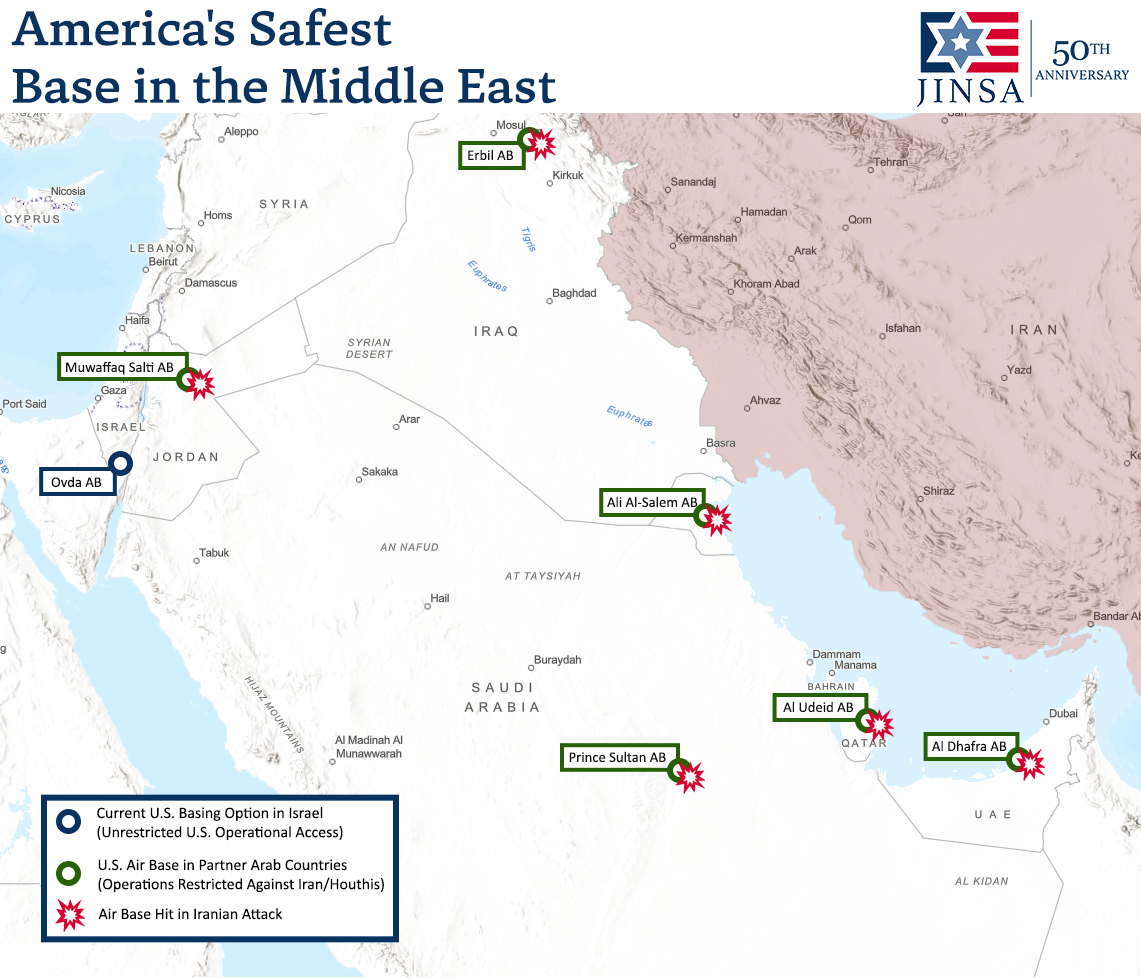
Since the start of Operation Epic Fury, air operations out of Israel have continued uninterrupted, with no American casualties at Israeli bases. By contrast, Iranian missile and drone strikes on bases in Arab countries have killed more than a dozen American servicemembers, wounded hundreds, and destroyed or damaged at least a dozen U.S. aerial refueling, early warning, and air defense platforms. These attacks also have taken important communications and logistical facilities offline. This has forced U.S. Central Command (CENTCOM) to sacrifice readiness and effectiveness for safety by dispersing thousands of American servicemembers away from these bases, to hotels and office buildings across the region and even farther afield. CENTCOM also is looking to bolster passive defenses at its bases in Arab countries, but concerted efforts to harden some of these facilities likely are years away from fruition.
Finally, the U.S. and Israeli air forces are highly interoperable and, increasingly, well-versed in the rhythms of joint planning and operations. Such close and growing cooperation serves as a unique force-multiplier for the United States in the Middle East. It also aligns with USAF’s ongoing shift from permanent deployments at large airbases, like Qatar’s Al Udeid, to rotational and flexible deployments that involve minimal U.S. investment and other upfront preparations.
The U.S. choice of Ovda specifically for the F-22 deployment is very fitting. The base meets the de facto U.S. gold standard for such facilities, having been built to American specifications in the early 1980s to implement the Camp David Accords. As part of contingency planning preceding the 12-Day War, certain additional features were added to the base to meet potential U.S. requirements. The most costly and crucial infrastructure already is on-site, in abundance, to accommodate the needs of U.S-made F-15, F-16, F-18, F-22, and F-35 combat aircraft, as well as aerial refueling tankers, large transport aircraft, and helicopters. In addition to on-site air and missile defenses, this includes runways, hardened shelters, parking ramps, hardstands, fuel bunkers, storage for ammunition and other supplies, housing, and even a dedicated terminal for U.S. use. Situated in the wide-open desert of far southern Israel, Ovda also offers extensive undeveloped acreage to accommodate potential future U.S. needs.
Recommendations
The United States should take Israel up on its offer to relocate U.S. assets and activities in the region to bases in Israel, and to strengthen America’s presence in that country more generally. Assuming Iran’s regime survives the war, it can be expected to continue threatening regional stability—particularly in the Gulf, where its intimidation and attacks have been most successful. A more effective and sustainable U.S. regional force posture entails expanded basing in Israel.
Most immediately, Ovda provides ample space and security to host additional U.S. combat, aerial refueling, and transport aircraft. It also is ready to accommodate prepositioning of critical munitions, and to provide much-needed maintenance and other logistical services. The United States should consider regular rotational deployments through Ovda, including by detaching units from other regional airbases. Ovda’s wide-open topography, including extensive spaces for U.S.-only activities, also could host U.S. Army and Marine Corps units for live-fire exercises.
Building on the interoperability of USAF and IAF platforms, and the invaluable experience of fighting together in the current conflict, Israeli bases can become a regional CENTCOM hub for prepositioning, combined exercises, planning, and even operations. Strengthening our partners’ operational capabilities can, in turn, enable them to assume added responsibilities for collective defense against Iran. By the same token, basing U.S. assets in Israel would be an important corrective to Arab countries, like Qatar, who believe that providing basing gives them permission to pursue policies counter to U.S. interests, and serves as a de facto a tripwire or security umbrella that substitutes for real burden-sharing. And it will reinforce to other partners, like Saudi Arabia, that to have good relations with Washington they will need to have good relations with Israel, too.