The Triple Betrayal: Operation Epic Fury, The Gulf’s Public Discourse, and U.S. Stakes
Click here to download the JINSA Insight.
I. Introduction: The Wrong Frame
The Gulf Cooperation Council (GCC) started the year cautiously neutral, balancing between Washington and Tehran, and carefully managing exposure on both sides. Prior to the operation, Qatar, the UAE, and Saudi Arabia neither endorsed nor criticized the strikes, despite reporting that any preliminary consultation or coordination, where it existed, was kept to private channels.
The GCC position was tested when Iranian missiles fell on their cities: Gulf governments condemned Iran’s strikes in clear and unyielding terms, but not once did they echo the U.S.-Israeli campaign. However, elite positions have shifted as the conflict has escalated. Reports that Saudi Crown Prince Mohammed bin Salman has privately urged President Trump to maintain military pressure on Iran, and Emirati Ambassador Yousef Al Otaiba’s op-ed calling for the campaign to succeed, suggest that at least some Gulf governments have quietly shifted from ambiguity to backing the campaign’s outcome. It is that divide between this attitude and public opinion that this paper examines.
The perspective of Gulf governments, however, is not necessarily shared by their publics, whose experience of the war thus far can be termed a “Triple Betrayal”: a series of breaches of trust by Iran, the United States, and the social contract that GCC governments established with their citizens. For each betrayal, the nature and degree of the gap between public and government perceptions point to how it might affect the post-war environment.
Given the lack of publicly available opinion polling specific to the Gulf region, the analysis that follows is grounded in research using primary Arabic-language sources across Gulf social media platforms and press that are not featured in English-language coverage of this conflict.
II. The Triple Betrayal
Betrayal One: Iran Responds to Diplomacy with Missile Strikes
In 2023, the diplomatic normalization between Saudi Arabia and Iran — brokered by China — was not a mere transaction among the elite. It significantly influenced public perception of threats within the Gulf region. After years of viewing Iran as a serious threat, the public in Gulf nations began to reassess their perceptions.
Whether the Gulf rulers privately promoted or acquiesced to Operation Epic Fury at an elite level is another question entirely from how their publics experienced what happened next. Whatever communication had taken place between Saudi Crown Prince Mohammed bin Salman (MBS) and President Donald Trump before the strikes apparently did not manifest in any observable public consultation or readiness, and so the populations of the Gulf countries experienced the onset of the conflict as sudden, waking on March 1 to Iranian missiles indiscriminately striking airports, ports, and energy infrastructure.
Prior to Operation Epic Fury, every GCC capital explicitly guaranteed to the Iranian authorities that their territories would not be utilized for attacks against Iran — a stance driven less by alignment with Tehran than by a desire to avoid retaliation and escalation, and revealing less of a calibrated public sentiment than elite risk management. Despite this good-faith assurance, it was not reciprocated.
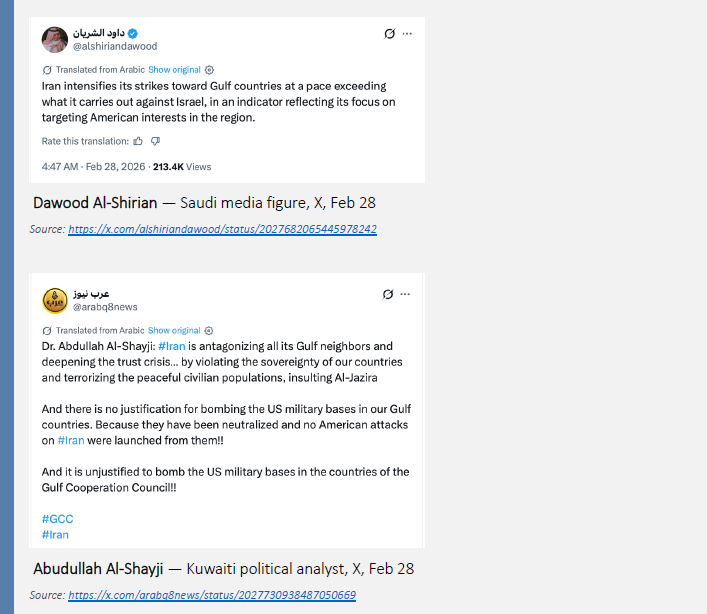
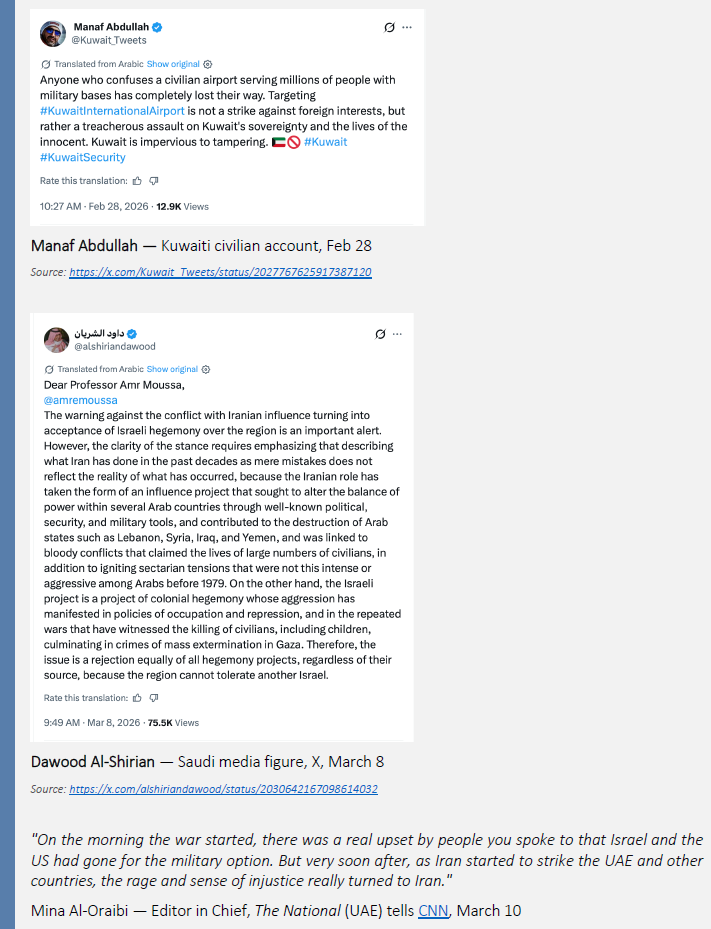
Iran launched a higher number of ballistic missiles and drones at Gulf states within the first four days than it did at Israel. The specific targets included Ras Tanura, Dubai International Airport, Qatar’s Ras Laffan, the Fifth Fleet headquarters in Bahrain, the U.S. base Al Udeid in Doha, Al Dhafra in Abu Dhabi, and Ali Al Salem Air Base in Kuwait. None of these nations had initiated an attack against Iran. On this matter, both public and government sentiments align closely — the condemnation of Iranian attacks is widespread and transcends the official/public divide.

Betrayal Two: Washington ‘Exploited the Gulf’s Victimhood’ without Consulting
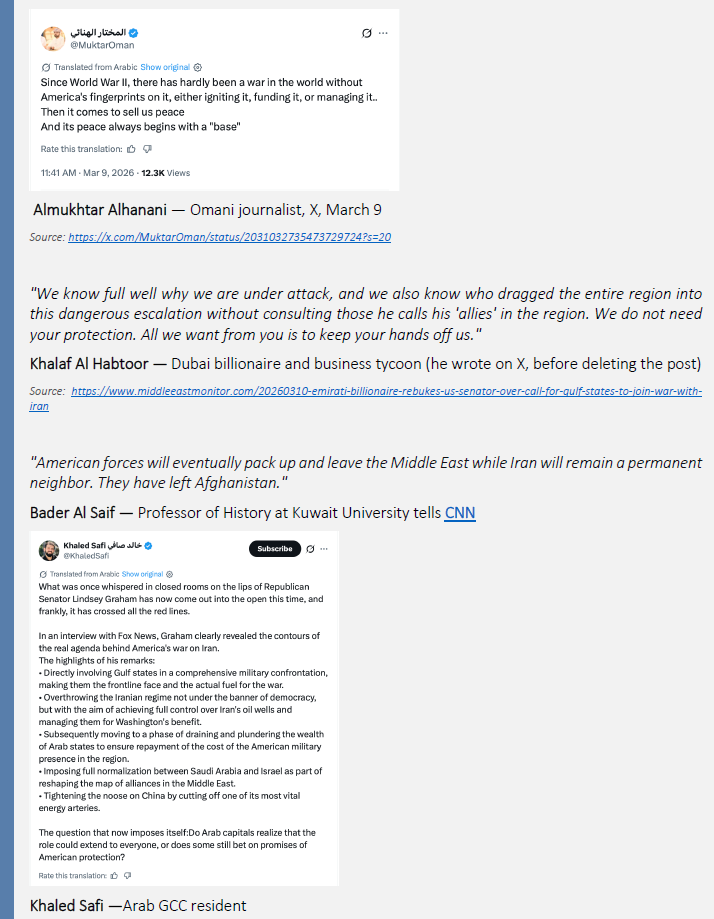
The security framework of the GCC was built on the understanding that the United States would, at the very least, engage in discussions before taking any actions that could endanger Gulf nations. According to Gulf discourse — and consistent with the absence of any GCC-wide endorsement prior to the operation — Operation Epic Fury was not preceded by broad consultation across Gulf governments, though coordination appears to have occurred through limited elite channels. Qatar and Oman’s mediation — their diplomatic efforts towards de-escalation — were completely disregarded. In the aftermath of Iranian missile attacks on Gulf cities, the region’s publics read American statements on the campaign as evidence that their suffering was being treated as political validation rather than as a cost that warranted pause.
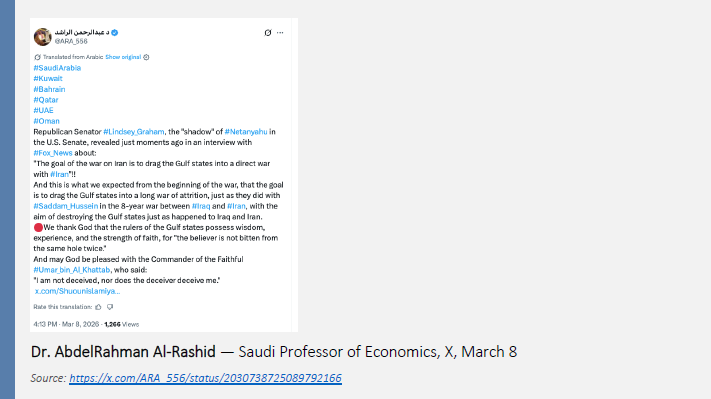
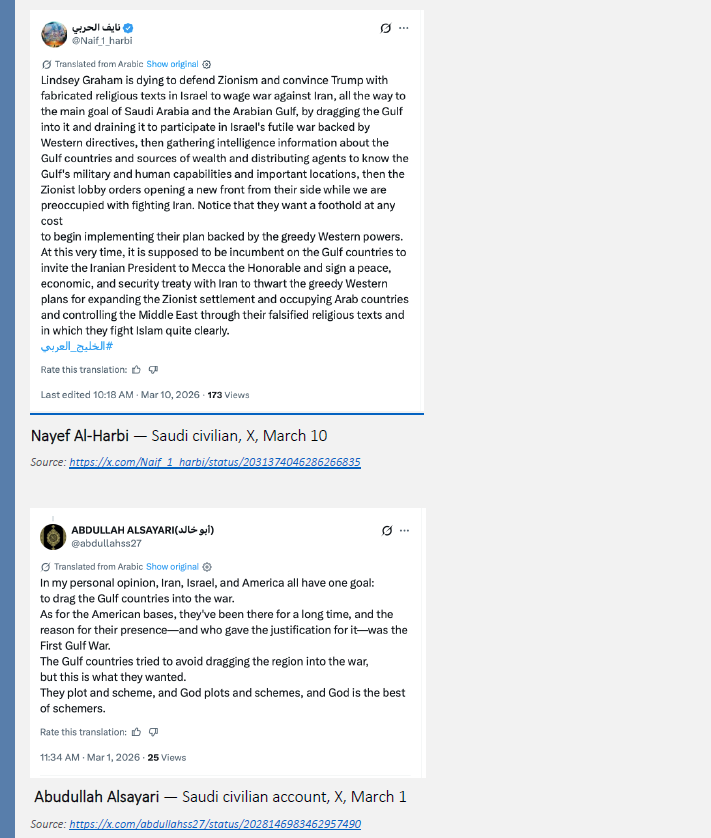
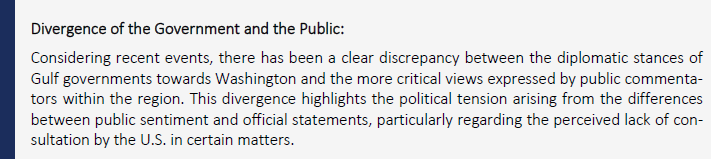
At this point, a division arises between the public’s sentiments and those of the government. Gulf states have been cautious in their criticism of Washington, recognizing the prominence of the security partnership and evading outright confrontation. However, the public, along with unofficial commentators acting as their representatives, have been less restrained.
Betrayal Three: The Strike on the Gulf’s Global Identity
The third act of betrayal is currently largely overlooked, not due to the lack of evidence but because the framing was wrong. This is not, fundamentally, a story about a shattered social contract between Gulf monarchs and their people. It is a story of what Iran decided to target — and what those targets symbolize.
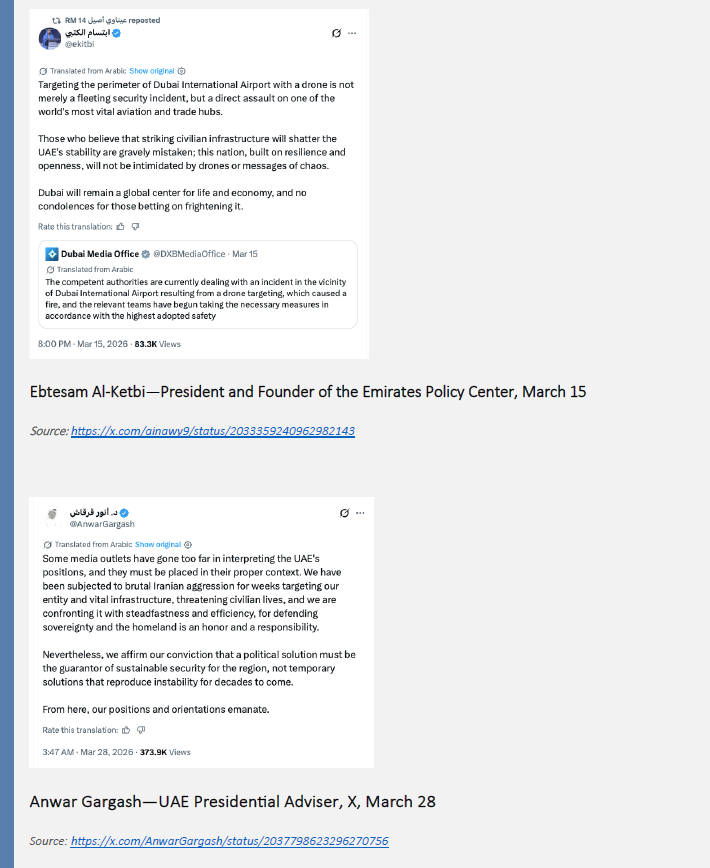
Iran’s response to Operation Epic Fury was not a traditional military response. A conventional response would have targeted American military bases — Al Udeid, Al Dhafra, Ali Al Salem, and the Fifth Fleet headquarters in Bahrain. Those targets were hit, but they weren’t the epicenter of Iran’s campaign. What Iran struck, systematically and at scale, were the physical emblems of Gulf modernity: Dubai International Airport, the world’s busiest passenger hub; Jebel Ali Port, which is the largest container port in the Middle East; QatarEnergy facilities at Ras Laffan, which powers Qatar’s emergence as a global energy power; Ruwais industrial complex; Amazon Web Services (AWS) data centers in the UAE. As the Baker Institute put it succinctly, Iran’s strikes were undoing years of effort to de-risk the region and jeopardizing the unique selling points and business models that underpinned the Gulf states’ global ascent. The Conversation expanded on that, adding that Iran’s attacks had transcended military facilities and hit squarely the sectors — travel, tourism, energy, sporting events — that planted the region so definitively on the global map.
It appears that Iran has deliberately aimed to disrupt this compact. Iranian state media commentators explicitly cited Kuwait’s trajectory pre-1990—once a thriving hub that never fully recovered—as a model to follow. The message embedded in the target selection was legible to Gulf publics even if it was not spelled out: what you have built can be unmade. As Badr Jafar, a prominent Emirati businessman, wrote in the Wall Street Journal amid the conflict: “Iran was not merely attacking Gulf infrastructure — it was attacking the idea of the UAE itself, the proposition that an open, modern, trade-oriented Gulf state could exist and thrive in this region.” That framing — the strikes as an attack on a model, not just on buildings — is precisely what Gulf publics absorbed.
The economic damage made the argument concrete. QatarEnergy CEO Saad al-Kaabi confirmed that Iranian strikes wiped out 17 percent of Qatar’s LNG capacity for up to five years, with an estimated $20 billion in lost annual revenue. The world’s largest gas-to-liquids plant, Pearl GTL, was damaged. A three-phase LNG expansion that would have added six new trains by 2027 is now delayed indefinitely. TIME observed that Gulf Arab states had invested heavily in building a carefully curated image as havens of stability and prosperity in an unstable Middle East — and that the Iranian attacks and their viral imagery of flames rising from hotels, airports, and ports had foregrounded a certain brittleness, threatening that sense of security and prosperity in ways that would outlast the conflict itself. The Middle East Council on Global Affairs concluded that the war had irreversibly shaken the region’s image, exposing a deep-seated fragility beneath the facade of the Gulf’s rapid economic transformation.
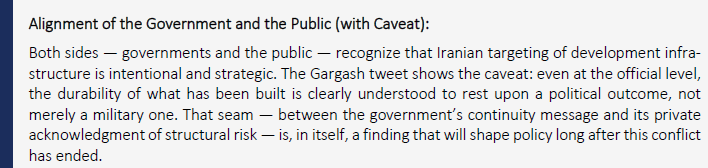
Gulf publics registered this not as abstract economic damage but as an attack on something they named as theirs. The dominant register was not fear — it was a specific kind of outrage at the target’s symbolism.
III. Strategic Implications for United States Policy
Gulf governments will still have ample motivations to sustain security ties with the United States. But the Triple Betrayal has changed the domestic political environment in which those relationships function. Three implications follow.
First, the notion that U.S. basing arrangements can be maintained as strictly intergovernmental decisions, decoupled from public sentiment, is now uncertain.
Second, public ire in the Gulf toward Iran does not necessarily mean support for the U.S.-Israel campaign, presenting a challenge that is less about the future of their cooperation with the United States and perhaps more about the visibility of that cooperation.
Third, Gulf governments have gained a kind of dual moral leverage over each of Iran and the United States — but that leverage is also increasingly conditioned by, and confined within, domestic political pressures.
GCC Public Outrage Towards Iran Does Not Equate Endorsement of Coalition
Gulf public frustration towards Iran does not translate into endorsement of the U.S.-Israel campaign — yet it also does not entirely hold back elite actions. Public discourse across the GCC reflects a populace hesitant to pick sides in the conflict but critical of Iranian attacks. Recent reports suggest that some leaders in Gulf nations, particularly in Saudi Arabia, have quietly approved of ongoing military pressure on Iran.
This divergence demonstrates a two-fold pattern: public restraint paired with selective elite support. Gulf states are not unwilling to support the campaign, but they increasingly cannot do so openly. Gulf citizens, although feeling wronged by Iran, are unlikely to accept being openly dragged into a campaign they perceive as indifferent to their safety by the United States.
Thus, any alignment that occurs will likely remain discreet, conducted through behind-the-scenes channels and shielded from public scrutiny politically. For Washington, the test lies not in whether Gulf allies will enhance cooperation but in making that collaboration transparent to the public without crossing a threshold of domestic political consequences that Gulf governments may struggle to manage.
The Foundation of the ‘Rights of Basing’ Under Strain
U.S. defense strategy has traditionally assumed that basing in the Gulf was too critical to be left simply to the whims of public opinion and remained squarely within the intergovernmental sphere, allowing GCC states to be reliably counted as partners. That perception has always been limited. Saudi Arabia’s decision in 2003 to request that U.S. forces depart Prince Sultan Air Base, in part as a result of domestic political pressure after the Iraq war, showed how public sentiment can intrude on basing arrangements under conditions of sustained tension.
Operation Epic Fury signifies a shift from episodic constraints to a more structural impact. The Triple Betrayal has not only added layers of complexity to negotiations with Gulf governments but has also dismantled the previous public consensus that once allowed these governments to host U.S. forces without facing public backlash. A Gulf leader navigating a populace that has witnessed Iranian missiles falling as American planes pass overhead must consider a different political landscape compared to one who has remained untouched by such events. Washington should be cautious not to conflate what Gulf governments privately agree to with what they can sustain domestically. This limitation goes beyond the scope of basing agreements to encompass the visibility of security cooperation itself — Gulf governments are increasingly inclined to separate operational coordination from public approval. The gap between these two spheres has widened and may persist even if a ceasefire is established.
Gulf States Possess Dual Moral Leverage—and Are Aware of It
Like never before in the U.S.-Gulf relationship, the governments in the Gulf region can now claim genuine popular moral authority against both external powers simultaneously, not only as a constraint on their own policy choices, but as a source of leverage in how those choices are negotiated.
Regarding Iran, the moral authority is upfront and well-documented. Gulf governments have garnered public support, received commitments to non-belligerency that were later violated, and engaged in a three-year effort towards normalization, which was met with missile attacks. The public shares this outrage without reservations, providing GCC states with a legitimate foundation to demand accountability from Tehran—the demand for reparations, diplomatic consequences, and a renegotiated security posture—without appearing to take sides in the broader conflict.
In dealing with Washington, Gulf leaders have indirect leverage alongside significant repercussions. The mechanism isn’t abstract disapproval — it’s domestic political cost rendered legible to an American interlocutor. Gulf governments can now reasonably state, in any negotiation covering the use of their bases, airspace, and intelligence sharing or postwar security architecture: our publics watched Iranian missiles strike their airports and ports while American planes flew through our airspace, and they are asking why. The domestic tolerance that previously enabled Gulf governments to host U.S. forces quietly, expand operational cooperation invisibly, and take the political cost of being close to American military power in their stride — that same tolerance carries a price tag now that it did not before. The domestic political cost of openly cooperating with Washington has become too much for Gulf governments to quietly absorb. This shift does not indicate a breakdown in U.S.-Gulf alignment, but rather a gradual reassessment of how this arrangement manifests, as the divergence between public opinion and government actions becomes increasingly difficult to sustain without introspection.
The repercussions are specific. In the immediate future, Gulf governments will decouple operational cooperation from public recognition — sharing intelligence and allowing overflight but stopping short of any arrangement that ties their hands or requires them to be in public view doing so. In the medium term, they will ask for even more in exchange for less visibility: expanded defense guarantees, technology transfers, economic concessions. For years, Washington has viewed Gulf basing as an elite transaction shielded from popular sentiment. That assumption is no longer safe.
The outcome is not rupture but rather structural repricing. Gulf leaders are not threatening to kick American forces out. What they are doing is more enduring: Making Washington understand that maintaining the relationship will take proactive spending rather than a passive assumption.
In the short run, policy functions on elite decisions. In the medium term, it rides the waves of public psychology. What the voices captured in this paper collectively reveal is not a temporary spike of grievance that can be worn away over time when the ceasefire holds. It is an enormous change in the extent to which Gulf publics believe external powers can be depended on. Whether the most consequential international security partnerships in the Middle East emerge from this war with their underpinnings still intact — or quietly, irretrievably hollowed out — depends on how Washington responds to that gap.