Turkey’s Rising Role Busting U.S. Sanctions
Click here to download the JINSA Insight
Standing at the crossroads of continents and empires, Turkey has long taken advantage of its position to play superpowers off each other. Increasingly, Turkey has provided a safe haven for companies and businessmen working to evade U.S. sanctions and supply arms, components, and cash to the Iranian regime, Russia, and Hamas—a U.S. designated foreign terrorist organization.
A JINSA analysis of U.S. government databases found that 355 individuals and entities residing or based in Turkey have been sanctioned by the U.S. Treasury since 2008. Of those, 217—or 61 percent—have been designated since October 7, 2023.
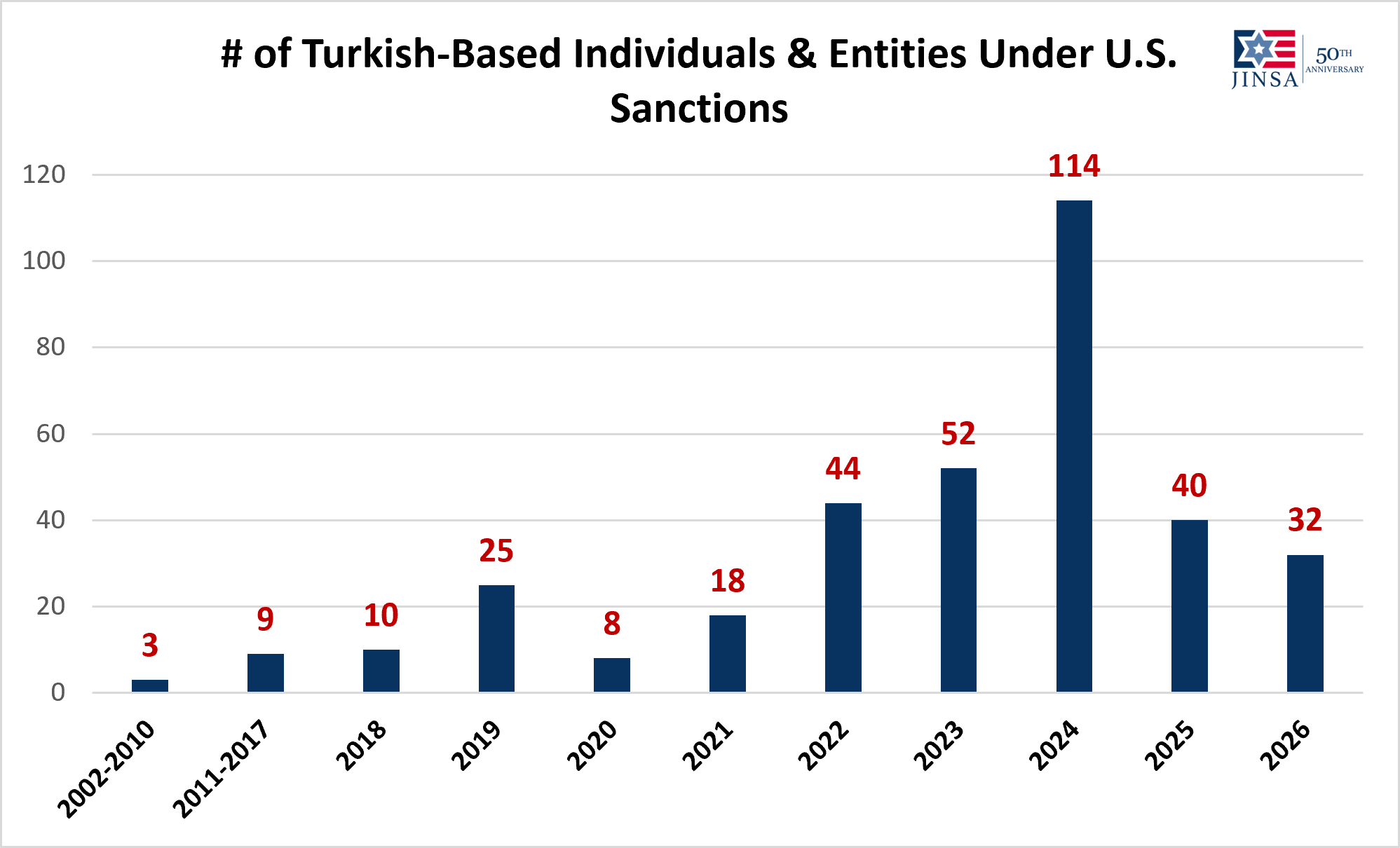
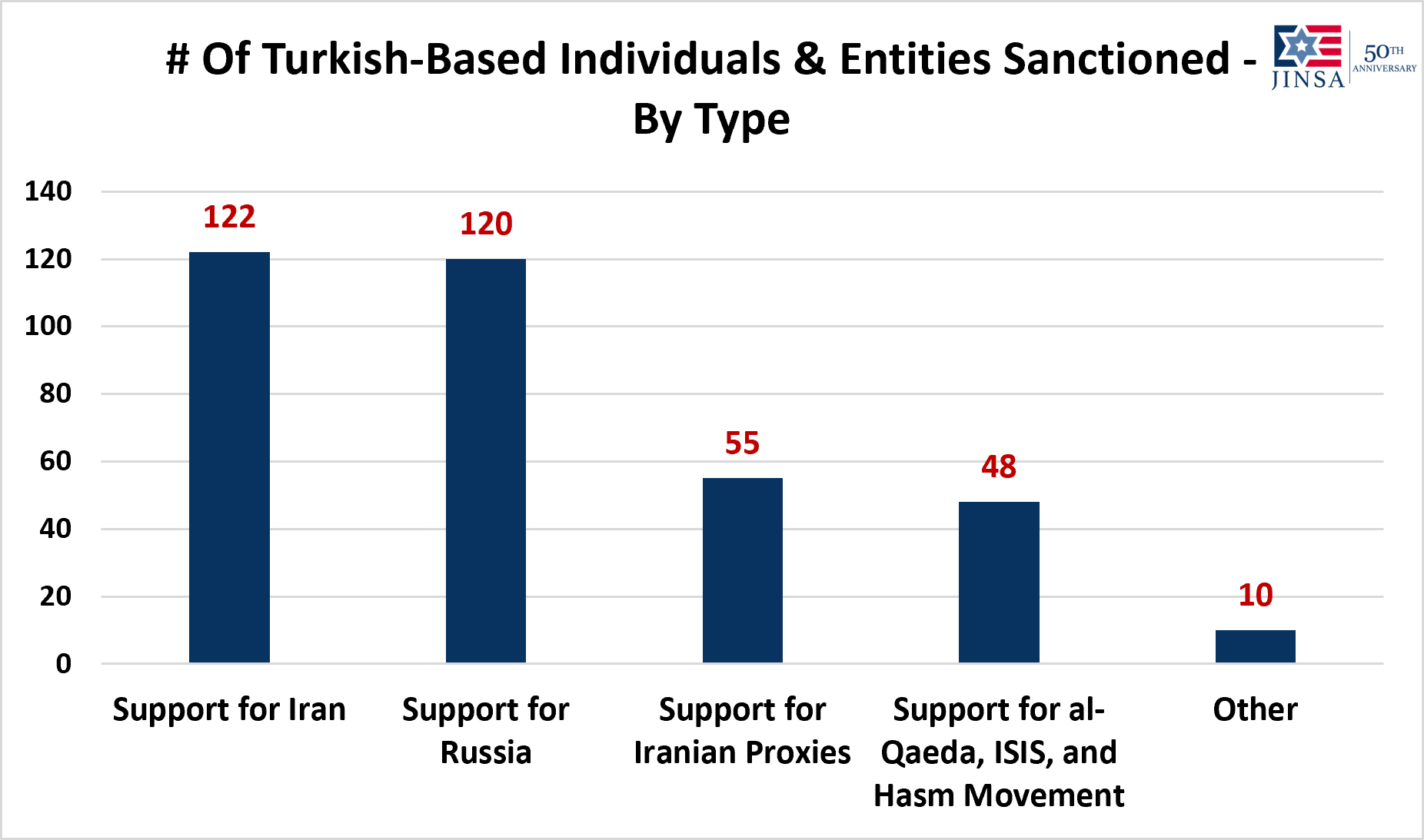
A plurality of the new additions to the U.S. sanctions list are individuals and entities who provided material support to Russia in violation of U.S. sanctions, as well as several state-owned defense entities listed for purchasing the Russian S-400 air defense system in violation of U.S. law (Countering America’s Adversaries Through Sanctions Act (CAATSA)). The Trump administration’s reticence to enforce and increase sanctions pressure on Russia partially explains the decline of new sanctions in 2025 and 2026.
Turkey’s government has lobbied the United States aggressively for these CAATSA sanctions to be removed yet has neither remedied the original sin (its purchase and operation of the S-400 system) nor addressed the vast number of its citizens and businesses violating U.S. sanctions on Russia, Iran, and the Iranian regime’s network of terror proxies. Indeed, Ankara declined to join Western sanctions on Russia following its February 2022 invasion of Ukraine—opposing the measures on principle—and has since become a critical conduit for Russian trade, capital, and sanctions evasion.
It is important to note that not all sanctions violations are done with the consent or approval of the Turkish government. In 2023, the U.S. Treasury took joint action alongside Turkish authorities on two occasions to sanction and freeze the assets of terrorist financiers: first, in January, targeting of a network of four individuals and two entities financing ISIS activities, and again in May, targeting two financial facilitators of the Syria-based Hay’at Tahrir al-Sham (HTS) and Katibat al-Tawhid wal-Jihad (KTJ).
However, the fact that Turkish authorities have the ability and track record of acting when it suits their interests (i.e., limiting financing of ISIS) only demonstrates their refusal to act to curb other sanctions evaders is intentional government policy.
For instance, while fundraising for ISIS appears to be a red line for Ankara, they have taken no action against a large network of Hamas fundraising activity based in Turkey. The U.S. has sanctioned 22 individuals and entities based in Turkey that grow and manage around $500 million in assets for Hamas. However, Turkish President Recep Tayyip Erdoğan has taken no actions to restrict this network and instead encouraged Hamas’ war against Israel and welcomed its leadership to find refuge in Turkey.
Additionally, Turkey serves as a key financial and operational sanctions evasion hub for the Islamic Revolutionary Guard Corps (IRGC) and its Qods Force, helping these organizations launder funds, conceal and obscure Iranian oil shipments, and illegally procure components for its missile, drone, and conventional military production—ultimately supporting Iran’s destabilization of the entire Middle East.
While Turkey remains a member of NATO, dozens of Turkish companies and businessmen also supply Russia with ammunition and weapons, electronic components for their drone and missile program, as well as manufacturing equipment and support for Russia’s Air Force, Navy, and Army.
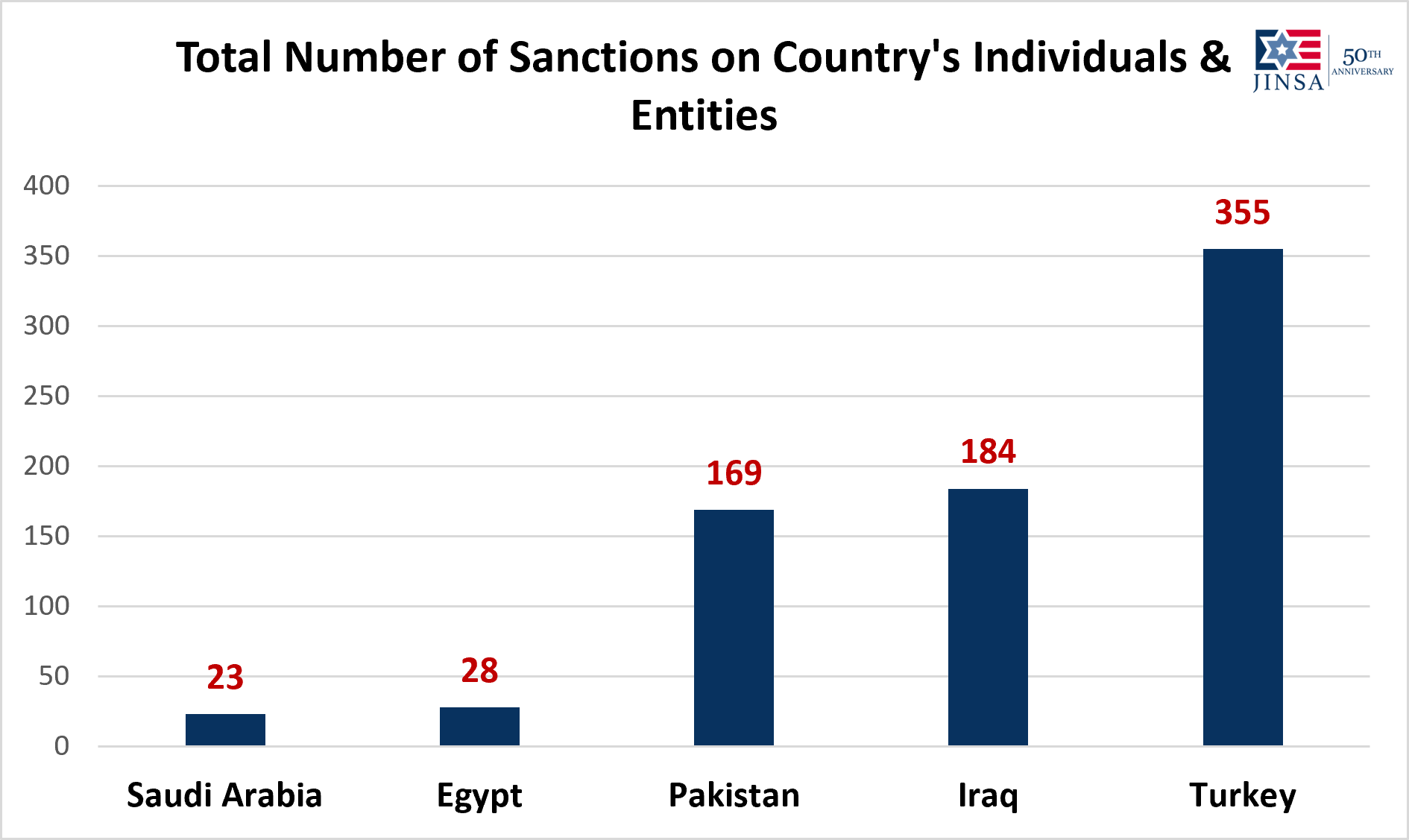
Turkey is not the only U.S. partner in the region whose citizens routinely flout U.S. sanctions—but it is one of the worst, and they are arrayed against a wide range of U.S. foreign policy interests. While Pakistan has long had a counterterrorism problem, and Iraq hosts many pro-Iranian individuals and entities, Turkey provides cover for ecosystems that support Russia, Iran, Iran’s proxies, and even Al-Qaeda.
Egypt and Saudi Arabia serve as regional counterexamples to Turkey’s permissiveness—countries which have successfully battled extremism and go to great lengths to ensure none of their citizens violate U.S. sanctions on other files. Ankara can and should adopt the same stringent policies to adhere to U.S. sanctions and act as a proper ally.
Recommendations for Policymakers
The United States should exert far more pressure on the Turkish government for its support and tolerance of severe violations of U.S. sanctions. This should include withholding of arms sales, military cooperation, and certain intelligence support until Turkey is willing to provide more support to U.S and NATO policy positions on Russia, Iran, and its terror proxies. President Erdoğan wishes to cooperate only when it serves Ankara’s interests—the United States has the leverage to demand a partnership that advances our interests as well as a precondition for further cooperation.
Given Turkey’s track record as a transshipment hub for restricted components use in Russia and Iran’s missile and drone program, Congress should consider an embargo of transfers to Turkey of items, materials, equipment, goods, and technology related to ballistic missile production until Turkey can strengthen its compliance, export, and prosecution standards related to transfers of these sensitive components. Existing U.S. regulations designed to prevent export of these components to Iran and Russia have unfortunately failed too many times—at the cost of untold lives and destruction of critical infrastructure throughout the Middle East and Ukraine. Stronger action is needed to ensure full compliance, and Turkish cooperation is essential to this task. This policy recommendation is less intended as a punitive measure than as a necessary forcing function to ensure Turkish compliance.
However, so long as Turkey threatens Israel and provides financial and military support to the Iranian regime and its proxies (particularly Hamas), Congress should add Turkey to the list of countries required to undergo a Qualitative Military Edge (QME) evaluation under the Arms Export Control Act. QME evaluations currently apply to all countries in the Middle East (excluding Israel), but not to Turkey, which the U.S. government treats as a European country in both the State and Defense Departments. Representative Dina Titus has proposed precisely this fix, offering an amendment that would require the United States to protect Israel’s QME when considering military sales to Ankara. Given Turkey’s increased threats to Israel and its support, both tacit and open, for Russia, Iran, and Iran’s terror proxies, inclusion in QME evaluations is an overdue and prudent step—particularly to ensure Turkey never develops capabilities that would threaten Israel’s security.