Turkey’s Syrian Ambitions, Israel’s Red Lines
Click here to download the JINSA Insight
On August 18, Israeli aircraft struck the Abu al-Duhur airbase in Syria’s Idlib province to prevent Turkey from installing radar and air defenses roughly 70 kilometers (43 miles) south of the Turkish border. The strike was the sharpest instance so far of a deeper problem: Israel and Turkey increasingly want the same Syrian airspace for incompatible purposes.
For Israel, Syrian airspace is the corridor to Iran that the Israel Defense Forces cleared after the December 2024 fall of the Assad regime. For Turkey, radar and surface-to-air missiles in Syria would convert its influence over Damascus into a durable, protected security role while expanding its regional influence further into the Middle East and narrowing Israel’s freedom of action overhead. Three factors have raised the odds of a direct clash: the collapse in relations driven by President Recep Tayyip Erdoğan’s rhetoric, Turkey’s near intervention on Tehran’s side during the Iran war, and the absence of an effective U.S. broker between the two. A NATO member that weighed entering the war on Iran’s side now seeks to place radars and air defenses across the very corridor Israel used to reach Iran.
Washington cannot afford a direct clash between its two partners, which could both constrain Israel’s ability to pressure Iran and draw American forces into another regional conflict. An Azerbaijani-brokered hotline currently links the two sides, but absent a more robust, U.S.-brokered mechanism, one hosted at Turkey’s own Incirlik airbase and expanded to include Syria, these partners could stumble into direct conflict.
Turkey’s Presence in Syria
Turkey’s extensive presence in Syria dates back a decade and positioned Ankara to be northern Syria’s powerbroker. When the Syrian civil war began, Turkey took a more hands-off approach and funneled money, weapons, and logistical support to elements of the Syrian opposition. As the war expanded and posed a greater direct threat to Turkish soil, Turkey took military action by launching Operation Euphrates Shield in August 2016. Its influence deepened the following year, when Ankara oversaw the creation and funding of a proxy force that consolidated an array of secular and Islamist opposition groups under a single umbrella, the Syrian National Army (SNA). Turkey’s ties to Hayat Tahrir al-Sham (HTS), the group led by Abu Mohammed al-Jolani, now Syrian president Ahmed al-Sharaa, were more complicated. Ankara listed HTS’s al-Qaeda-linked predecessor as a terrorist organization, but its protection of Idlib from regime forces helped HTS entrench as the province’s de facto ruler, and by shielding that stronghold, Turkey gained standing with the faction that would go on to topple Assad.
The SNA secured Turkish military bases in the north and fought Kurdish forces along the border, while Turkish troops worked alongside it to hold a buffer zone inside northern Syria. Between 2019 and the new government’s takeover in January 2026, Ankara’s sponsorship of the SNA placed much of northwest Syria under direct Turkish administration: it appointed civilian officials, stood up institutions such as post offices, and made the Turkish lira the local currency.
As a result of its operations and control of Syrian territory, Turkey maintains roughly 20,000 military and security personnel across an estimated 126 military installations in northern Syria. Rather than draw down after Assad’s fall and the new government in Damascus exerting control over northern Syria, Turkey is consolidating its gains to become more permanent by folding smaller outposts into fewer, hardened positions while deepening security cooperation with Damascus.
That permanence serves Turkey’s larger ambitions. Turkey seeks to convert years of intervention and its sponsorship of President Sharaa into durable influence over the new Syrian state, and to use Syria as a springboard for the wider regional reach that animates Erdoğan’s neo-Ottoman project. Securing that position is what pushes Ankara beyond its long-held northern outposts toward new geographic deployments deeper in the country, as well as the introduction of new military equipment on Syrian soil, including in the one domain that would change Israel’s calculations: air defense.
What Turkey Wants to Move
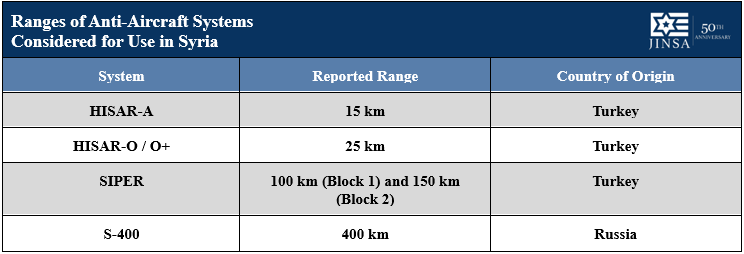
Turkey has already taken the first step to move air defense equipment to Syria. In January 2026, it installed an ASELSAN HTRS-100 radar at Damascus International Airport, a surveillance system with a reported visibility range of 150 to 200 kilometers. More consequential than the introduction of radar systems is the potential movement of surface-to-air missiles (SAMs). At one airbase in central Syria, Ankara reportedly sought to establish a layered air-defense network that would have included Turkey’s indigenous medium-range HISAR-O and long-range SIPER SAM batteries. Turkey even mulled sending the Russian S-400 system to Syria, which would require Moscow’s approval. The S-400, with a range of 400 kilometers, would give Ankara its widest coverage across Syrian territory. While reporting has suggested Turkey could deploy the system in Syria as a way to address the U.S. objections that continue to block its return to the F-35 program, the move would have the added consequence of putting Turkey’s most capable system well within reach of Israeli aircraft.
Israel’s Air Corridor and the Geography of the Turkey Threat
In the first 48 hours after Assad’s flight to Moscow, Israel carried out roughly 480 strikes on Syria to destroy its military arsenal, and in doing so, left Syrian airspace more permeable than at any point in its history. That permeability is now a strategic asset, because the Israeli Air Force’s (IAF) most direct route to Iran runs some 1,500 kilometers northeast from Israel, crossing the southern Syrian governorates of Quneitra, Daraa, Suwayda, and Rif Dimashq before entering Iraq. During both the June 2025 12-Day War and the current war against Iran, that corridor was the primary route for Israel’s air campaign, and preserving it is a first-order Israeli interest and an indirect American one to keep operations against the Iranian regime going.
Geography decides how much Turkish air defenses would ultimately matter, and Syria’s T4 airbase is the key site. From there, most of the systems Turkey could field today, including a long-range SIPER Block 1 battery, would leave the IAF’s southern corridor open, since it lies well beyond their range. Only the longest-range systems would hold it at risk: an S-400 would reach the corridor through Daraa and Suwayda, and a SIPER Block 2, still in testing, would pinch the corridor toward Jordanian airspace, which could limit the number of IAF aircraft flying at a single time in the area. That option carries a political cost, not only a logistical one. Routing strikes through Jordanian airspace would cast King Abdullah as involved in Israeli operations against Iran, an exposure Amman has every reason to avoid and that Israel, mindful of a key partner, has reason not to force. No system on Turkish soil substitutes batteries in Syria, as even an S-400 at Turkey’s Incirlik airbase, roughly 490 kilometers from Daraa, cannot reach the corridor.

Where Turkey’s Ambitions Cross Israel’s Red Lines
Israel has lived with Turkey’s civil war-era footprint in northern Syria. Its objection is to what that footprint is becoming: the conversion of Turkey’s influence over Damascus into military capabilities that could threaten Israel, restrict Israeli operations, and project Turkish power across the region, with each new emplacement enlarging a Turkish military presence that Israel would then be pressed to accept as the baseline. During the civil war, Israel would strongly condemn Turkish incursions in statements but never answered them with force. The calculus is different now. As Prime Minister Benjamin Netanyahu put it after the recent strike, Israel will “not tolerate a military Turkish presence taking root in Syria and threatening Israel.” New bases, radar, and air defenses, whether in Turkey’s current positions or farther south, would carry Ankara past the footprint Israel has treated as the status quo and give its position in Syria a military floor that Israel could not easily roll back.
Israel has already used force to keep Turkey from expanding beyond its long-held footholds. In April 2025, it struck the T4 airbase in central Syria amid reports that Turkey was preparing to base forces and air defenses there. Because sufficiently capable systems at T4 could threaten Israel’s corridor to Iran, the two sides then agreed in Baku, Azerbaijan, to a dividing line north of the base. The Abu al-Duhur strike suggests that Israel’s red line has since broadened, or that the two sides never shared the same understanding of the demarcation.
However, the base itself is not the threat. Abu al-Duhur lies too far north for any Turkish SAM battery there to reach the southern corridor, and Israel struck it anyway. What Israel moved against was the precedent. Ankara has a long record of probing the outer limit of what other states, including its partners, will tolerate, advancing until it meets resistance and pocketing whatever it holds, from its purchase of the Russian S-400 to drilling in Cypriot waters. Air defense in Syria is the newest test of that limit, and it advances by increments: a radar near Damascus, then interest in one base, then another farther south, each step small enough to look tolerable on its own and each one making the next harder to stop. No single emplacement may reach the IAF’s corridor in the near term, but the network those steps would form over time could. By striking even a northern, low-value site, Israel signaled that it will contest the pattern at its first move rather than wait for the last, before every advance southward arrives as a fait accompli that is costlier to reverse and easier for Ankara to justify.
That risk is magnified by the broader deterioration in relations. Erdoğan has accused Netanyahu of following “the path of Hitler” and warned that “just as we entered Karabakh, just like we entered Libya, we might do [something] similar to [Israel].” He has said that Israeli actions in Syria and Lebanon “threaten Turkey” and would draw a “very strong” response. The rhetoric does not speak directly to Turkey’s Syria ambitions, but it gives Israel reason to read the military capabilities that accompany those ambitions as potentially aimed at it.
Turkey’s conduct during the Iran war deepened that concern. Ankara condemned the U.S.-Israeli campaign against Iran as a “clear violation of international law” and worked for weeks to prevent it. More striking, Israeli and American reporting indicates Ankara was prepared to intervene on Iran’s behalf. Israel’s public broadcaster reported that Turkey warned it would act to stop a Kurdish incursion into Iran and weighed providing Tehran aerial defense against Israeli and American strikes, derailing an Israeli-U.S. plan months in the making. Trump publicly called Erdoğan “a prime candidate to go into the war with Iran, maybe on the Iran side,” and said he had personally urged the Turkish leader to stay out.
An Honest Broker Is Hard to Find
Washington’s conflicting response to the Abu al-Duhur incident has damaged its already weakened ability to broker honestly between Israel and Turkey. The Trump administration has invested heavily in post-Assad Syria, lifting sanctions and removing the country from the State Sponsors of Terrorism list. President Trump himself was unusually quiet on the strike, but his ambassador to Turkey, Tom Barrack, publicly disputed Israel’s account, calling it an “unnecessary escalation” and saying U.S. agencies had determined that the intelligence Israel passed to Washington a week earlier “was not true.” Israeli Defense Minister Israel Katz rejected that account and said Israel had warned Damascus before striking. Because Barrack serves as Trump’s envoy for Syria and the wider Eastern Mediterranean, his words carry the administration’s weight, and siding against Israel’s version in public is difficult to square with the role of neutral intermediary. It also fits a broader pattern in his tenure. Barrack has publicly cast Israel’s strikes in Syria as counterproductive and has, critics argue, increasingly framed regional questions in terms that align with Ankara’s, complicating his standing as a broker on precisely the file where Israeli and Turkish red lines are hardest to read.
Recommendations
Washington needs a Turkish-Israeli deconfliction mechanism that both prevents accidental engagements and preserves Israel’s freedom of action against Iran. Turkish and Israeli forces operate in increasing proximity amid badly deteriorated relations, and Syria’s crowded skies have produced accidental confrontations before, most notably between Turkey and Russia in 2015. Washington therefore has two related interests: preventing skirmishes between U.S. partners that could spiral and draw in American forces, and preventing Turkish military expansion in Syria from constraining Israeli operations against Iran.
A more robust mechanism should both prevent collisions or shootdowns of Israeli aircraft and give Israel a reliable channel for communicating its red lines before the next strike. Azerbaijani-mediated talks produced only a hotline in May 2025, and Abu al-Duhur demonstrates the shortcomings of an arrangement that does not clearly communicate where each side believes the limits of the earlier understanding now lie.
Washington should broker a more robust mechanism, one that goes well beyond the current hotline, brings Syria into the arrangement, and is hosted at Turkey’s own Incirlik airbase, where U.S. forces are already stationed. Early reporting indicates Washington is already working toward such a mechanism and toward bringing Syria in. Ideally, it would co-locate U.S., Turkish, Israeli, and Syrian personnel at a single U.S. facility, and Turkey’s agreement to host it would itself be a show of good faith. Washington should treat the mechanism’s establishment as a condition of any decision to return Turkey to the F-35 program. The necessity of working together in Syria could begin the long process of rebuilding confidence between Turkey and Israel, and between Israel and Syria, whose negotiations for a security agreement have remained frozen since the start of the Iran war.