Uncertifiable and Illegal, but Probably Unstoppable: Congress Must Review the Iran MOU
Click here to download the JINSA Insight
“Send it to Congress, please,” President Donald Trump declared shortly after announcing that the United States had reached a memorandum of understanding (MOU) with Iran, including on its nuclear program. He is right to involve Congress and acknowledge its right to review the deal.
That comes right from the Iran Nuclear Agreement Review Act of 2015 (INARA), a law that requires that Congress receive and review any “nuclear agreement” with Iran. It stipulates short but precise timelines for congressional review: five days to send the deal to Congress along with certifications of its adequacy to secure specific objectives; 30 days for Congress to review; and during that whole period no sanctions relief for Iran. That five-day clock is already ticking; INARA requires that the president send the deal to Congress by June 19.
However, if accurate, leaked text of the MOU suggests that it will have trouble meeting INARA’s requirements. The required certifications that the deal meets nonproliferation objectives and is verifiable could be impossible for the administration to make in good faith. And the MOU’s provision of “immediate” U.S. sanctions waivers appears to constitute a clear violation of INARA’s requirement that there can be no such relief given until the deal has gone through congressional review. It is vital, therefore, that Congress assert its right to review the deal, demand the president follow the letter of INARA, vigorously vet and debate the MOU’s provisions, and immediately but temporarily constrain the president’s authority to waive sanctions on Iran. This process itself will be salutary and instructive in publicizing and understanding the deal’s apparent inadequacies, even though INARA’s own weaknesses mean that it likely cannot present more than speedbump to the MOU’s implementation.
What is INARA?
Congress played a critical role in the negotiations that led up to the 2015 Joint Comprehensive Plan of Action (JCPOA). In overwhelmingly bipartisan votes, often against the public wishes of President Barack Obama, it repeatedly passed ever tougher sanctions against Iran, creating the economic leverage that brought Tehran to the negotiating table. But then, Congress was shut out. Obama structured the outcome of the talks as not a treaty, nor even a deal or agreement, but a murky “plan of action,” which did not require ratification by the Senate and the White House could undertake at will.
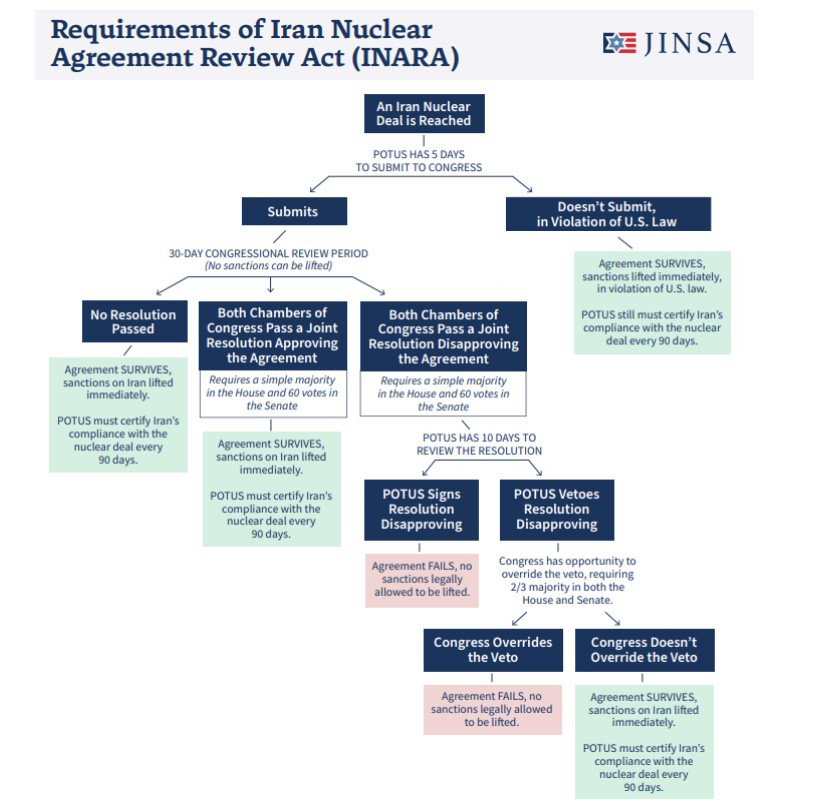
So incensed was Congress at this, that they passed, again in a bipartisan vote, the Iran Nuclear Agreement Review Act of 2015. The law boils down to the following requirements:
- Any nuclear agreement between Iran and the United States must be submitted to Congress within 5 days of being reached;
- Congress will then have 30 calendar days to review and vote on the agreement under expedited procedures;
- During the period of congressional review, no sanctions relief can be granted to Iran;
- A majority vote in both the House and the Senate is required to pass a joint resolution disapproving the deal, but the president can veto such a resolution;
- If a joint resolution of disapproval goes into effect, the president is barred from granting any sanctions relief to Iran;
- If the resolution fails and the agreement goes into effect, the president is required to regularly notify Congress of Iran’s compliance with its terms.
The MOU Counts
Congress went to great pains to ensure that INARA would apply to the JCPOA—and any future potential deal or other attempt by a president to get around the need for congressional review. As Secretary of State Marco Rubio testified last year, “Congress has a right to weigh in on any deal and could actually reverse any deal.” INARA specifically and intentionally spells out a wide definition of what counts as a “nuclear agreement” that triggers the law’s requirements:
The term ‘agreement’ means an agreement related to the nuclear program of Iran that includes the United States, commits the United States to take action, or pursuant to which the United States commits or otherwise agrees to take action, regardless of the form it takes….
The current MOU, assuming that the text leaked by multiple sources is accurate, clearly falls within the scope of INARA’s definition of a nuclear agreement. First, and most obviously, it counts as an agreement, despite being officially called a memorandum of understanding, under the “regardless of the form it takes” clause. Second, it checks the box of the United States being included in the agreement. Third, it counts as a nuclear agreement because it does relate to Iran’s nuclear program. Reportedly, the MOU requires Iran to “maintain the status quo on its nuclear program.” If accurate, that provision explicitly makes Iran’s nuclear program part of the MOU, thereby triggering the legal requirement to submit it, and any additional annexes, side agreements, or other materials, to Congress for review.
A Short Clock
Trump has already expressed his willingness to submit the MOU to Congress, saying, “I never even thought about it but I will, I will send it to Congress. I mean who wouldn’t approve it? I like the idea. Send it to Congress, please.” It is notable, however, that the deal has not been sent to Congress and that no member of Congress has seen the deal, yet. Congress should, therefore, act quickly to affirm that the MOU requires their review and make clear to the president the quickly ticking clock that has already been activated.
Under INARA, “Not later than 5 calendar days after reaching an agreement with Iran relating to the nuclear program of Iran, the President shall transmit…the agreement.” It is unclear when exactly the MOU was reached, but it is reasonable to start the clock at Trump’s June 14 social media post announcing “The Deal with the Islamic Republic of Iran is now complete.” That would mean that by Friday, June 19, the White House is legally required to send the full text of the deal to Congress.
An argument could be made that the five-day clock for sending the deal to Congress does not start until the official signing of the deal, which is slated for June 19. However, both precedent and the administration’s own statements undermine such an argument. First of all, the JCPOA, which INARA was specifically designed around, was transmitted to Congress on July 19, five days after it was finalized on July 14, 2015. Indeed, the JCPOA was never even signed, so any suggestion that a deal is only “reached” under INARA once it is signed is refuted by how the law was construed in its original application. Moreover, even if signing the MOU is now considered to be the standard for a deal being “reached” under INARA, Vice President JD Vance has stated that the deal has already been electronically signed by both parties on June 14. It is clear, therefore, that however INARA is construed, the transmission clock started on June 14 and the MOU must be sent to Congress by June 19.
At that point, another clock starts ticking. Congress then has 30 calendar days to hold hearings, receive briefings, and vote on the deal. That clock would run out on July 19. Given the congressional calendar with the July 4 break, that would give the House three working weeks and the Senate just two to assess, review, and vote on the deal. It will be critical that congressional leaders move expeditiously to schedule hearings on the deal as soon as the week of June 22.
Uncertifiable
It is not just the agreement that Congress must receive by June 19. INARA also requires the Secretary of State to submit a series of certifications, some of which—judging based on the purported MOU text available so far—might be hard to make.
The required materials that must be submitted accompanying the text of the deal include:
- A certification that the transmitted agreement includes the “appropriate terms,” i.e. all the relevant language and sections of the deal;
- A certification that “the President determines the agreement meets United States non-proliferation objectives, does not jeopardize the common defense and security, provides an adequate framework to ensure that Iran’s nuclear activities permitted thereunder will not…constitute an unreasonable risk….”
- A Verification Assessment Report that includes:
- “the extent to which the Secretary will be able to verify that Iran is complying with its obligations and commitments under the agreement”
- “the adequacy of the safeguards and other control mechanisms and other assurances contained in the agreement with respect to Iran’s nuclear program”
- “the capacity and capability of the International Atomic Energy Agency to effectively implement the verification regime required by or related to the agreement”
The first of these should be easy for the Secretary of State to provide. Hopefully, there are no secret annexes or other undisclosed elements accompanying the MOU —such as the reported but denied claims that Iran received an advance transfer of $3 billion or more from the United Arab Emirates to secure its agreement. However, administration officials in trying to defend the deal have suggested to CNN that it involves additional arrangements with Iran—including, reportedly, “U.S. involvement in the destruction of [Iran’s] enriched materials”—not contained in the text itself. Any such side agreements must also be transmitted to Congress.
The second and third certifications might prove much harder, if not impossible, to make in good faith.
The leaked text of the MOU, if accurate, meets essentially none of the criteria laid out in the second required certification. By the terms set by Trump himself—“A WALL TO NUCLEAR WEAPONS”—the MOU does not meet the U.S. nonproliferation objectives simply because it does not include any restrictions on Iran’s nuclear program. True, Iran apparently pledges not to pursue a nuclear weapon, but it has already made, and violated, that pledge multiple times before, most notably as signatory to the Nuclear Non-Proliferation Treaty.
It would also be hard to certify that the MOU “does not jeopardize the common defense,” seeing as it seemingly requires the United States to withdraw its troops from the region and pledges it to a permanent end of war, and threat of force, against Iran and its proxies. In light of Iran’s long history of aggression and violation of previous agreements, any claim that this MOU will do more to protect U.S. interests and partners than the U.S. forces that will now be withdrawn from the region cannot be taken seriously.
Nor is it possible to certify that the MOU establishes “an adequate framework to ensure that Iran’s nuclear activities…will not…constitute an unreasonable risk” because there is no such framework included in the deal.
Finally, it is particularly hard to imagine how the Secretary of State would be able to file a Verification Assessment Report for the MOU, seeing as the leaked text includes no verification mechanisms whatsoever. Nor can the Secretary in good faith assess that the IAEA will be able to implement the verification regime because not only does it not exist but, even if it did, the MOU does nothing to provide the IAEA access to the Iranian nuclear facilities from which it has been blocked for more than four years.
Illegal
While INARA requires the president to submit the deal, and additional certifications, to Congress within five days, it effectively bars the administration from taking any other steps related to the deal for a significant period of time. In particular, the law spells out that the president “may not waive, suspend, reduce, provide relief from, or otherwise limit the application of statutory sanctions with respect to Iran…pursuant to an agreement”:
- prior to and during the five-day period for transmission of an agreement to Congress;
- during the 30-day period for congressional review;
- if a joint resolution of disapproval passes, for a period of 12 calendar days following its passage (to prevent the president from implementing the deal without vetoing the resolution);
- if the president vetoes the resolution, for 10 calendar days following the veto to allow Congress to attempt to override it.
Thus, no sanctions relief can be legally provided to Iran until at least July 19 and potentially as late as August 10.
The leaked text of the MOU, if accurate, clearly violates this legal requirement, with its provision that: “The US undertakes that immediately after the signing of this Memorandum of Understanding, and until the date of the lifting of sanctions, the US Treasury Department will issue waivers for exports of Iranian crude oil….”
Congress should seek immediate clarification from the administration on whether it has granted any sanctions relief to Iran already. It should also issue a very clear demand that no further relief be granted until the deal has been reviewed under the terms of INARA. Finally, given the serious legal breach that would result from the administration fulfilling the terms of the MOU, Congress should consider passing emergency legislation to remove the president’s ability to waive sanctions on Iranian exports without congressional review and approval, at least temporarily. While generally Congress gives the president wide latitude to apply or waive sanctions on national security grounds, there is precedent for constraining these powers. As part of the Countering American Adversaries Through Sanctions Act, Congress required that any presidential waiver on certain sanctions on Russia be subjected to review by Congress with the option to disapprove of them. Ideally, a similar but stronger mechanism should be enacted now, requiring any sanctions waiver on Iran to be affirmed by Congress before going into effect.
Unstoppable
Despite criticism that the MOU has already come under from Congress, and what appear to be its major failings of the basic INARA requirements, it is likely that the deal is unstoppable.
Both houses of Congress would have to pass resolutions of disapproval, which are majority votes but, in the Senate, requires first overcoming the 60-vote filibuster threshold. But to survive the inevitable presidential veto, what is really needed is two-thirds supermajority. Such strong opposition to the deal is all but unthinkable unless the MOU is either even worse than what has been leaked or the administration flagrantly defies its legal requirements in refraining from granting sanctions relief until the deal has been reviewed. That is why JINSA has long argued that it would be far better for Congress to make clear that it requires any Iran nuclear deal to be treated as a treaty, requiring a two-thirds vote in the Senate for ratification before it can go into effect.
But that does not mean that INARA in its current form is completely useless. Any process of publicizing, assessing, and reviewing the deal in public will increase the currently woefully lacking public knowledge and understanding of what is and is not in the deal. In 2015, that review process, along with the fact that there was a bipartisan majority that found the JCPOA inadequate, helped shift the terms of the debate and set the grounds for Trump’s eventual withdrawal from that deal. A vibrant debate about this MOU might not stop it from going into effect, but it may lay bare its deficiencies that help inform this or future administrations’ further negotiations with Iran or, better yet, course corrections.
That public debate will also force members of Congress to clarify their positions. Democrats have been pushing to end this war and generally oppose anything that Trump does, but will they vote in support of this deal? That would make them a party to its many failings and at least partially responsible for them. Or will they oppose the deal and the president, a vote that would be tantamount to voting for a return to war but one that they could cast knowing that it would not really come to that? And what of the Republicans that lambasted the JCPOA as a disastrous deal and encouraged Trump to secure a better outcome? Will they stick to their principles and vote based on what deal actually does or on what Trump claims it does?
INARA might be as weak as the MOU that it will now be applied to, but Congress must nevertheless use this opportunity to shine as much light as it can on this deal and constrain the administration from violating the law’s basic requirements.
Click here to download the JINSA Insight.