Why Iran’s Protest Movement Cannot Succeed Without the Kurds
Click here to download JINSA Insight
Iran is once again gripped by widespread protests, with demonstrations erupting across the country in response to rising costs of living and deepening economic distress. While the immediate trigger for the latest protests is economic, the grievances animating Iran’s diverse population run far deeper. Whether expressed through demands for economic relief, ethnic recognition, religious freedom, or gender equality, these frustrations ultimately stem from the same source: the Islamic Republic’s brutally authoritarian system of governance. It is this brutality, against its own people as well as against America, Israel, and Arab states, that makes the prospect of the protestors’ success and the Islamic Republic’s collapse so strategically compelling. And it is the protestors’ shared root cause that makes the Iranian opposition’s persistent inability to unite against the Ayatollah’s regime so confounding.
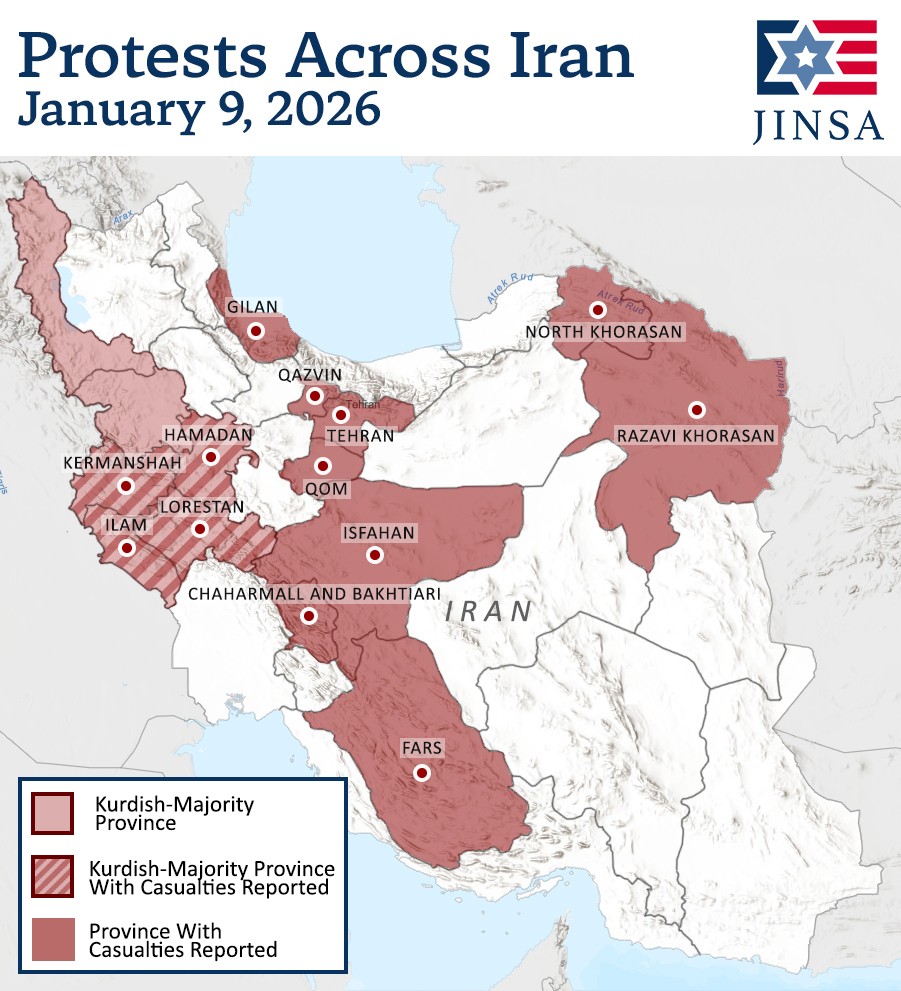
More than any other factor, the opposition’s capacity to overcome fragmentation will determine whether this round of protests dissipates or gathers irreversible momentum. In particular, that includes overcoming fragmentation both within Iran’s multiple Kurdish groups and, more importantly, the traditional reluctance of nationalist opposition groups to work with Kurds and other Iranian minorities. The success of these—or any future protests—in toppling Iran’s regime depends on the coordination among and inclusion of Iran’s Kurds.
As has so often been the case in moments of popular upheaval, Iran’s Kurdish population (making up between 10-15 percent of the population) has found itself at the forefront of dissent. Kurds have put up some of the most ferocious opposition to dictatorship in Iran for decades, fighting Khomeini’s imposition of an Islamic regime into the early 1980s and sparking the 2022 “Women, Life, Freedom” movement, ignited by the killing of Jina (Mahsa) Amini, a young Kurdish woman, at the hands of the Basij morality police and thus named after an originally Kurdish slogan (“Jin, Jiyan, Azadi”).
It is often Iran’s Kurds who bear the brunt of the Iranian regime’s violent backlash. In 2025, Iranian authorities arrested many Kurdish citizens throughout the country, providing no information on their alleged crimes or whereabouts to their families. After the 12-Day War in which Israel and, ultimately, the United States destroyed Iranian military and nuclear sites it was again the Kurds of Iran that were disproportionately targeted for “espionage and collaboration” with Israel.
Both these trends hold true in the current protests. Although the protests started in Tehran’s Grand Bazaar on December 28, 2025, they quickly spread to Kurdish areas. And Kurds are already paying a disproportionate price. According to Reuters, the most intense clashes and highest casualty figures have been recorded in Iran’s western provinces, where the country’s Kurdish population is overwhelmingly concentrated. So far, human rights monitor Hengaw has reported 77 new arrests, of which 45 detainees were Kurds, and 27 civilian deaths, of which 17 were Kurds.
In this context, the Kurdish dimension of Iran’s unrest deserves particular attention. Even before these protests began, Kurdish political parties in Iran had noticeably stepped up their activities, both on the ground and in diplomatic outreach abroad. This reflects not only growing popular anger in Kurdish regions, but also a calculation that the regime’s current moment of weakness may present an opening for sustained pressure.
In September of last year, Iran’s various Kurdish groups—PJAK (Kurdistan Free Life Party), KDPI (Democratic Party of Iranian Kurdistan), PAK (Kurdistan Freedom Party), and the Komala Party of Iranian Kurdistan—came together to hold a first-of-its-kind joint conference to support the “Women, Life, Freedom” movement. On January 5, 2026, in a joint announcement these parties met again to discuss developments in Iran and Kurdistan, voice full support for the nationwide protests against the Islamic Republic, and stressed the need for coordinated action to strengthen the uprising. At the meeting, they called for a general strike on January 8, 2026 “to demonstrate the unified support of the Kurdish people for the struggle and protests being waged by the Iranian people against the Islamic republic.”
KDPI, Iran’s oldest Kurdish party, seeks to attain Kurdish national rights within a federal and democratic Iran. The organization retains significant historical and symbolic capital as the founding party of the short-lived Republic of Mahabad but only a declining support base among older generations and parts of the Kurdish diaspora. Twenty-four years after KDPI’s founding in 1969, Kurdish students and scholars in Tehran formed the Komala Party based in secularism, democracy, and social justice. As a political institution, Komala seeks to implement a federative system in Iran. Rounding out the joint conference, PAK is a nationalist separatist group with a goal of developing a Kurdish state. They are the smallest of the organizations in both fighting force and influence amongst the Kurds in Iran.
PJAK is the Iranian wing of the Turkey-based Kurdistan Workers’ Party (PKK), which disbanded in May 2025 ending a 40-year insurgency against the Turkish state that had prompted its designation by the United States as a Foreign Terrorist Organization. It is a late entrant among Kurdish political groups but now possesses the strongest and best-positioned armed forces and a growing capacity for social organization. It was not impacted by either the Kurdistan Regional Government’s 2023 deal with Iran to disarm exiled Kurdish opposition parties or the PKK’s dissolution . PJAK’s pluralist ideology, inspired by the theories of still imprisoned PKK leader Abdullah Ocalan, brings together Kurds across linguistic and sectarian lines and opens doors for cross-ethnic cooperation.
In Syria, it was the People’s Protection Units (YPG) and Women’s Protection Units (YPJ), both emerging from the Democratic Union Party (PYD)—the Syrian PKK affiliate—that proved to be the most effective armed force and the quickest to organize politically once the state retreated from Kurdish-majority areas. This fundamentally altered Syria’s internal balance and later shaped international engagement with the conflict, leading to the creation of the Syrian Democratic Forces (SDF), based on Kurdish units but incorporating Arab and other minority fighters, and their partnership with U.S. troops.
None of the major Kurdish parties in Iran (with the exception of PAK) seeks to divide the country. Rather, they promote political programs focused on reforming and democratizing Iran as a whole and ending the oppression of the current regime. Simply put, there are no structural obstacles to forming a joint platform between Kurdish and non-Kurdish opposition forces; on the contrary, the incentives to do so are substantial.
Burgeoning coordination among Iran’s Kurdish parties and Kurdish participation gives Iran’s protest movements geographic depth, organizational experience, and a moral clarity born of decades of repression. It would be a mistake to overstate the Kurds’ ability to singlehandedly transform Iran’s political system. At the same time, it is equally true that no serious effort to challenge or reform the regime can succeed without them, as every popular protest movement to date has ultimately been suppressed.
The regime has consistently exploited ethnic divisions to isolate Kurdish regions, portraying dissent there as separatism rather than legitimate opposition. And, while Kurdish parties are largely united in support of a decentralized, democratic Iran in which Kurds and other ethnic communities, like Baloch, Arabs, and Azeris, obtain the same rights as Persian Iranians, some mainstream Iranian opposition forces oppose these pluralistic demands. Some supporters of the deposed monarchy call for the restoration of a system under which Kurds were just as oppressed as they are under the Islamic Republic.
If the current protests are to become the proverbial straw that breaks the camel’s back, the Kurdish component will need to be not only strong, but integrated into a broader, inclusive opposition framework. The non-Kurdish opposition must recognize that marginalizing the Kurds has been one of the regime’s most effective survival strategies. In the January 5 meeting, Kurdish leaders took an important step towards internal unity by signing on to a joint statement of support for the protests and pledging to work towards a shared framework for action. Other opposition groups should join with the Kurds and make similar commitments to cooperation.
Whether this moment leads to meaningful change or yet another cycle of repression will depend less on the courage of protesters, of which there is no shortage, than on their ability to forge a common political horizon. The Kurds may not be able to topple the system alone. But without them, the system will not fall.