Blockade Evasion Update – 5/8/26
Click here to download JINSA’s update on blockade enforcement.
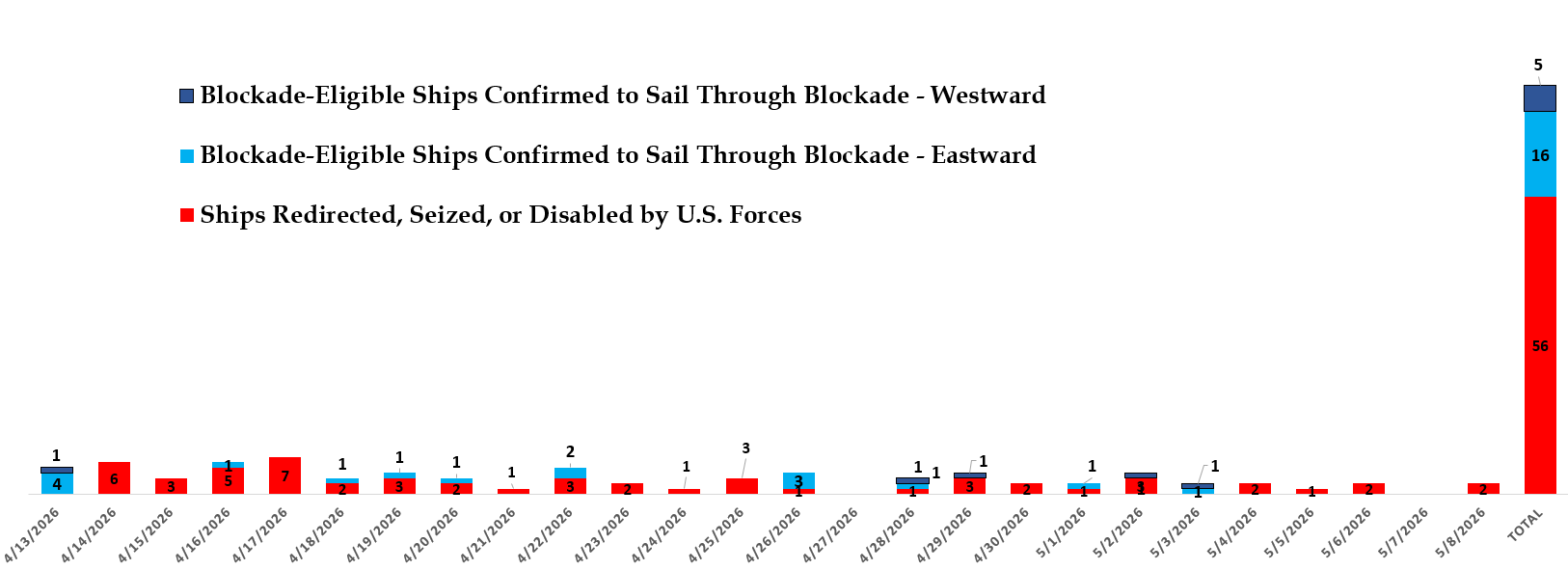 Click here to view a high-resolution version of the above.
Blockade Evasion Updates
Since JINSA last released blockade enforcement data in its May 1 report Turning Tides, several key blockade-related developments have occurred, including:
- An additional eight ships attempting to evade the blockade were redirected by U.S. forces, and another three were disabled by U.S. strikes.
- On May 8, U.S. Central Command (CENTCOM) conducted airstrikes on “two Iranian-flagged unladen oil tankers attempting to pull into an Iranian port,” the Sea Star III and the Sevda, according to a CENTCOM press release. Previously, on May 6, the Iranian-flagged oil tanker Hasna was disabled by a U.S. F/A-18 jet’s cannon gun as the tanker tried to reach an Iranian port.
- In total, 56 blockade-eligible vessels attempting to breach the blockade have been blocked, with 52 of the 56 being redirected back to port. In addition to the three now-incapacitated ships listed above, a fourth, the Touska, was struck and disabled by the U.S. Navy on April 19.
- At least eight of those 52 redirected vessels, new United Against Nuclear Iran (UANI) data released on May 5 indicated, were tankers attempting to transport Iranian oil past the blockade line likely en route to East Asia.
- Four blockade-eligible vessels crossed the blockade line since May 1, for a total of 21, according to JINSA-reviewed data from the shipping analytics firm Kpler. These were:
- The Marshall Islands-flagged Star Laura bulk carrier, traveling from Bandar Imam Khomeini, Iran, to Santos, Brazil;
- The Comoros-flagged cargo ship Gulf King, traveling from Bandar Abbas, Iran to an unknown location, which is now near Yemen’s coast;
- The Liberian-flagged Star Despoina, traveling from Karachi, Pakistan to Bandar Imam Khomeini, Iran; and
- The Maltese-flagged bulk carrier Seamelody, traveling from Rio Grande, Brazil to Bandar Imam Khomeini, Iran.
- The Seamelody is transmitting a message that it is transporting food. Such ships are exempt from the blockade, per the U.S. Navy, but are subject to inspection by U.S. forces. It is unclear if the bulk carrier was, in fact, searched.
- Iran and Brazil have extensive commercial ties, particularly trading large quantities of corn and grain. However, the Seamelody may not be benign, and its claim to have humanitarian aid may be a façade.
- Though potentially unrelated, the Brazilian and Iranian foreign ministers spoke by phone on May 3 about unknown topics.
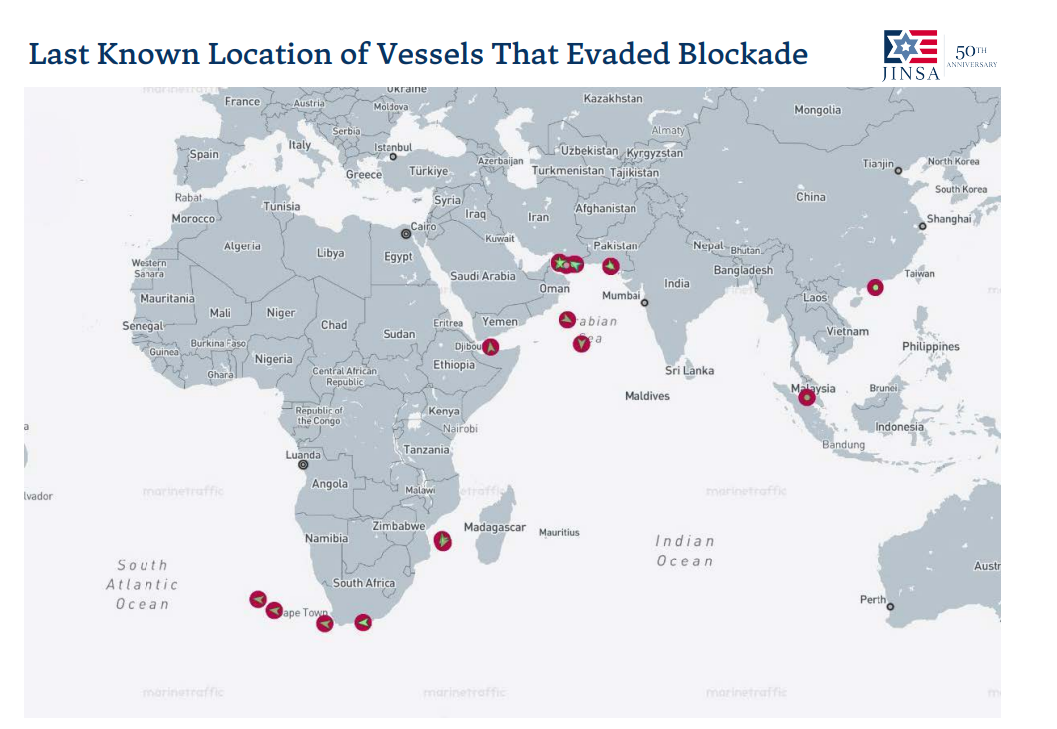
- The only two-blockade eligible vessels JINSA detected breaching the blockade en route to East Asia are anchored at ports, likely offloading their cargo. When JINSA last released blockade evasion data, the ships were still at sea.
- One of these ships, the Iranian-flagged Shabdis, is now anchored off the coast of Zhuhai, China, where it has previously docked.
- The Shabdis, at the height of the war in early March, reportedly transferred chemical fuel inputs from the Zhuhai port, where a chemical storage loading terminal is located, back to Iran for the Iranian regime to create additional missile fuel.
- Another, the Iranian-flagged Azargoun container ship, is now anchored at the Malaysian port of Port Klang. The vessel has previously been linked to the transfer of components used to assemble ballistic missiles and drones.
- One of these ships, the Iranian-flagged Shabdis, is now anchored off the coast of Zhuhai, China, where it has previously docked.
- Two vessels changed their stated destination following JINSA’s May 1 report about Santos, Brazil’s role in Iranian illicit networks.
- Two Marshall Islands-flagged bulk carriers that evaded the blockade, the LB Energy and the Ponente, each changed their declared destination from Santos, Brazil, to Paranagua, Brazil—150 miles away—following JINSA’s May 1 report highlighting that, according to a former senior State Department official, the port of Santos is connected to Iranian and Hezbollah international financial networks.
Unverified Claims of Additional Blockade Violations
Since JINSA’s last release of blockade evasion data, additional claims have surfaced indicating that five energy tankers may have violated the blockade. JINSA has not been able to independently verify these claims, some of which lack direct evidence, and they are excluded from JINSA data. They include:
- On May 5, Windward Intelligence asserted that an unnamed Vietnamese-flagged gas tanker, in mid-April, crossed the blockade line en route to East Asia, though there is no evidence the ship ever was docked in Iran.
- Windward Intelligence said the ship “likely spoofed its location to conceal an Iranian loading following the April 13 blockade,” without elaborating.
- On May 4, Windward Intelligence alleged that a Madagascan-flagged gas tanker in East Asia, which it did not name, had an “Iran-linked deception pattern” and may have crossed the blockade line between April 13 and 20. The firm did not provide evidence of links between the ship and Iran.
- On May 4, Windward Intelligence said that the Botswanan-flagged Vigor crossed the blockade line en route to Iran between April 20 and 26, after traveling there from Indonesia, and proceeded to Iran’s Kharg Island export terminal.
- Once the Vigor arrived at the Kharg Island terminal, according to Windward Intelligence’s review of commercial satellite imagery, it loaded 2 million barrels of crude oil. Its present location is unknown.
- On May 4, TankerTrackers.com claimed that the Xavia, a Guinean-flagged gas tanker, traveled into the Arabian Sea in early April after loading in Iran.
- It did not specify if this after the blockade began, and it has previously combined pre-blockade and post-blockade activity in its X posts.
- On May 4, the United Against Nuclear Iran (UANI) watchdog organization asserted that it tracked the Iranian-flagged crude oil tanker Huge transiting the Lombok Strait in Indonesia, possibly en route to China.
- UANI said the Huge left Iran’s Chabahar port on April 14 after previously loading cargo at Kharg Island. The tanker’s last known location, according to Kpler data, was the Lombok Strait as of May 3.
Operation Economic Fury Updates
The U.S. naval blockade is just one, though significant, component of the multi-agency effort called Operation Economic Fury.
As part of Operation Economic Fury, the Treasury Department has targeted other key nodes in Iran’s illicit energy supply chain over the past month. Since JINSA’s last blockade data release on May 1, several key Economic Fury-related developments have taken place, including:
- On May 7, the Treasury Department sanctioned Iraq’s Deputy Minister of Oil, Ali Maarij Al-Bahadly, for facilitating Iranian oil shipments to Iraq to be blended with Iraqi oil, then resold.
- On May 7, Bloomberg reported, “China’s financial regulator advised the country’s largest banks to temporarily suspend new loans to five refiners recently sanctioned by the U.S. over their ties to Iranian oil,” citing insider sources.
- One of these, Hengli Petrochemical Refinery, is among China’s largest private refineries. The Treasury Department sanctioned it on April 24 for purchasing billions of dollars of Iranian petroleum in recent years.
- On May 1, the Treasury Department sanctioned three Iranian foreign currency exchanges for facilitating billions of dollars of Iran-China oil trade, specifically by helping conduct transactions in Chinese yuan.
- On May 1, the Treasury Department sanctioned a Chinese oil terminal that is a major importer of Iranian oil, as well as Britain-based and Hong-Kong based ship management companies and two tankers involved in Iran-China oil transfers.
- New public data was released highlighting Economic Fury’s overall impact.
- On May 7, The Washington Post reported that the volume of Iranian oil on tankers in Asia’s Riau Archipelago, where ship-to-ship transfers facilitating Iran-China oil trade routinely occurred before the war, has decreased by 53 percent since February.
- This is likely due to a combination of the war’s impact on regime operations, the blockade, and other Economic Fury measures.
Big Picture: Blockade Enforcement and Strategic Context
The U.S. blockade’s impact is not fully reflected in shipping data. The data does not account for all the shipping firms, shipowners, port and refinery owners and energy companies that the blockade deterred from aiding Iran’s energy trade in the first place.
Nor is the naval blockade geared solely at blocking Iranian energy trade. It is also impeding Iranian military efforts and the regime’s overall operations. The blockade, JINSA’s May 1 report underscored, also “constricts the regime’s ability to import weapons components, assembled weaponry, inputs for missile fuel, and cash.”
To view the full list of blockade-eligible vessels JINSA has monitored breaching the blockade line, click here. For an explanation of what makes a vessel blockade-eligible, click here to read JINSA’s detailed clarification of misconceptions surrounding the blockade.
Click here to view the full, detailed list of blockade-evading ships.