Center of Gravity: New U.S. Platform Highlights Rising EastMed Energy Potential
Click here to download the JINSA Insight.
Recently, a new center was established at a small university in Texas. Despite the center’s seemingly modest profile, it brings together under one roof the governments and industry leaders of an emerging international energy axis.
The new Eastern Mediterranean Energy Center (EMEC) unites all U.S.-aligned EastMed partners—Cyprus, Greece, and Israel—and the United States in a single entity, in the energy industry hub of the world: Houston, Texas. The center is the quartet’s first formal entity after years of extensive collaboration. That cooperation, in recent months, has included wide-ranging defense agreements and multilateral meetings between the four countries’ respective parliaments.
Right in Europe’s backyard, the EastMed is increasingly emerging as a prime solution to European energy woes. The maritime region, it now seems, has sufficient natural gas reserves and supporting infrastructure—particularly liquefied natural gas (LNG) terminals and gas pipelines—to meet European natural gas needs for decades to come. If the EastMed assumes that role, it would advance core U.S. interests by denying Moscow its energy weapon against Europe; economically strengthening America’s European partners; and solidifying America’s role as a top gas supplier to Europe.
Yet for the EastMed’s vast energy potential to materialize, Washington must exert its leadership in two parallel efforts. First, it will have to counter emerging political tailwinds encouraging a turn away from U.S. partners like Cyprus, Greece, and Israel, and a turn instead to Syria and Turkey, as future energy hubs. Second, crucially, American influence is needed to prevent further Turkish efforts to redraw the EastMed maritime map for its own gain—and at U.S. partners’ expense.
Old Partnerships, New Platform
On June 15, the governments of Cyprus, Greece, Israel, and the United States jointly established the Eastern Mediterranean Energy Center (EMEC) at Rice University in Houston, Texas. EMEC, which U.S. lawmakers first called for in 2019, formalizes the previously ad hoc United States-Greece-Cyprus-Israel geopolitical bloc (the so-called 3+1 framework), whose efforts have spanned the defense and energy domains. The four countries agreed to establish a detailed roadmap for future projects within the year.
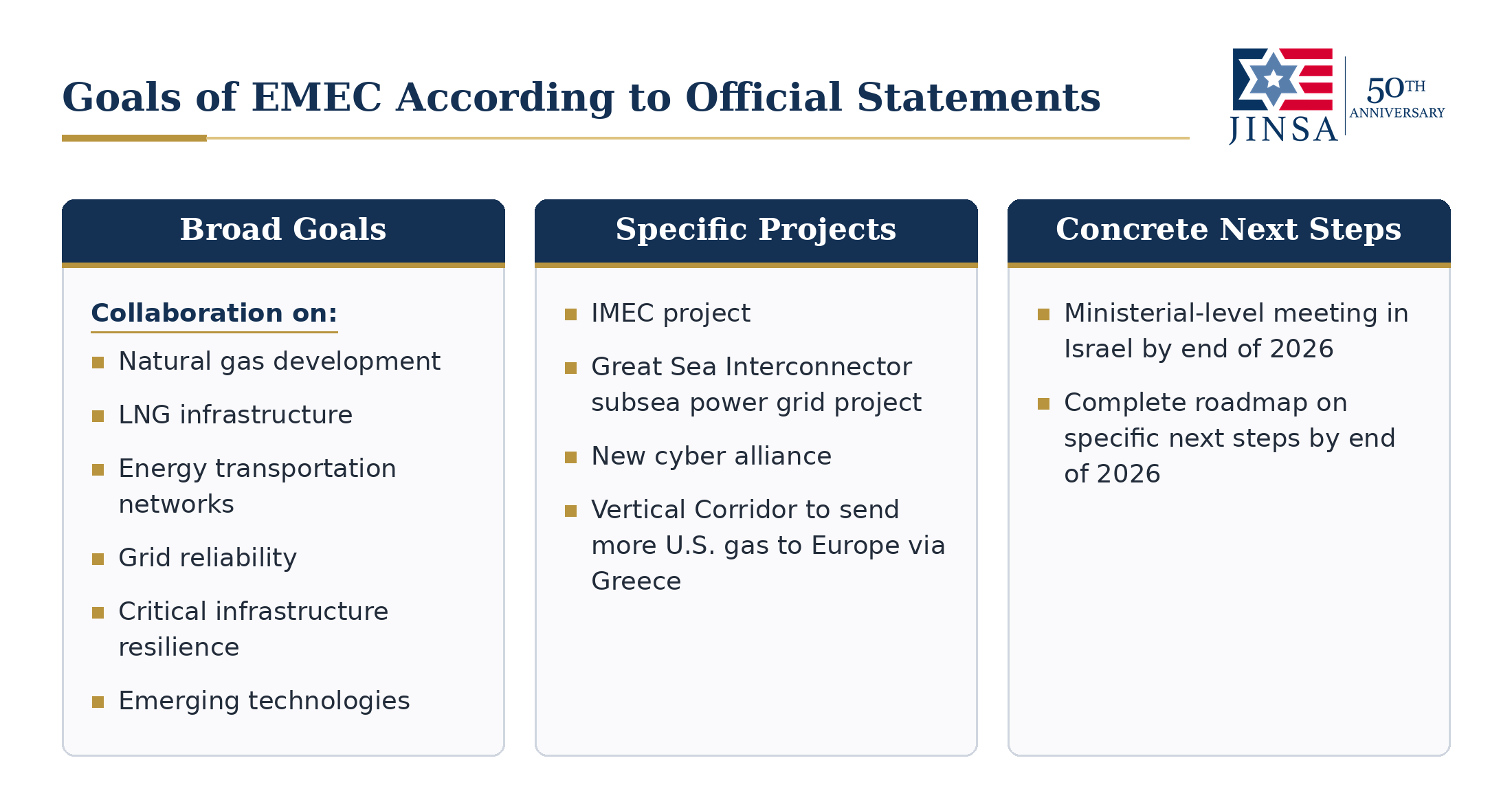
EMEC’s agenda is ambitious. According to a Department of Energy readout, the center “will support collaboration … [in] gas development, U.S. LNG infrastructure, energy transportation networks, grid reliability, critical infrastructure resilience, and emerging technologies … facilitate scientific and technical exchanges … and engagement with industry stakeholders.” Also discussed at EMEC’s launch was the Great Sea Interconnector, a proposed vast subsea electricity cable network to connect Cyprus and Israel, via Greece, with the EU electric grid and lower energy costs. EMEC represents a strong, centralized framework for collaboration among the four countries’ private and public sector energy leaders.
The potential for this new multilateral body, headquartered in the world capital of the energy industry, is considerable. Each of the four countries is slated to help anchor the India-Middle East-Europe Economic Corridor (IMEC), a planned trade and infrastructure network, with a significant energy component, forming a land-and-sea geopolitical bridge from Europe to Asia. And unlike the Eastern Mediterranean Gas Forum (EMGF), the new EMEC platform includes the biggest possible engine of regional change: the United States. With the creation of EMEC, in which America is a host and full partner, Washington is officially no longer a mere observer in the EastMed.
The Key to European Energy Security: Hiding in Plain Sight?
Momentum in the EastMed energy scene is welcome news in Europe, which has few appealing long-term options to meet its natural gas needs. Despite its pledges and efforts to wean itself off Russian energy, Europe is still consuming Russia’s natural gas in large volumes. The European Union (EU), in December 2025, formally committed to ending Russian gas imports by November 2027. Yet EU natural gas consumption still far outpaces production: imports accounted for roughly 85 percent of EU natural gas consumption in 2025. That year, Russian natural gas constituted nearly 15 percent, over 36 billion cubic meters (bcm), of the EU’s overall natural gas consumption.
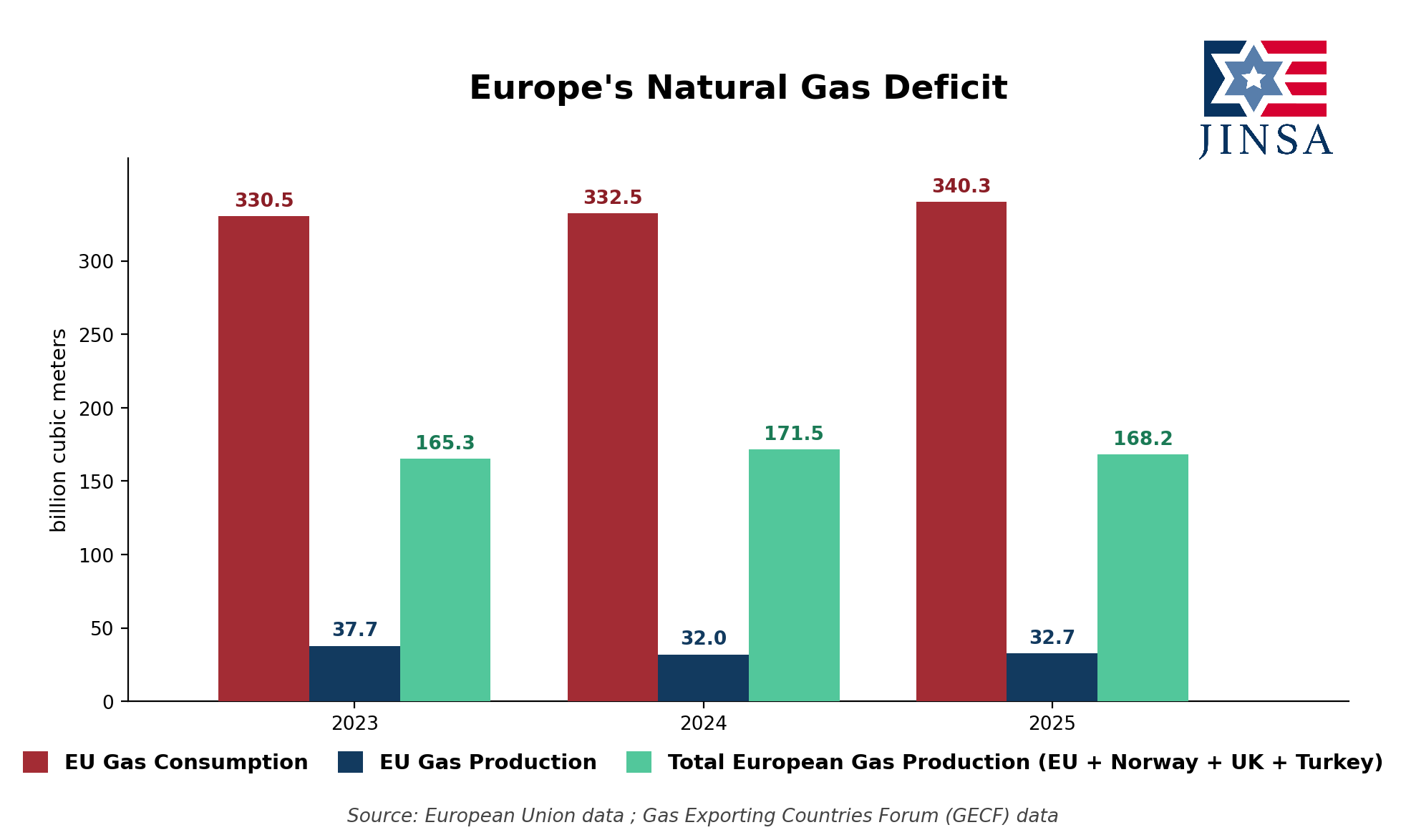
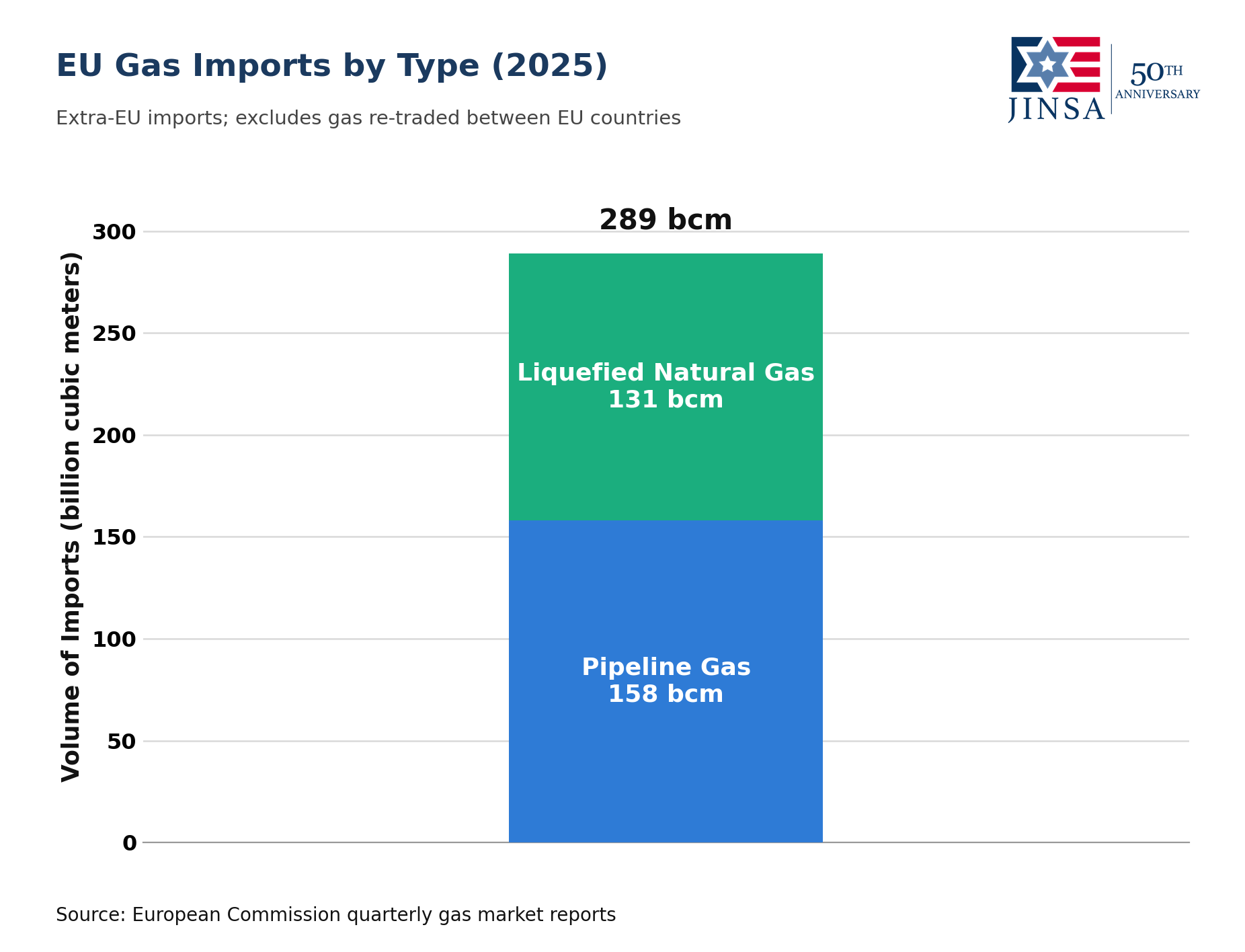
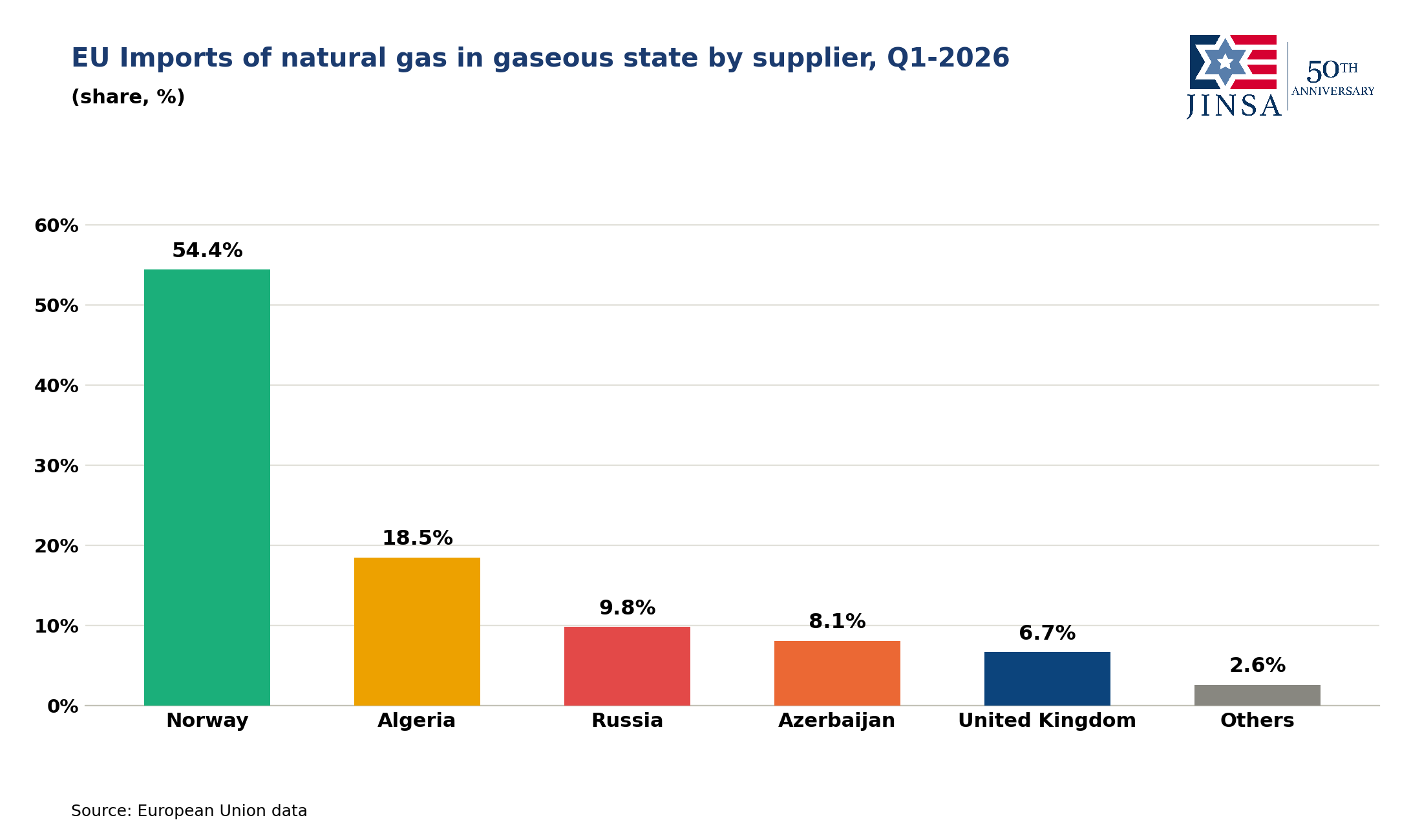
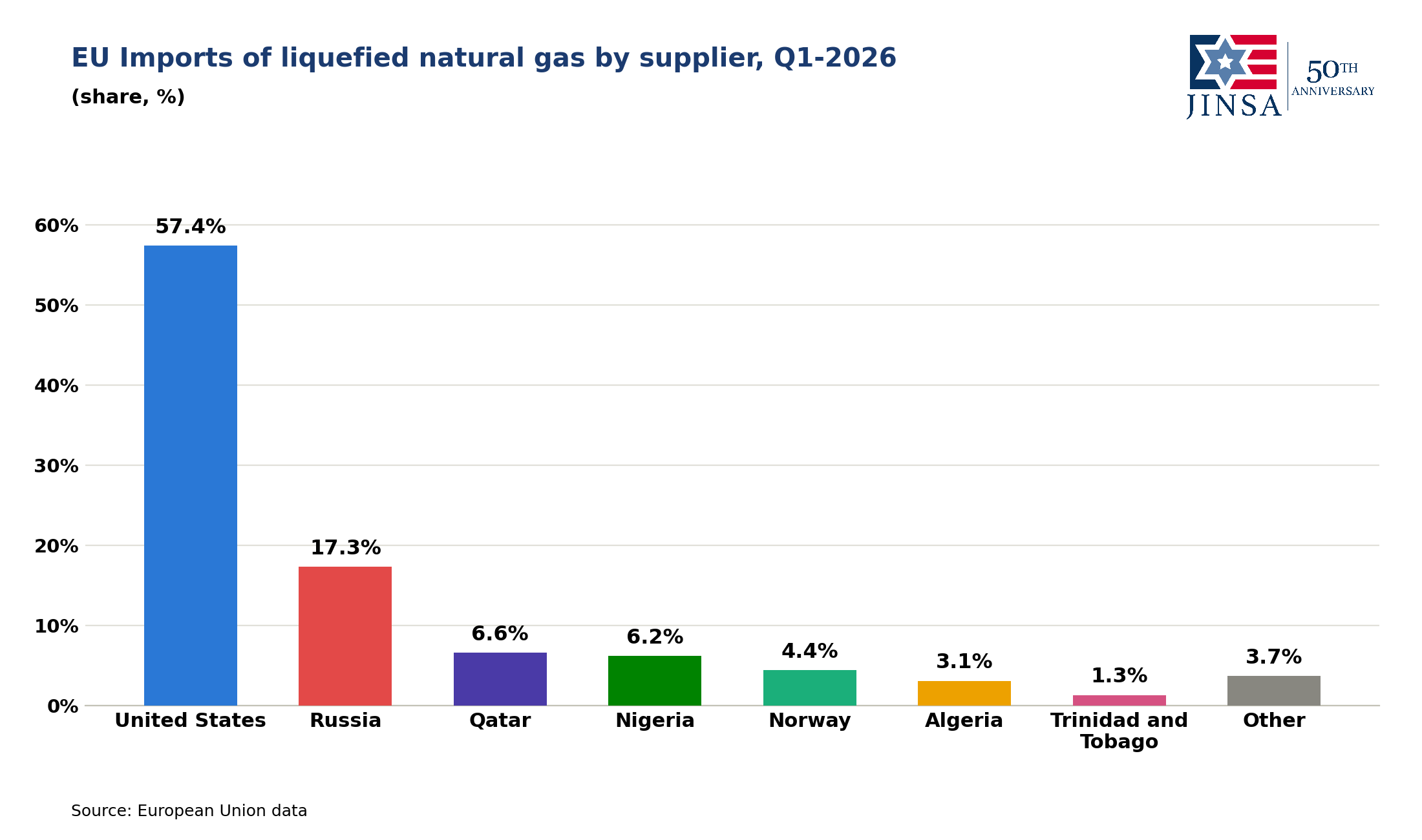
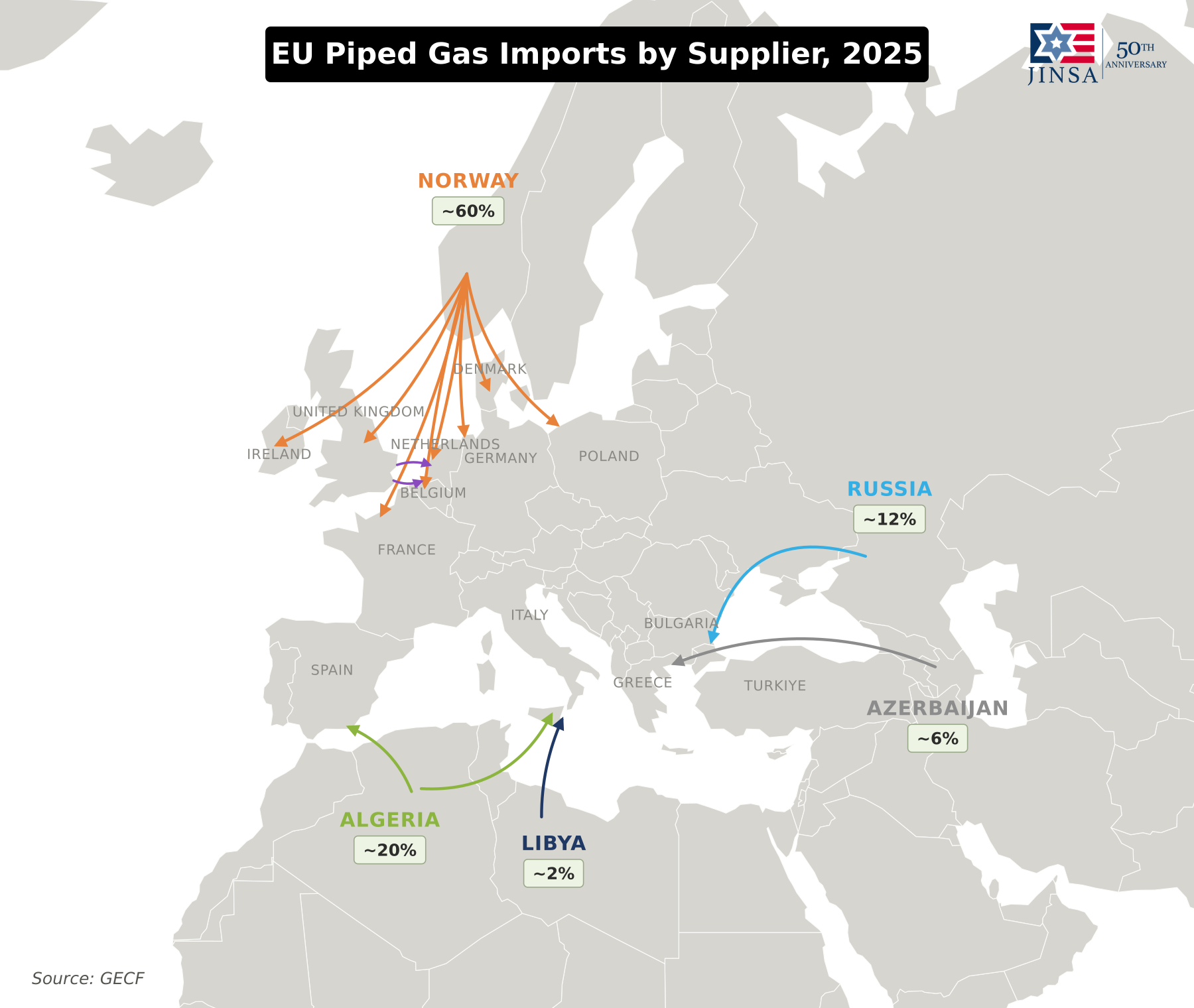
The United States is increasingly helping meet European natural gas demand—and it is one of the few countries able to do so. The two other primary nations that the EU relies on for natural gas, Algeria and Norway, face serious challenges—skyrocketing domestic demand and infrastructure problems in Algeria’s case and fast-declining natural gas output in Norway’s case—that call into question their long-term export viability. Another once-promising candidate to be Europe’s top gas supplier, Qatar, is no longer likely to fill that role. Qatari natural gas flows have proven acutely vulnerable to major long-term supply disruptions, due to Iran’s attacks on its gas infrastructure and shipping in the Strait of Hormuz. Two other potential suppliers, Egypt and Libya, are years away from being able to provide gas to Europe at scale. Despite both countries’ significant reserves, each faces massive domestic obstacles to being major gas exporters and no clear plans to overcome those challenges.
As other suppliers falter or face limits, the EastMed emerges as an obvious candidate to fill European natural gas needs. As JINSA wrote in 2021, it is “home to some of the world’s largest hydrocarbon discoveries this century,” and the region’s energy potential has only grown with the passage of time.
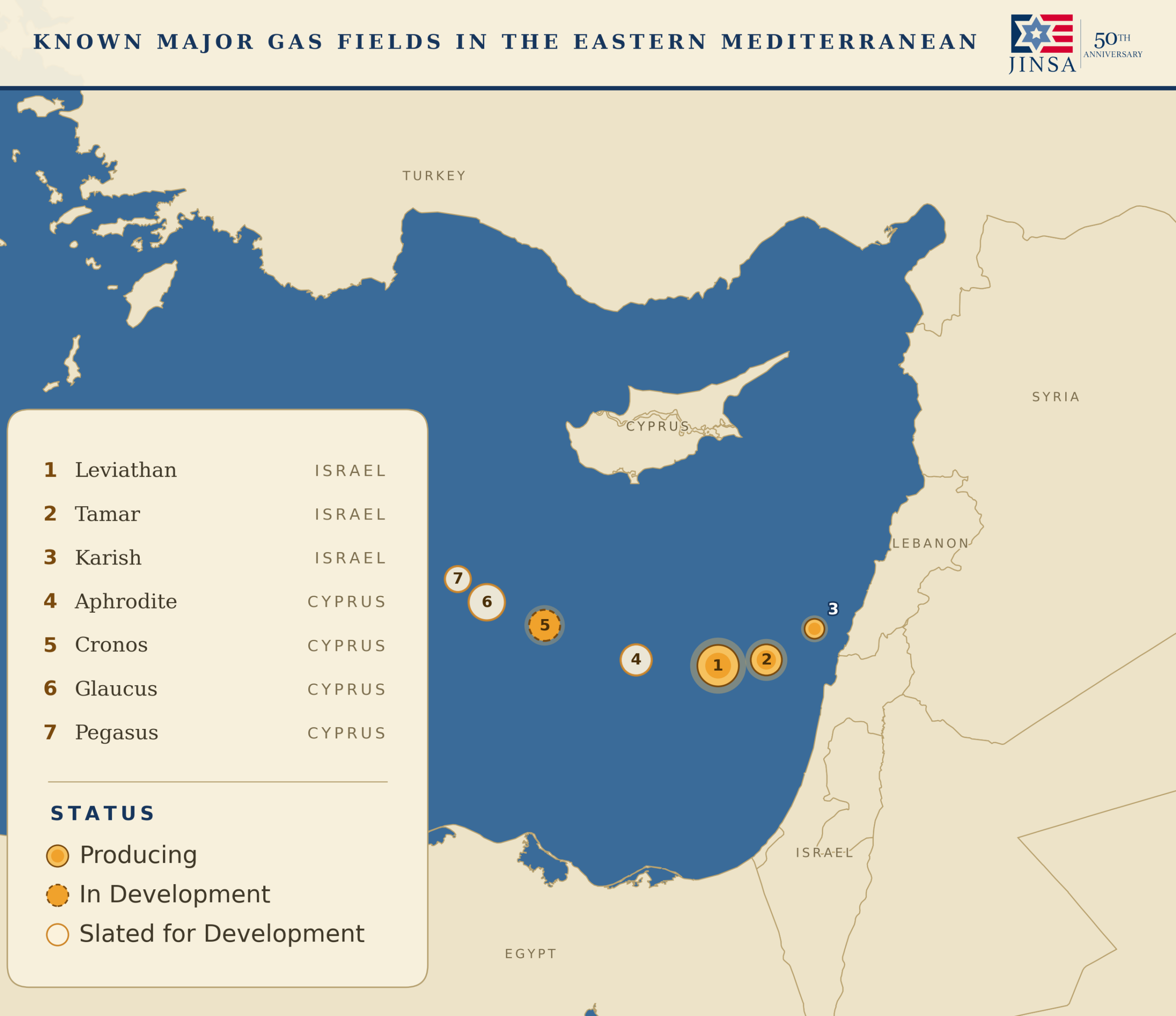
Cyprus’s energy-rich waters will soon be tapped for the first time, as the island nation plans to start producing and exporting natural gas in 2028. Its Glaucus and Pegasus offshore gas fields were recently deemed commercially viable, after the latter was discovered just months earlier. Together, the two offshore fields are estimated to hold over 8 trillion cubic feet, or over 225 bcm, of natural gas. Cyprus’s still-untapped Aphrodite and Cronos gas fields have major potential as well, containing an estimated 99.1 bcm and 96.3 bcm of natural gas respectively.
Greece, too, is emerging as a regional energy powerhouse. While Greece’s own gas reserves are untapped, that will likely change when U.S. firms begin exploratory drilling off Greece’s southern coast in 2027. Yet even without its own gas to export, at least for now, Greece is quickly becoming a central node for Western energy.
Through its LNG infrastructure and pipelines to Central and Eastern European nations (via Bulgaria), Greece is linking large volumes of U.S. natural gas to European markets. Those quantities will increase under an Athens-Washington deal taking effect in 2030. Greece currently has an LNG terminal in Revithoussa, a floating LNG terminal at Alexandroupoli—with annual capacities of 7 bcm and 5.5 bcm, respectively—and plans to construct three new LNG terminals. Greece becoming a continental gas hub, as it is poised to do, would be transformational for European consumers and markets. Interior Secretary Doug Burgum recently commented, “one ship … [of] American natural gas … can heat 200,000 German homes for a year,” and Greek natural gas infrastructure can make that a reality.
Israel, for its part, has raised its energy profile even in wartime. Thanks to its Karish, Leviathan, and Tamar gas fields, Israel is a regional gas exporter. It produced around 26.8 bcm in 2025 and exported nearly half, approximately 12.4 bcm, to Egypt and Jordan, two nations that have imported Israeli gas for years. Even during the multifront war beginning in October 2023, in which Israel faced continuous threats to its offshore energy sites, Israel attracted $1.2 billion of investment in its Katlan field; finalized a $2.3 billion deal to increase gas yield capacity; reached a $35 billion gas supply deal with Egypt; and recorded a record-high annual gas output, which it is set to surpass again.
There are other promising prospects on the horizon for Israel’s energy sector. Israel, in July 2026, began exploration efforts in five offshore blocks where an estimated 200 bcm of natural gas is still untapped. This project has attracted interest from major energy firms, including ExxonMobil. Israel has also explored building a floating LNG terminal to increase export volume. A proposed, but since stalled, gas pipeline to Europe may also be back on the table.
The European Pipe Dream: Was the Iran War a Wake-Up Call?
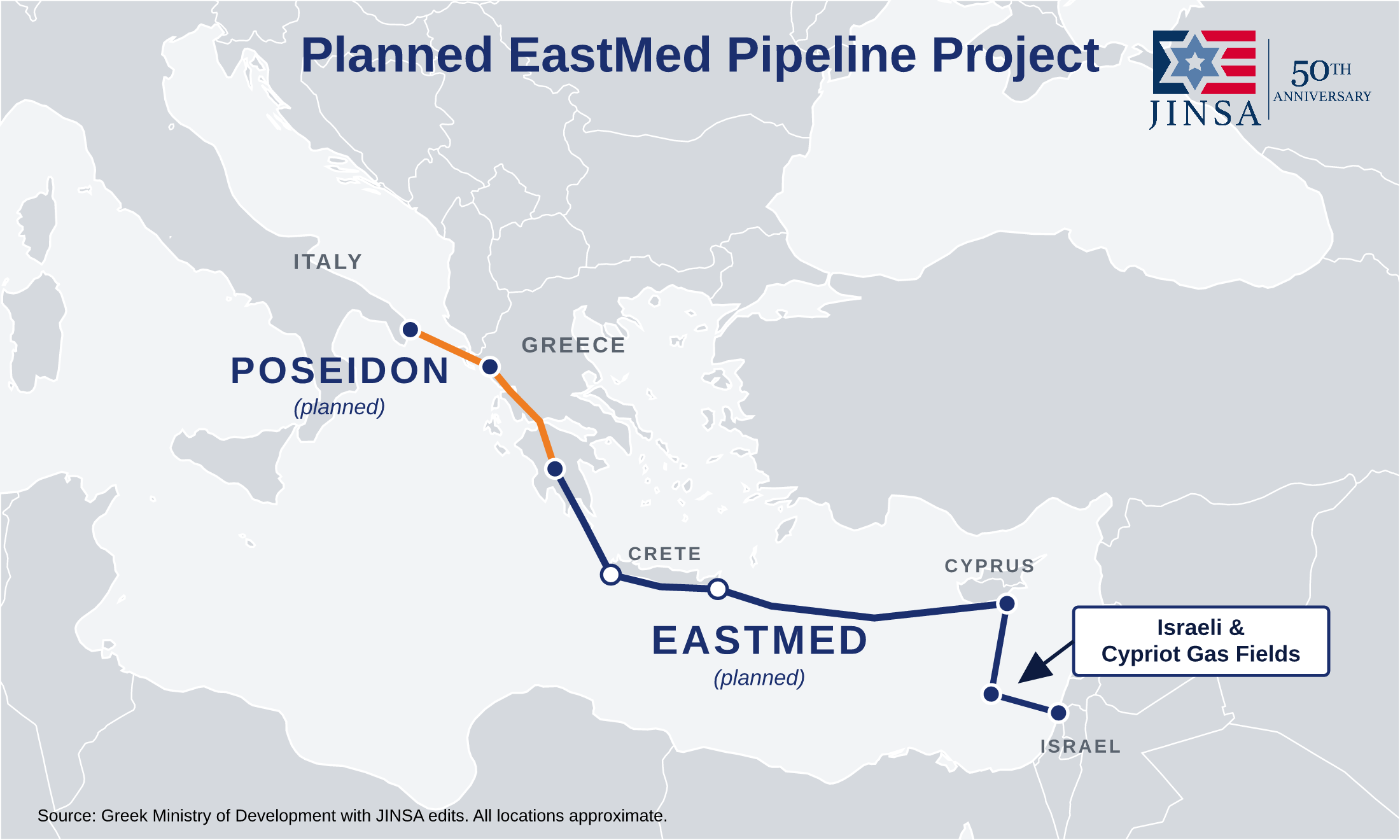
The previously shelved EastMed pipeline concept is now being revived, for good reason. The pipeline, first discussed in 2012, would link Cypriot and Israeli offshore gas to Greece, where it would be consumed domestically but also piped to other European nations. However, the pipeline project was put on hold, largely due to American opposition, in January 2022. Now, however, with the creation of EMEC—providing customized technical research, an established platform for government and industry engagement, and more—and growing U.S. interest, the project’s necessary conditions may be in place.
Part of why the EastMed project has yet to materialize is Washington’s role. In January 2022, the Biden administration reversed prior U.S. support for the initiative, citing three reasons for doing so: lack of commercial viability; environmental concerns; and the potential for increased regional tensions, referencing Turkish resistance to the project. Now, these are no longer—if they ever were—good reasons to withhold U.S. backing.
First, several developments suggest the project’s economic upside has increased since 2022. These include subsequent gas discoveries in Cypriot waters; new exploration projects in Greek and Israeli waters; rising worldwide freight costs; and all three countries’ efforts to expand their LNG infrastructure to boost competitiveness.
Second, the environmental logic of halting new gas projects is dubious. The environmental damage caused by burning coal far exceeds that of natural gas. Yet in the absence of reliable gas supply, Germany and Italy have paused or reversed coal restrictions, and European coal imports are steadily increasing.
Third, U.S. geopolitical concerns about the proposed pipeline, namely that it would antagonize an otherwise flexible Turkey, have aged poorly. America’s rejection of the project did not reduce Turkish aggression—it increased it. Turkish incursions into Greek airspace jumped by over 300 percent in 2022, setting a single-year record. In the air and at sea, Turkey has continued its confrontational behavior. Turkey has also begun building its own natural gas pipeline to northern Cyprus, to be completed in 2028, which risks additional regional friction and potential crises.
The good news is that the United States now recognizes the virtues of Europe drawing on EastMed energy. After a November 2025 meeting with U.S., Cypriot, and Greek counterparts, Israeli Energy Minister Eli Cohen said the EastMed pipeline concept is “back in play,” described “very significant progress” on multilateral discussions, and added that “the Americans are now willing to take on a major role.” While the pipeline may emerge through piecemeal efforts, not as a single overarching project, it would still have the same result: Cypriot and Israeli natural gas being piped to European markets. A proposed high-capacity Cypriot-Israeli gas pipeline advanced to a final decision phase in November 2025 but was delayed by the Iran war’s outbreak in February 2026. The Greek-Cypriot segment is also back under discussion by regional leaders.
Next Steps to Strengthen the EastMed Energy Axis
Washington’s next regional moves will determine whether momentum in the EastMed speeds up or stalls. To solidify the EastMed region as a strategic anchor for U.S. interests, three broad American policy efforts are required.
Ensure EastMed Policy Doesn’t Fall Through the Bureaucratic Cracks
U.S. political capital is required to actualize the EastMed’s energy potential. The EastMed’s important geostrategic perch at the crossroads of Europe, Asia, North Africa, and the Middle East has, ironically, often caused the region to fall through bureaucratic cracks in Washington. The United States should create a special envoy for the EastMed to sustain and synchronize policy efforts across departments. In addition, Washington should consider—as France and Italy have done—appointing a special envoy for the IMEC project, in which the EastMed will play a key role. Finally, Congress should fulfill its oversight functions by requesting reports from the Departments of Energy and State detailing their EastMed policy efforts and objectives.
Mobilize Targeted Funding to Maximize EastMed Energy Potential
To accelerate the industry efforts already underway, American leaders should marshal financial and logistical support for EastMed energy connectivity projects, which can be done at low expense to U.S. taxpayers. Washington can utilize policy tools like the U.S. International Development Finance Corporation (DFC), a federal agency that leverages public-private efforts on strategic projects, to limit governmental expenditures but still achieve tangible results. The Trump administration is reportedly considering giving the DFC a role in funding a potential new floating LNG terminal in Greece’s Alexandroupoli port. If that occurs, it will represent a promising step that Washington should build on.
Stop Disruptive Actors From Playing Spoiler
To unlock the EastMed’s full energy potential, Washington will need to take a firm stance against Turkish coercive behavior in the Mediterranean. Pipeline projects and offshore gas fields are becoming geopolitical flashpoints between Turkey and its neighbors. Turkey’s intimidation tactics, including its repeated naval harassment of Cypriot and Greek energy exploration vessels, risk jeopardizing the EastMed’s stability and energy reserves. To avoid this, Washington should explicitly link its willingness to help or punish Ankara to Turkish behavior in the EastMed. Turkey remains keenly interested in American defense technology and energy investment, among other points of U.S. leverage. Washington has an interest not only in preventing outright conflict in the Mediterranean, but also in upholding principles of dialogue, territorial integrity, and the rule of law in a strategically vital region. That is U.S. policy toward the South China Sea, the Taiwan Strait, and Ukraine, and it should be how Washington approaches the EastMed region, too. Unlocking the full potential of the Cyprus-Greece-Israel geopolitical axis, a clear U.S. interest, depends on it.
Click here to download the analysis.