Dismantling UNRWA: What’s Needed Now?
Click here to download the JINSA Insight
The United Nations Relief and Works Agency for Palestine Refugees in the Near East (UNRWA) is facing an existential crisis—or so its leader, UNRWA Commissioner-General Christian Saunders, claimed on June 30. There is good reason both to hope that is true, and doubt that it is. The boy-who-cried-wolf routine is a familiar one for the Hamas-penetrated UN agency, which has overcome any and all challenges to its survival. In fact, despite overwhelming evidence it has been systematically co-opted by Hamas, UNRWA raised over $300 million this year from foreign donors and continues to operate in Gaza. The ongoing U.S. funding freeze has not stopped UNRWA. Neither has the Trump administration’s declaration in August 2025 that it seeks to dismantle the agency.
A new, hopeful paradigm for the Gaza Strip could become reality—thanks to the creation of the U.S.-led Board of Peace and Hamas’s weakness—so long as UNRWA is not part of it. UNRWA’s humanitarian functions in Gaza can be carried out by other entities, and indeed, already are. Currently, excluding UNRWA, there are nearly a dozen UN aid agencies and 34 charities operating inside Gaza in coordination with Israel, doing the work UNRWA was supposed to be doing.
For Gaza to have a constructive future, and one that does not endanger Israel or empower Hamas, UNRWA must be removed from day-to-day life in Gaza. That will not happen organically—it requires a U.S. plan and its successful execution. The United States needs a concrete roadmap to dissolve and replace UNRWA—in practice, if not law—for good.
Nine Lives of UNRWA: The UN’s Zombie Agency
According to UN leaders, UNRWA is always on life support. During a June 30 speech, UN Secretary-General Antonio Guterres warned that UNRWA is now hitting a “breaking point.” Guterres said the same thing in 2023 and 2018. In July, UNRWA Commissioner-General Christian Saunders said that “the viability of our operations … is at stake.” His predecessor, Philippe Lazzarini, similarly warned in March that UNRWA “may soon cease to exist,” echoing his 2023 claim that UNRWA would soon “be unable to maintain operations.” Preceding that, in 2022, Lazzarini said UNRWA was “at risk of collapsing like a house of cards.” That house of cards, as it turns out, is remarkably sturdy – UNRWA’s magic trick is that it never disappears.
UNRWA has survived near-death experiences for decades despite the fact that, when it was established 77 years ago, its creators intended it to have a short lifespan. UNRWA’s 1949 founding charter, UN General Assembly Resolution 302, specified that the new agency was to have a narrow mandate—coordinating aid efforts for Palestinian refugees of the 1948 Arab-Israeli war—and transitory nature. UNGA Resolution 302 stated that UNRWA’s operations should be conducted “…with a view to the termination of international assistance for relief … and that direct relief should be terminated not later than 31 December 1950 unless otherwise determined by the General Assembly.”
Nearly 80 years later, UNRWA remains in operation, despite having achieved little for Palestinian civilians and much for Palestinian terrorists. UNRWA leaders often cite the agency’s very existence as evidence of its importance, as Lazzarini did in 2025, saying that “UNRWA was always intended to be a temporary agency—that it continues to exist, and to be needed, reflects long-term failures to reach a political solution.” In fact, its existence only reflects a long-term failure by the Western world to terminate UNRWA.
American Funding to UNRWA
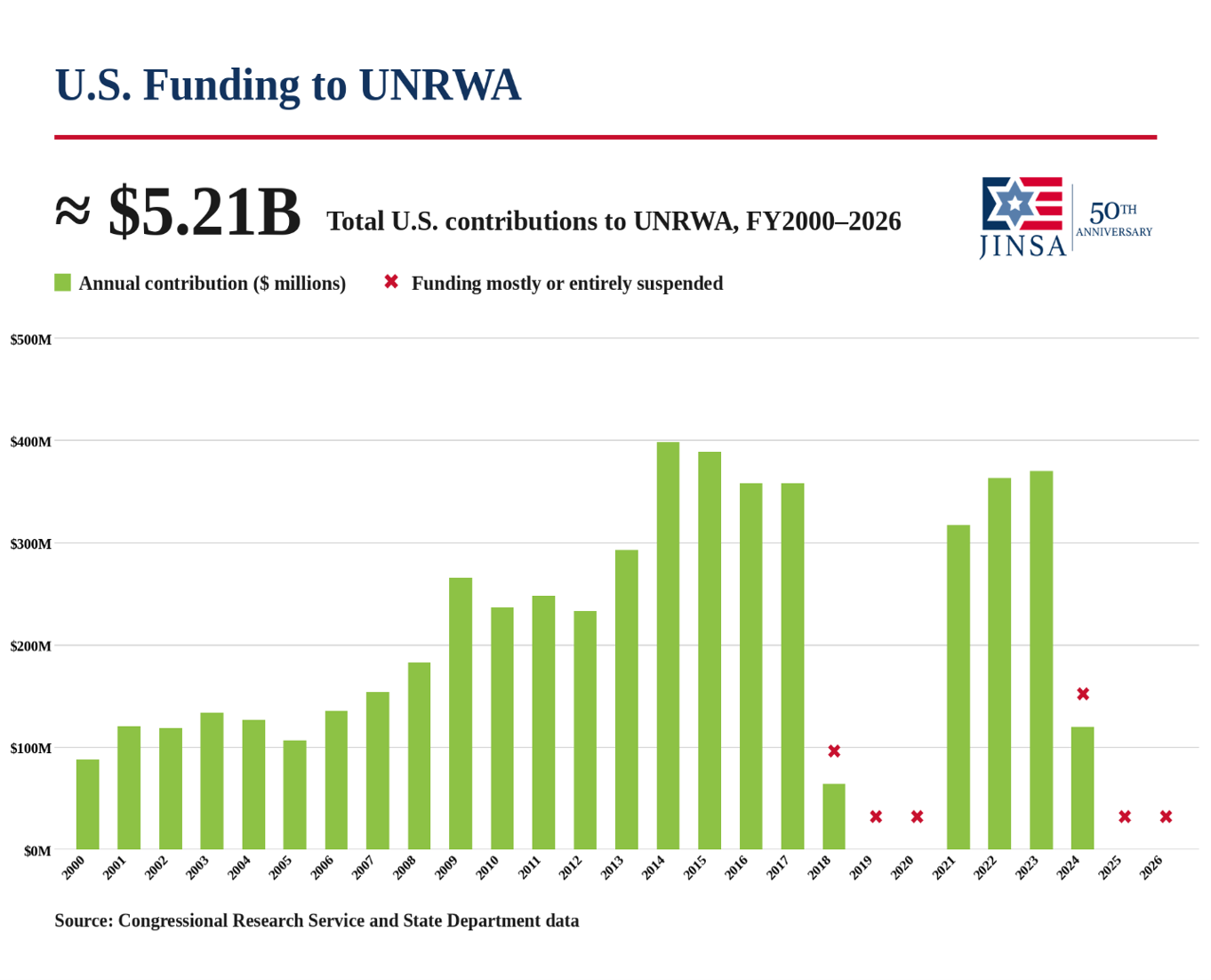
The more than $5.2 billion the United States has provided to UNRWA in the 21st century has not been money well spent. UNRWA’s Gaza operations have been characterized by inefficiency, corruption, and indoctrination of Palestinian youth in its radical schools.
The Cost of Giving UNRWA a Free Pass
UNRWA has escaped accountability for its threat to regional stability, Israeli security, and Gazan civilians’ well-being. The so-called aid agency has spent years giving metaphorical and physical cover to Palestinian terrorists, many of whom have infiltrated UNRWA’s ranks.
The revelation that a dozen UNRWA personnel participated in Hamas’s October 7 massacre was shocking but not surprising. Hamas’s main intelligence hub in Gaza under UNRWA’s headquarters is the perfect metaphor for how UNRWA aids and shields Hamas. In addition, Hamas, in the Gaza war, was actively overseeing UNRWA’s operations—including its aid distribution. That crooked relationship enabled Hamas operatives to steal, according to intelligence estimates, over $500 million worth of aid in the Gaza war’s early months. That dynamic is nothing new.
UNRWA’s terror links were brought to global attention by the October 7, 2023, massacre in which many of its personnel participated. At least nine UNRWA staffers entered Israel during the attack, including two who were Hamas operatives, and dozens of other UNRWA personnel played an indirect role.
Yet UNRWA’s October 7 involvement, as shocking as it was, was not an isolated event. UNRWA sites and vehicles have facilitated terror activity since 2002, most notably aiding Hamas in the 2014 and 2021 Gaza wars—serving as staging grounds for attacks on Israeli soldiers and fitted with Hamas tunnel shafts.
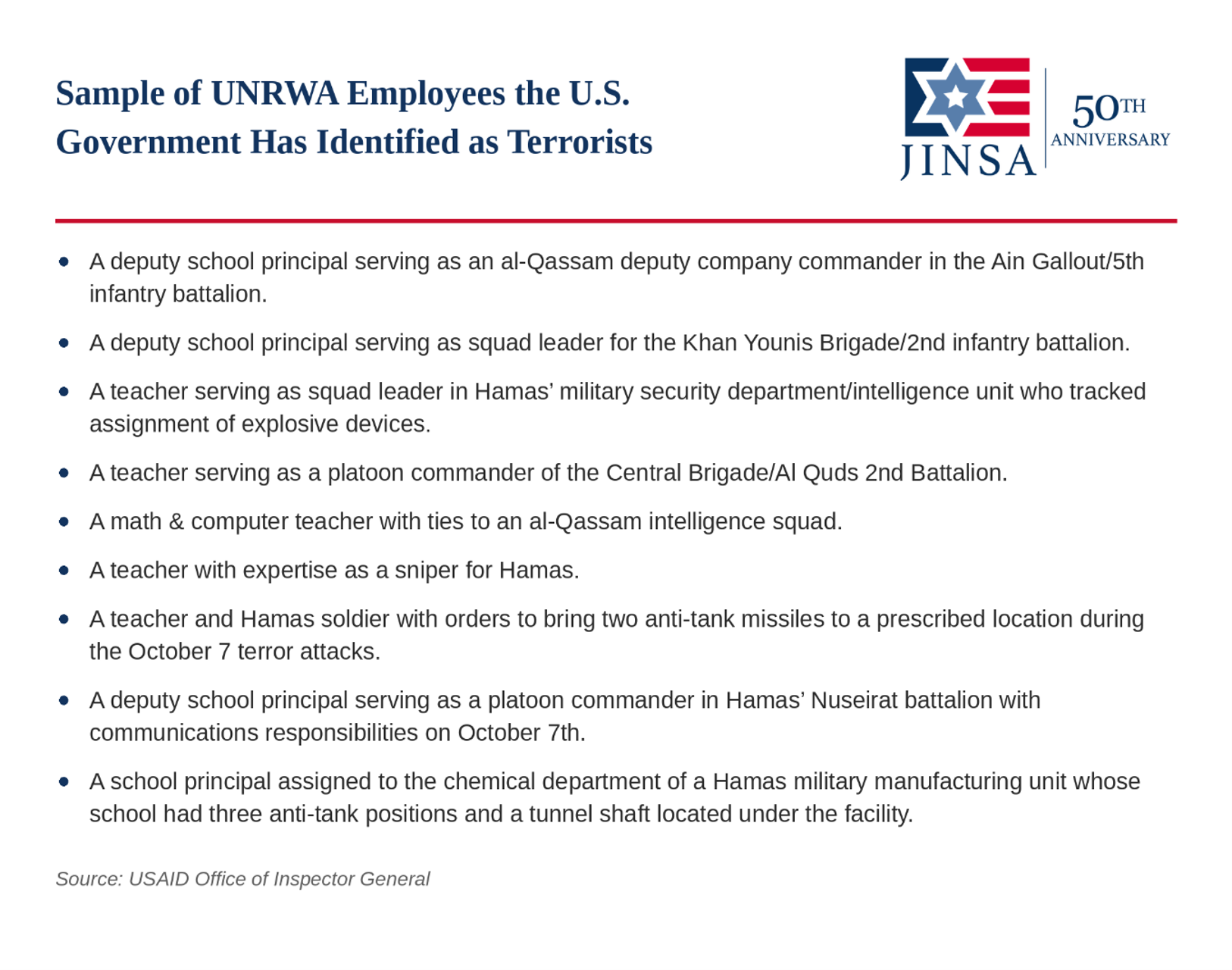
UNRWA’s proponents argue it has been tarred by a few bad apples that do not represent the agency, but this claim rings hollow. According to intelligence estimates, around half of UNRWA’s roughly 12,000 Gaza employees have family members with terror ties, and over 1,000 more are under U.S. investigation for alleged terrorist activity. Israel has identified over 1,450 UNRWA personnel who are active terror operatives, and according to some estimates, over 9,500 UNRWA personnel have direct connections to Hamas. If so, terror ties are the rule and not the exception for UNRWA’s Gaza staffers.
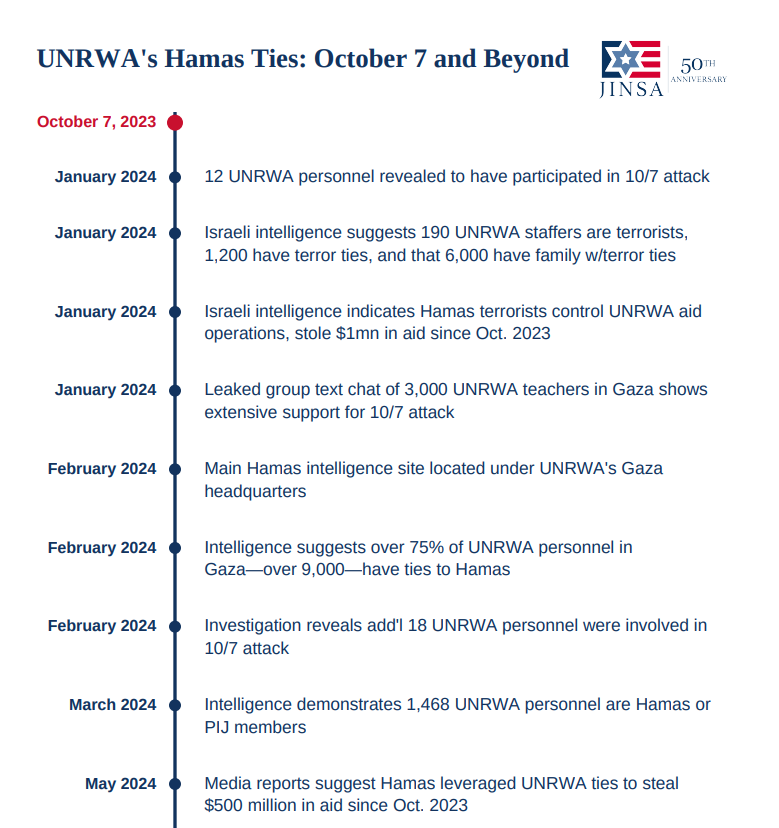
Click here to view a higher-resolution version.
Others argue that UNRWA simply needs to be reformed, yet the agency itself does not even make this claim. No senior UN or UNRWA officials, at any point, have admitted any widespread problem with the agency. The UN’s website still describes allegations of UNRWA staffers’ role in the October 7 attack as “disinformation.” The result of that implausible deniability is that UNRWA has taken few, and mostly cosmetic, steps to reform itself since the October 7 attack. This, despite being given a playbook for reforms by the UN-commissioned Colonna Report. Even after two years, UNRWA failed to implement the systemic reforms that the Colonna Report laid out in April 2024. The agency terminated 70 of its Gaza personnel in June for having ties to Hamas, and previously fired 23 UNRWA staffers in 2024 over their involvement in the October 7 attack. Yet UNRWA has yet to terminate many dozens, if not hundreds, of staffers whom Israeli intelligence identified over two years ago as having terror links.
With a track record like this, UNRWA’s very existence seems improbable. However, UNRWA has thus far proven capable of surviving major scandals and securing funding from much of the Western world. While many European countries stopped providing funds to UNRWA in 2024, after the revelations of its terror ties came to light, most have since resumed funding the agency.
After UNRWA
Fortunately, UNRWA is by no means irreplaceable when it comes to humanitarian functions in Gaza, as the world can now see. Many organizations are already on the ground in Gaza doing the work UNRWA was supposed to be doing—and have been doing so for months. Currently, excluding UNRWA, there are 10 UN aid agencies and 34 charities operating inside Gaza, with Israeli approval.
The non-UNRWA aid model is already proving effective at meeting the basic food needs of Gazans. When Israel, in January 2025, banned UNRWA from operating inside its borders, many predicted humanitarian catastrophes in Gaza would ensue. One U.S. senator claimed UNRWA’s efforts “cannot simply be replicated or replaced quickly” and would jeopardize the “basic needs of Palestinian civilians.” That has proven false, and since then, UNRWA has been shown to be expendable. In the nine months following the October 2025 ceasefire, over 1.78 million tons of food entered Gaza, far exceeding the UN’s per-person food requirements for the population. The majority, nearly 80 percent, was provided by NGOs and private industry, not by any UN agency, and certainly not by UNRWA. In that timespan, UN agencies supplied a total of six percent of all food entering the Gaza Strip.
UNRWA’s education functions, too, can be replaced by other entities—who almost certainly will do a better job than UNRWA has. UNRWA’s Gaza school system has done a dismal job teaching students reading, writing, and mathematics. According to UN statistics from 2007, 75 percent of UNRWA students in grades 4-9 failed mathematics, and 40 percent of them failed Arabic, their native language. The fact that UNRWA has not, since 2010, released educational attainment data on its Gazan schools shows how transparent UNRWA is: not at all. UNRWA’s schools are good, though, at indoctrinating students with radical views. Gaza’s education system is far better served by being handed to Board of Peace-backed non-governmental organizations (NGOs), at least temporarily, and staffed with vetted, moderate teachers from the Gaza Strip or elsewhere.
While UNRWA cannot technically be dissolved without a two-thirds majority vote from the United Nations General Assembly, which is unlikely to happen, it can be de facto dismantled as an operational entity. Doing so would require little more than restricting UNRWA’s ability to operate in Gaza—as Israel, with U.S. backing, has done—and the United States and its partners terminating funding to the agency. UNRWA only receives about 5 percent of its total funding from the UN regular budget, with most of its funds coming from America’s partners in Europe.
Current U.S. executive branch and legislative branch measures to stop American funding of UNRWA are temporary, not permanent, fixes. Executive Order 14199 blocking the United States from providing funds to UNRWA, and congressional appropriations doing the same, can both be reversed by future administrations or lawmakers—as occurred in 2021. The same can happen again unless permanent American funding freezes are written into law, or unless the United States, in practice, dismantles UNRWA.
Now, though, the seemingly indestructible UNRWA is facing a real challenge to its survival. Namely, U.S. leadership that is determined to pull the plug on the agency and replace it with something better. In August 2025, the Trump administration, for the first time, made it official U.S. policy to pursue UNRWA’s dismantlement, not just ending U.S. funding.
Washington may yet achieve that goal. On July 1, the U.S.-led Board of Peace made clear that it opposes UNRWA playing a role in Gaza’s future. Later that month, lawmakers introduced a bill that would require the Secretary of State to lay out a plan for dissolving UNRWA in Gaza and identifying and empowering replacements.
To truly deal a fatal blow to UNRWA, though, the United States will have to convince its partners to stop bankrolling it, and instead, identify and fund a replacement. There are signs this process has already begun. Earlier this month, the European Commission and another 15 countries, with the European Investment Bank and World Bank, pledged $1 billion to Gaza’s reconstruction, though to a new entity called the Team Gaza Initiative (TGI) and not, seemingly, through UNRWA channels.
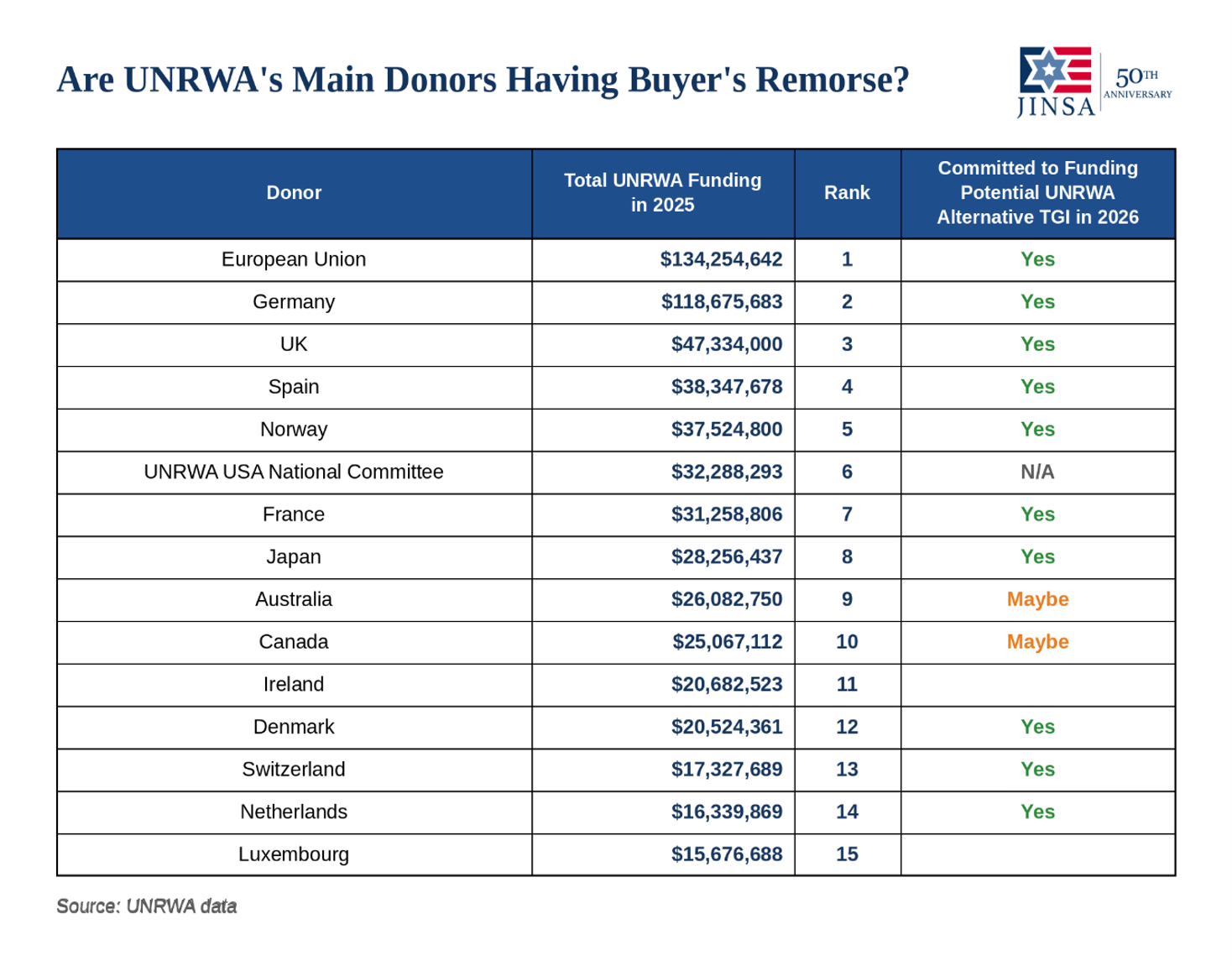
TGI is a promising potential mechanism for phasing out UNRWA. According to an official readout, TGI is linked to UN Security Council Resolution 2803, which established the U.S.-led Board of Peace in November 2025 following the ceasefire. Promisingly, the 15 countries pledging include each of the six largest governmental donors to UNRWA in 2025 and UNRWA’s largest funder, the European Union (EU). Two other top UNRWA donors, Australia and Canada, reportedly will also join TGI in the weeks ahead.
There are other positive signs that Europe is open to shifting away from UNRWA and towards a new framework for Gaza aid. Last October, more than 20 members of the European Parliament, from 16 countries, requested that the EU stop funding UNRWA. Germany, UNRWA’s largest governmental donor in 2025, is now considering suspending its funding and calling on the EU to do the same. If that occurs, it would deal UNRWA a major blow. Sweden, historically one of UNRWA’s largest donors, permanently suspended its aid to UNRWA in 2024 and diverted the funds to other aid groups in Gaza. The United States should encourage other partners to follow suit.
Ultimately, UNRWA is not just an organization with a few bad apples; it is a poisonous apple tree, and one that has been watered by Western taxpayer dollars. For the first time in history, the United States has a real chance to uproot it.
Click here to download the Insight.