From Cairo, Xi Jinping Touts New Middle East Order
Click here to download the JINSA Insight
Chinese President Xi Jinping traveled to Cairo on September 1, his first Middle East trip in nearly four years. The visit commemorated the 70th anniversary of Egypt becoming the first Arab country to recognize the People’s Republic of China (PRC), and it came in the closing days of a major Egypt-China joint air force exercise, Eagles of Civilization 2026, the two countries’ second in as many years. During the visit, Xi pledged to build up Egyptian data center and semiconductor capacity, mineral supply chains, and more. Beyond its commercial interests in Egypt, China seeks to make America feel it is losing a Middle East partner.
Egypt’s calculus is more complex. As a decades-long close American partner—the frequent host of multilateral U.S. military exercises, a leading recipient of U.S. defense aid, and a regular buyer of advanced U.S. weapons systems—Egypt should not have any interest in drifting away from Washington and towards Beijing. Yet Cairo has dusted off its Cold War hedging playbook.
Through the 1960s, and 1970s, Egypt played the Soviet Union and the United States off one another to receive concessions from each in exchange for its loyalty. Cairo is doing the same thing now, using Xi’s high-profile visit to get U.S. attention—and ideally more concessions.
The U.S. response should be to deny Cairo what it seems to want: American leaders panicking and providing generous concessions to Egypt, thereby rewarding Egypt’s highly choreographed outreach to Beijing and incentivizing further hedging.
China’s Pursuit of Strategic Gains in Egypt
Egyptian President Abdel Fattah el-Sisi rolled out the red carpet—literally—for Chinese President Xi Jinping. Xi championed a “new security architecture for the Middle East,” one without “external interference”—a message clearly directed at Egypt’s longtime patron, the United States.
In tandem, China secured deals with Egypt to expand cooperation on defense and counterterrorism; artificial intelligence (AI), data centers, and semiconductors; critical minerals; currency exchanges; and expanded industrial projects along the strategic Suez Canal. Days before Xi’s visit to Cairo, China’s Huawei offered to provide Egypt with 2,000 advanced AI chips. The two leaders also agreed to increase Egyptian use of China’s currency, the yuan. Bilateral annual trade now exceeds $20 billion, and Egypt denominating these billions of dollars’ worth of payments in yuan would significantly boost the yuan’s value in global markets.
The Chinese Defense Laboratory on the Mediterranean
There is more, however, to the expanding China-Egypt partnership than Xi’s trip to Cairo. For one, the visit was clearly intended to draw attention to the Chinese-Egyptian joint air force exercise, Eagles of Civilization 2026, which concluded that week.
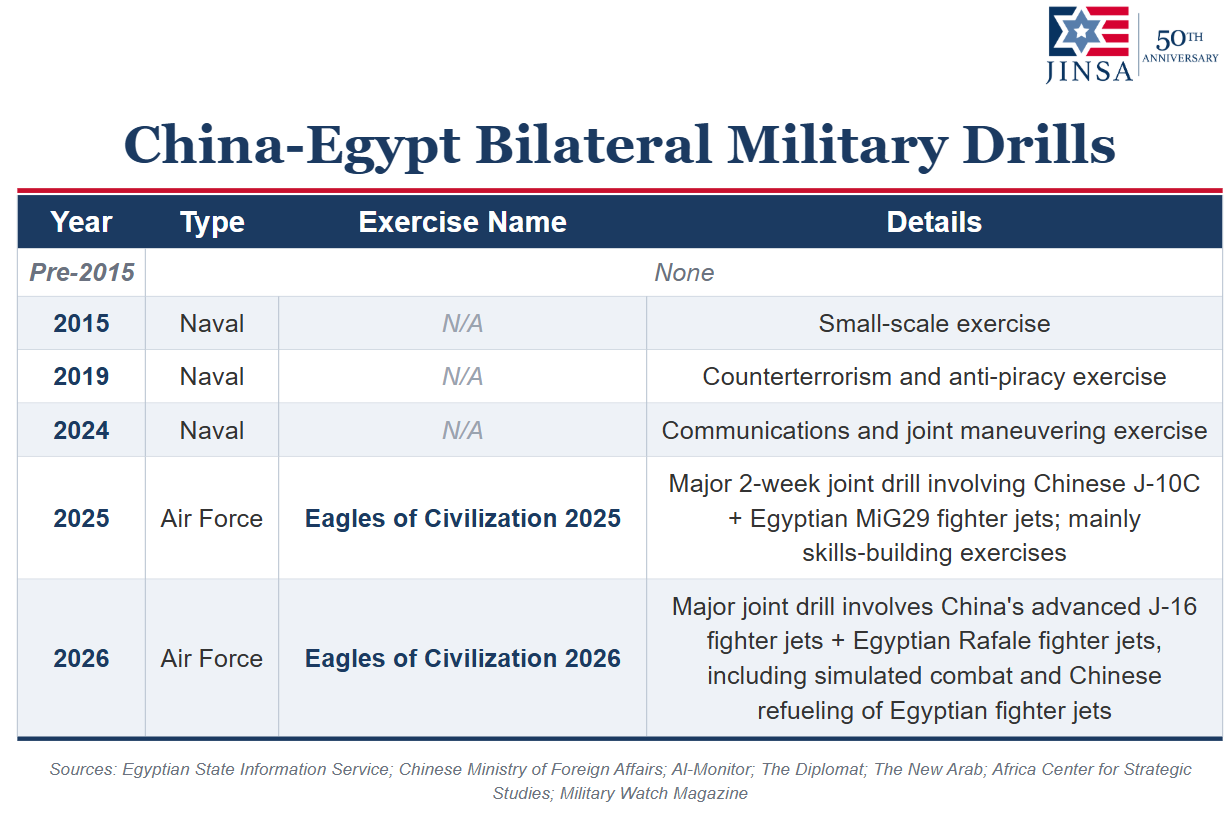
Like the countries’ joint April 2025 air force drill—China’s first in the Middle East—and the 2024 naval drill preceding it, the exercises advertise Chinese capabilities and global reach. Through the bilateral drills with Egypt, China did more than just flex its muscles in the Middle East—it gained five significant tactical or strategic benefits.
One, China’s People’s Liberation Army Air Force (PLAAF) practiced cross-continental power projection and long-distance aerial refueling. For the joint exercise, the PLAAF sent six J-16 fighter jets and other aircraft on the over 3,000-mile journey to Egypt—requiring mid-flight aerial refueling and long-range logistics planning. China’s only overseas military base, in Djibouti, currently cannot accommodate PLAAF fighter jets. Now, however, thanks to Egypt, the Chinese military has gained rare and valuable experience projecting power halfway around the world.
Two, the joint drill reportedly involved China refueling Egypt’s Western-made aircraft, showcasing a key Chinese tactical ability. It highlighted China’s intimate knowledge of U.S. partner fighter jets, and a capacity to retrofit Chinese technology to interface with Western military aircraft.
In the joint air force exercise, according to the Egyptian military, China’s YY-20 aerial tankers refueled the Egyptian Air Force’s Rafale, a Western fighter aircraft—one produced by U.S. ally France; flown by U.S. partner India; sought by U.S. partner Taiwan; and built to North Atlantic Treaty Organization (NATO) specifications. That likely gave China insight into the refueling hardware and procedures of the United States and its partners. Beijing may also have wanted to signal its own utility and global reach in response to frequent U.S.-Israeli aerial refueling during the Iran war.
Three, the PLAAF was able to simulate aerial combat against the United States and its partners, chiefly Taiwan, thanks to Egypt’s sizable fleet of Western-made fighter jets. During the recent joint exercise, the PLAAF actively drilled its prized J-16 fighter jets against the Rafale fighter, which India operates and which Taiwan seeks to acquire. In addition, both the Egyptian and Taiwanese militaries fly the F-16 and the Mirage fighters, albeit different variants, and F-16s make up nearly half of Taiwan’s fighter jet fleet.
Four, China gained an opportunity—though it is unclear if it took advantage of it—to examine advanced American defense items in Egypt’s possession, including U.S. fighter jets, with or without Egyptian consent. In past visits to Egypt, Chinese defense officials reportedly inspected U.S.-made F-16 fighter jets with Egyptian military permission. It is plausible that Egyptian officials did so again, or that China covertly extracted sensitive data about Western platforms without Egypt’s consent, during the recent exercise.
Five, by exhibiting a major air force presence in Egypt, China was able to send a menacing signal to neighboring Israel. For its part, Israel is reportedly expanding defense cooperation with Taiwan, a relationship which China has openly criticized.
During Xi’s visit, and as the Chinese and Egyptian air forces drilled together, the two leaders issued a joint statement criticizing Israeli policies in the West Bank. That all seems a deliberate signal, and one that aims to deter further Taiwanese-Israeli strategic cooperation. Reportedly, Taipei and Jerusalem have recently held high-level meetings and are working together to develop Taiwan’s air defense architecture. The PLA flying fighter jets in Egyptian skies near Israel’s border is likely Chinese deterrent messaging to Israel: militarily assist our neighbor, and we’ll do the same to you.
Egypt’s Seeming Calculus: Reopening the Hedging Playbook
Hedging between great powers is nothing new to Egypt. Throughout the Cold War, Egypt ping-ponged between the U.S. and Soviet camps with remarkable finesse. Though the United States provided Egypt with economic and security aid in the early 1950s, the Soviet Union became Egypt’s sole arms supplier from 1955 to 1974. After U.S.-Egypt ties were fully severed, Cairo and Moscow signed a 15-year cooperation pact in 1971. Yet before long, Egypt fully abandoned its Soviet ties and re-entered Washington’s orbit later that decade, securing billions of dollars in U.S. aid.
Now, Egypt appears to be hedging between China and the United States, specifically in ways that seem designed to generate concern in Washington.
First, Egypt has moved to court China financially. Total Chinese investment in Egypt has surpassed $10 billion since 2015, and Chinese firms have built $22 billion (in inflation-adjusted figures) worth of Egyptian infrastructure in that timespan—frequently involving large loans that are often forgiven, and other favorable financing arrangements.
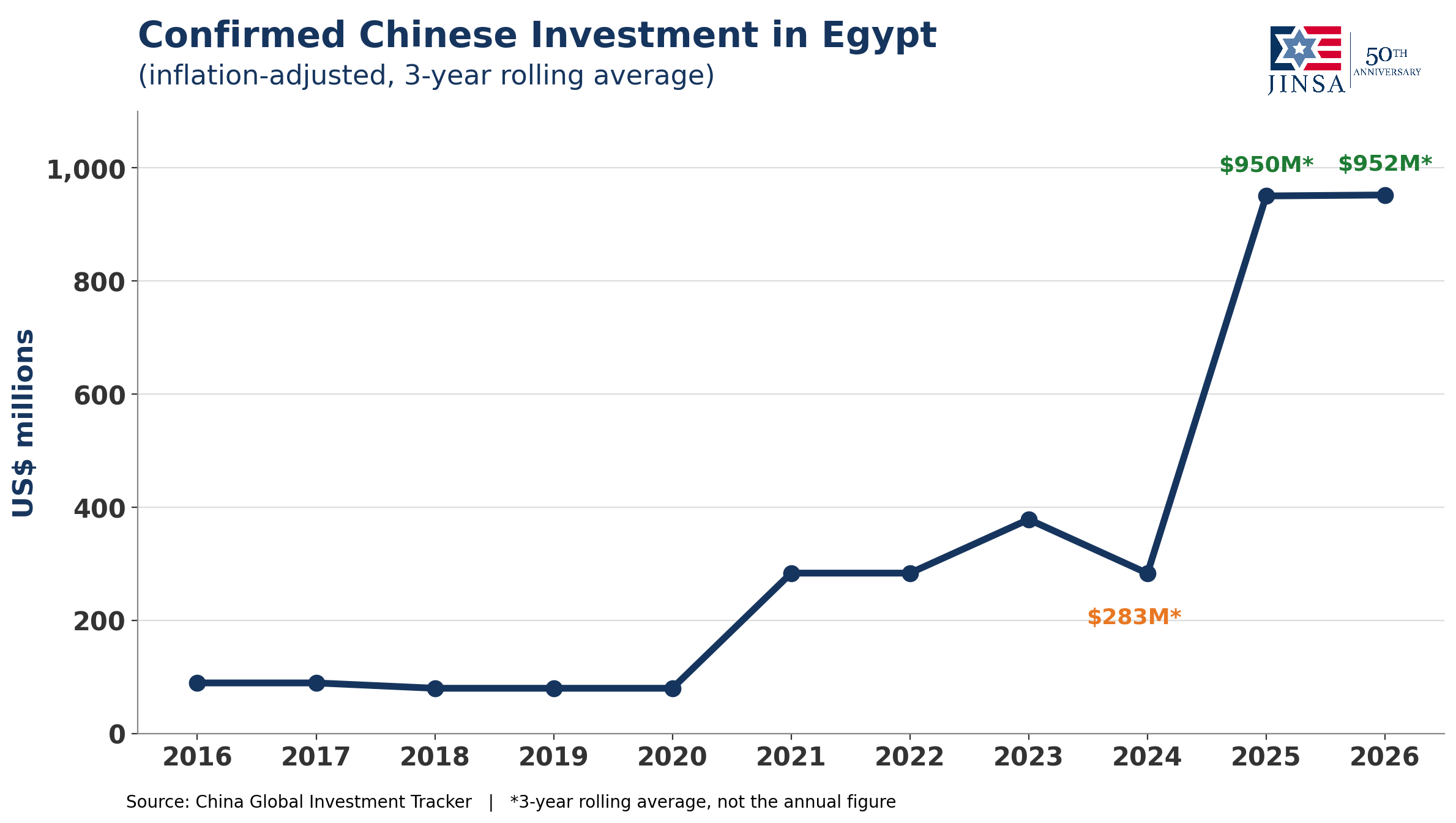
For that generosity, China gets in return access to, or control of, key sites in Egypt, like port facilities along vital sea lanes in the Suez Canal and the Mediterranean Sea. During the recent visit, Presidents Xi and el-Sisi pledged to expand industrial operations—with potential military applications—in the China-Egypt industrial zone on the Suez Canal, where Russia is constructing a parallel zone. Nearby, China is expanding the world’s deepest manmade port, which can accommodate warships. Chinese firms operate or partially own four Egyptian ports, including two bookending the Suez Canal—similar to PRC-linked firms’ past control of strategic ports at both ends of the Panama Canal. Beijing clearly wants to alarm Washington by doing so, but it seems Cairo does as well.
Second, Cairo’s courtship of Chinese weaponry has also evolved in ways that seem designed to get Washington’s attention. Egypt’s past acquisitions from China were niche systems: precision-guided munitions and surveillance drones. Yet in recent months, Cairo’s wish list has expanded to China’s elite military platforms, including stealth-capable submarines; 4.5-generation J-10C fighter jets that are China’s answer to the U.S. F-16; and the HQ-9B air defense platform—the Chinese counter to America’s Patriot system—which Egypt has reportedly purchased and deployed.
Third, Egyptian defense cooperation with other U.S. adversaries likewise seems, at least in part, designed to spark alarm in the United States. Among several other examples, Egypt brazenly purchased munitions from North Korea in violation of international sanctions; tried to arm the Russian military against Ukraine; and has bought over $2.1 billion of Russian weapon systems over the past decade.
The View From Washington
Cairo’s embrace of Beijing requires Washington to internally reassess its relationship with Egypt. Despite over $1 billion in annual defense aid dating back to the 1980s, the United States has not bought Egypt’s strategic allegiance. Egypt forcefully brought home that point just weeks ago, hosting China’s air force in major drills simulating intense PLA combat against U.S. partner and NATO fighter jets.
Washington has rarely gotten tough with Egypt in recent years—but pressure tactics worked when they were tried. One such case was in 2019, when the Trump administration threatened Egypt with sanctions, and being cut off from future U.S. defense sales, if it proceeded with its attempted purchase of advanced Russian Su-35 fighters. Facing that outcome, Egypt canceled the sale. The present moment, and the prospect of Egypt buying Chinese jets or submarines, likewise warrants stern U.S. warnings—and penalties if necessary. Short of that, Cairo is unlikely to change course.
“We’ve never seen a crisis like this.” That is how a former senior State Department official described the state of U.S.-Egypt relations after the 2025 China-Egypt air force drill. True or not, Egypt’s calculus seems to be that generating statements like these helps, rather than hurts, its relationship with the United States. Sparking alarm in Washington over its China ties, Egypt may believe, is likelier to produce U.S. carrots than sticks.
The United States should not give Egypt what it seems to want. Above all else from its closer cooperation with Beijing, it appears Cairo hopes a desperate America will run to buy Egypt’s loyalty, on an indefinite basis and at Egypt’s asking price. The strategic partner whose allegiance the United States has long taken for granted is, at a minimum, openly playing a double game. Washington would be unwise to reward that approach.
Click here to download the analysis.