Iraqi Kurdistan’s Political Fracture Leaves the Region Exposed
Click here to download the JINSA Insight
The Kurdistan Region of Iraq faces a deepening political crisis after disagreements between the two main political parties in the Kurdistan Regional Government (KRG) escalated last week, raising the possibility that the world’s only recognized Kurdish government could split apart. Such a fracture would weaken a key U.S. partner, which contributes to counterterrorism and regional stability, at a time when it is already vulnerable to security threats from Iran and its Iraqi proxies.
After nearly two years of disagreement between the Kurdistan Democratic Party (KDP) and Patriotic Union of Kurdistan (PUK) over senior government positions, the KDP’s Vala Fareed made a surprise call on November 3 for all parties to attend a parliamentary session the following day. Until then, the KRG parliament had met only once since the 2024 elections, to swear in its members; subsequent attempts to convene had failed to reach a quorum. The November 4 session went ahead after several lawmakers from the PUK and other opposition parties defied their parties’ boycott and attended. The 52 lawmakers present in the 100-member parliament unanimously elected Fareed as speaker.
A Power-Sharing Agreement at Risk
In a video statement released on X the very next day, PUK leader Bafel Talabani called the situation “the single largest political crisis in the history of the Kurdistan region,” declared the KDP-led government a failure, and announced that he was withdrawing his party from the KRG. The PUK leader said he did not recognize the parliament and demanded that all unilateral moves be reversed. Otherwise, he said, he would counter every KDP move made in Erbil, seemingly suggesting that he could establish a parallel administration in Sulaymaniyah.
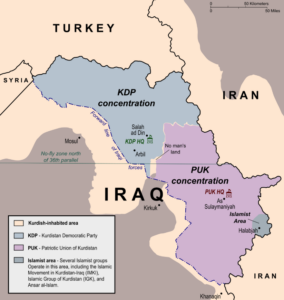
The Iraqi constitution recognizes the Kurdish region as a federal entity with its own legislative, executive, and judicial powers. However, even after formally uniting under a power-sharing arrangement in 2006, the PUK and KDP’s political influence and security structures have remained divided, with the KDP strongest around Erbil and Duhok and the PUK dominant in and around Sulaymaniyah. The rivalry has even deeper roots, as the two parties fought a civil war in the 1990s and operated separate administrations before unification.
Since that 2006 unification, the Kurdistan region has been a relative haven of stability in a turbulent neighborhood. While its people have benefited from that stability, access to economic opportunities and political decision-making has remained unequal. Much of the region’s power is still concentrated in the hands of its two dominant parties and the families that lead them: the Barzanis and the Talabanis.
Now, however, Talabani’s threat raises the prospect of a return to divisions that many people in the region remember vividly and painfully.
Greater democratic accountability and less corruption would help address many of the region’s problems, but neither side has made these reforms the central promise of its position in the current dispute. The KDP controls a larger share of the region’s political power and resources, while the PUK is seeking what it considers a fairer distribution. Meeting the PUK’s demands would dilute the KDP’s control, but it is unlikely whether more resources would reach ordinary people or simply be redistributed among PUK elites.
The Stakes Beyond the Political Crisis
Beyond its internal disputes, the Kurdish region already faces several major challenges. A long-running budget dispute with Baghdad, which led to a major suspension of payments in 2014, has hurt the regional economy and delayed salaries for public employees. Economic development has also been hindered by limited access to formal banking services and allegations of patronage in a political and economic system dominated by two families: the Barzanis, who lead the KDP, and the Talabanis, who lead the PUK.
Alongside these economic challenges, the region has been a major battleground in the wider conflict with Iran. At the outset of the U.S.-Israel war against Iran earlier in the year, Iranian Kurdish groups based in the Kurdistan Region of Iraq were discussed as a possible ground force against the regime in Tehran. Although President Donald Trump publicly rejected the idea early in the conflict, Iran and its Iraqi proxies targeted the region with thousands of drones and missiles. With U.S. forces and their air defenses leaving the region in September as part of a deal with Baghdad, the fracture between the KDP and PUK leaves the KRG more exposed to Iran-aligned Shia forces in Iraq that have openly threatened it. Washington, Baghdad, and Tehran are watching developments in the Kurdistan region closely.
Responding to a question at an event hosted by the U.K.-based think tank Chatham House, U.S. Ambassador to Turkey Tom Barrack, whose responsibilities were recently expanded to include Iraq, told the PUK and KDP to “get over it.” Sounding exasperated, he characterized the conflict as “a series of disputes between families” and one that Iraq had to solve internally. While many Iraqi Kurds will share the ambassador’s frustration with their leaders, his remarks are also likely to cause concern, particularly given that some Kurds in neighboring Syria blame him for the loss of their autonomous administration. Barrack said the United States could not intervene and that the parties had to resolve their differences themselves, adding, “we need unity from the region.”
KRG Prime Minister Masrour Barzani has said that the reopening of parliament is “not directed against any party.” Critics argue, however, that by prioritizing the consolidation of power over political consensus, he is putting the region’s future and the longer-term Kurdish national project at risk. His father, Masoud Barzani, has called on the PUK to return to the negotiating table. But Bafel Talabani has dismissed the call as “not serious” and vowed that the PUK will appoint its own president if the KDP does so unilaterally.
Unlike in the 1990s, the current tensions do not appear likely to erupt into violence between the two parties. Nevertheless, the KDP and PUK will have to recognize that no one is coming to resolve or gloss over the region’s fundamental problems for them. A solution must come from within. Otherwise, amid rapidly changing conditions across the Middle East, the KRG faces an uncertain future.
In this regard, Kurdistan Region President Nechirvan Barzani has distinguished himself through his ability to engage not only with all sides in Iraqi Kurdistan but also with Kurdish leaders and organizations in neighboring countries. Images of him at last month’s Middle East Research Institute annual conference in Erbil, alongside Bafel Talabani, Mazloum Abdi and Ilham Ahmed from Syria, and Tuncer Bakirhan of Turkey’s pro-Kurdish Democracy and Equality Party, were celebrated by Kurds across the region. Nechirvan Barzani’s approach offers a path forward that others in the KRG’s leadership would do well to follow and Washington would do well to support.