Not Bottlenecks, But Strategic Opportunities: Making Room for More U.S. Refueling Tankers in Israel
Click here to download the JINSA Insight
The United States has been moving its aerial refueling tankers to Israel at a rapid rate. No fewer than 14 additional U.S. aerial refuelers were deployed to Israel between July 18 and 20, and dozens more are expected to follow. On August 1, Israeli media reported that 10 more refueling tankers would arrive that week. According to Israel’s Walla News, the U.S. military plans to station 100 aerial refueling tankers across the country—over 20 percent of the global U.S. refueling tanker fleet. Rather than being deployed rotationally, according to media reports, many of these tankers may be permanently stationed in Israel.
These deployments also represent the latest signal that a major evolution in U.S. regional force posture is underway. Increasingly, the United States is shifting away from its Gulf basing sites, which are dangerously close to Iran and have been proven vulnerable to Iranian attack, and towards Israel. Through Operation Epic Fury, in fact, Israel served as a central power projection hub for American forces in wartime—a historic first.
However, at least superficially, rain seems to be falling on this parade. Israel’s military airbases are not all able to host the heavy, resource-intensive U.S. tankers, and dozens have been placed at Israel’s main airport, Ben Gurion Airport, and the less-trafficked Ramon Airport. This has caused significant alarm, with some Israeli political figures claiming the tankers’ presence threatens to disrupt civilian air traffic on a large scale.
These fears, thus far, have been overblown. Yet they do highlight a reality: not all Israeli military bases have proper specifications for U.S. refueling tankers, meaning some are being diverted to Israeli civilian airports—where landing and holding space, for commercial and military aircraft alike, is finite. Those facts, though, underscore opportunities for mutual gain, not friction. The more the United States and Israel can do to accommodate American refueling tankers, and a broader U.S. military presence in general, at Israeli bases, the better—for both countries.
The Unsinkable (Refueling) Aircraft Carrier
The fact that American refueling tankers are being sent to Israel at scale, along with other prized assets, implicitly shows an important fact: U.S. military planners now view Israel’s airbases as more secure than the Middle East bases that America has used for decades.
They are right to think so. Despite significant U.S. military deployments to the country this year, Israel is the lone nation in the Middle East in which American military personnel or assets have not been struck by Iranian missiles or drones in the current war. Satellite imagery indicates that Iranian strikes impacted approximately 225 structures or military platforms—including five KC-135 tankers damaged in an Iranian strike on U.S. assets in Saudi Arabia—at 15 U.S. military sites across the region between March and May. Since July 7, Iran or its proxies have struck nine U.S. military sites in four Arab nations. Public estimates suggest Iranian and proxy strikes have caused at least $1 billion in damage at U.S. regional bases.
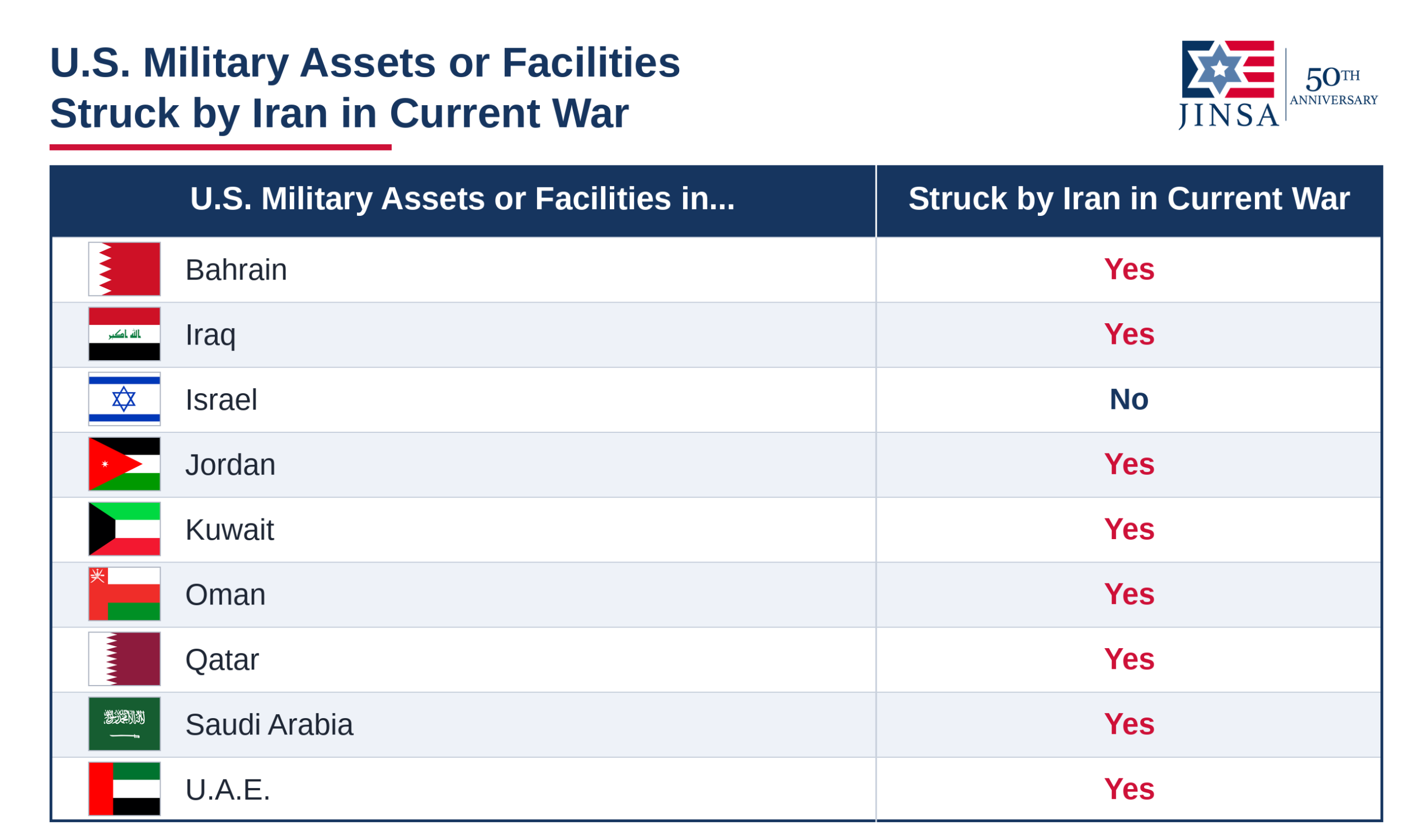
As the United States begins to rethink its entire regional footprint, Israel is emerging as an appealing option. However, it is not just its elite air and missile defenses, and strategic depth from Iran, that make Israel a more attractive host for American basing than Gulf Arab countries. Unlike other regional countries where U.S. forces are based, Israel is unlikely to deny the United States access, basing, and overflight (ABO) rights for its regional missions. Yet basing in Israel does more than just enhance U.S. combat readiness in the Middle East. For example, southern Israel’s Ovda Air Base can support U.S. combat operations across North Africa and the Eastern Mediterranean, and is close to a key naval port, Eilat, enabling regular and quick resupply.
The strategic logic of making Israel a U.S. regional basing focal point is clear. Former commander of U.S. Central Command Gen (ret.) Frank McKenzie, who led U.S. forces in the Middle East, has endorsed this approach. Maj Gen (ret.) Charles Corcoran, former Chief of Staff for U.S. Air Forces Central Command, wrote in July 2025 that “U.S. basing [in] Israel checks all the boxes of a Goldilocks solution to project power … without jeopardizing troops and military assets.” Now, with approximately 100 U.S. KC-46A Pegasus or KC-135 Stratotanker refueling tankers—around one-fifth of the total American aerial refueler fleet—currently or soon to be stationed in Israel, the U.S. military is implicitly recognizing that reality.
U.S. tankers’ presence on Israeli soil benefits Israel as well. American tankers are capable of refueling Israeli fighter jets, too, enabling longer-range missions for both air forces. That occurred frequently during Operations Epic Fury and Roaring Lion, a major asset to both nations.
Why U.S. Military Refueling Tankers Are Now at Israel’s Civilian Airports
However, given Israeli airbases’ and civilian airports’ physical space constraints, the tanker deployments have generated, among some Israeli officials, a more pessimistic narrative: Israel now has too much of a good thing. Not all Israeli bases can accommodate the aerial refueling tankers, which can weigh up to 415,000 pounds when fully loaded. As a result, with parking slots at Israeli airbases that can accommodate the tankers now filling up, dozens of tankers have been placed at civilian airports. With major combat against Iran and Hezbollah on pause—though liable to resume at any time—Israelis are flocking to summer vacation destinations. Yet the planes to take them there are now competing with new neighbors on the tarmac.
At Israel’s primary airport, Ben Gurion Airport, and its less-trafficked Ramon Airport, parking slots now must be allocated between U.S. tankers and Israeli commercial aircraft. According to some Israeli officials, U.S. refueling tankers at Ben Gurion Airport are interfering with Israelis’ air travel and risking mass flight cancellations.
Short-term solutions are being put into action to reduce the number of U.S. refueling tankers at Ben Gurion and thus avoid disruptions. On July 14, the United States and Israel reportedly reached a compromise, and in just one week, the United States decreased the number of tankers stationed at Ben Gurion Airport from 74 to 33 total. Now, roughly 30 U.S. refueling tankers are at the airport, according to officials, though 10 more will soon arrive. According to estimates, at least 13 are at Ovda Air Base, and an additional roughly 20—and potentially up to 28—are positioned at Israel’s civilian Ramon Airport. While some flights have been delayed, no widescale cancellations have occurred despite reporting that 30 flights could be axed each day. Authorities say they have no plans to cancel flights. Moreover, the scenario of up to 2.4 million Israeli passenger tickets being voided, as some feared, has not remotely materialized.
Refueling Tanker Deployments: Avoiding Turbulence Ahead
What remains true is that the United States and Israel would be better off if Israel could accommodate more American refueling tankers—and other U.S. military assets as well. U.S. refueling tankers’ presence at Ben Gurion Airport has imposed $229 million in costs on the Israel Airports Authority and caused many logistical headaches. Yet the American refueling tankers are also indispensable to counter-Iran operations that enhance Israel’s security. The episode therefore highlights real opportunities to advance U.S. and Israeli strategic aims.
Expanding Parking Slots at Existing Bases
Addressing a lack of appropriate parking slots at Israeli bases, in the near- and medium-term, requires a straightforward fix: build more. While runways and hangars can take years to build, simply constructing more parking slots around Israeli airbases’ perimeter areas is a far quicker and simpler approach. An obstacle, JINSA has learned, is funding. Here, the Pentagon, and U.S. defense contractors and construction firms, can play an advantageous role.
Still, adding more parking slots, while necessary, is not an adequate long-term solution. Some Israeli airbases lack the proper logistical infrastructure, runways, and general specifications for U.S. refueling tankers and other military assets to begin with. Yet that can, and should, change.
Boosting Infrastructure Capacity at Ovda Air Base
U.S. and Israeli officials are reportedly weighing expanding an Israeli base to integrate a long-term, sizable U.S. military presence. Of the options, Ovda Air Base—where many American military assets and personnel are already stationed—stands out. Three retired U.S. Air Force generals who visited Ovda in 2025 have noted that the base was built to U.S. specifications and has the command-and-control infrastructure to support American operations. It also has vital parking ramps, heavy-duty hardstands, fuel bunkers, storage facilities, and runways necessary for accommodating U.S. refueling tankers and other key aerial platforms.
The Iran war has been proof-of-concept for Ovda’s utility to the U.S. military. According to JINSA sources in Israel and the United States, during Operation Epic Fury:
- Approximately 6,000 U.S. personnel and 240 U.S. aircraft were stationed at Ovda;
- Warfighters from the U.S. Air Force, Army, Marine Corps, Navy, Space Force, and Joint Special Operations Command (JSOC) utilized the base; and
- U.S. forces generated, from Ovda, approximately 4,300 total sorties—including over 2,580 combat sorties to Iran—with a combination of F-22 fifth-generation fighters, F-35 fifth-generation fighters, F-15 fourth-generation fighters, and additional assets.
The last statistic is especially significant. Of the roughly 10,200 sorties U.S. forces conducted during Epic Fury, those launched from Israel accounted for over 40 percent. For U.S. combat sorties, rather than cargo and transport sorties, at least 30 percent were staged from Israel.
Given this baseline success, even modest and incremental expansion of Ovda would boost U.S.-Israel joint readiness. Building additional runways, storage and fueling units, and parking space at Ovda to increase surge capacity is a clear next step—and that process can begin now.
Ovda’s capacity should also be sufficient to host large numbers of U.S. platforms—not just tankers, but also more U.S. fighter jets, military transport planes, and intelligence, surveillance, and reconnaissance (ISR) aerial platforms. In 2025, the Pentagon instructed the U.S. Army Corps of Engineers to begin building hangars and ammunition bunkers—including facilities specifically for refueling tankers—at an Israeli base, though for Israel’s use. Future, similar efforts geared towards U.S. operability, not just Israel’s, would enhance the two militaries’ deterrence and readiness at a fairly low cost—but with a big strategic return on investment.
Exploring Greater Use of the Joint-Use Facility Model
More Israeli joint-use airports for civilian aircraft and U.S. and Israeli military aircraft—including refueling tankers—could help complement basing at Ovda. Several months ago, Israeli lawmakers approved plans for two new Israeli commercial airports, which are potentially well-suited for the task. In addition, joint-use airports can be built from scratch. Potentially, such an airport could be a U.S.-built one, operated as a joint commercial venture with Israel. Construction could be funded by U.S. firms, or as a binational consortium. Were it located near the Mediterranean Sea, it could be the center of a profitable commercial-residential-tourism-transit zone.
Fortunately, the joint-use model is neither impractical nor untested. The United States operates over 20 such facilities, including Charleston International Airport/Joint Base Charleston, where commercial and military aircraft share certain runways. The facility hosts 21 Air Force squadrons and is a major logistical hub for U.S. Transportation Command, while its civilian terminals accommodate roughly 500,000 travelers per month. Israel could certainly not replicate the site’s scale, but it represents a useful case study.
Conducting Pentagon Study on Ways to Enhance U.S. Basing in Israel
Thanks to Israeli basing, the United States is gaining unprecedented security and flexibility in its Middle East operations. The refueling tankers that enable U.S. combat operations have been shifted to Israel by the dozens in recent months, with approximately 20 percent of all American aerial refueling tankers in the world reportedly soon to be stationed in Israel. They have been accompanied by over 40 advanced U.S. fighter jets and over 100 supporting U.S. military logistics and intelligence aircraft that were shifted to Ovda Air Base during Operation Epic Fury.
A Pentagon study exploring how more U.S. refueling tankers can be accommodated at Israeli airbases, and what the United States can do to facilitate that, is worth undertaking. That study should also explore ways to unleash Ovda’s considerable potential for the U.S. military more broadly. The damage Iran inflicted on so many U.S. assets at other regional bases should catalyze action. There is nothing but upside to enhancing America’s ability to use the Middle East’s best-defended bases—hosted by its most capable and trustworthy regional partner.
Click here to download the analysis.