Oil For Tehran, Not Us: Removing Iran’s Strait Jacket on Global Energy Flows
Click here to download the JINSA Insight
Since the United States lifted its naval blockade on June 17 and waived U.S. sanctions on Iranian oil—via the U.S. Treasury Department’s General License X—on June 21, the Iranian regime has likely reaped $5 billion from oil exports and tanker tolls, per JINSA estimates. At the same time, Iran is still taxing, attacking, and generally choking off maritime energy trade through the Strait of Hormuz—a blatant violation of the MOU’s terms requiring Iran to permit “the safe passage of commercial vessels with no charge.” Even now, nearly a month after the MOU was reached, over 15 million barrels of non-Iranian crude oil are stranded on tankers inside the Persian Gulf—collectively worth over $1 billion. All of it is being held hostage by the Iranian regime.
Fortunately, the United States is pivoting to an overdue course correction. In response to Iranian attacks on three energy tankers, and on Bahrain and Kuwait, in recent days, the U.S. government formally revoked General License X on July 7. It also has intensified military strikes on Iran, and informally suspended the MOU. Significantly, President Donald Trump has said he is considering reimposing the blockade that—as JINSA data shows and as Iranian leaders have now admitted—cut off Iran’s main revenue stream for months by stopping its crude oil shipments.
The Iranian regime is once again feeling the heat—at least for now. It is vital that the United States, rather than returning to the failed MOU, continue applying pressure to Iran until there are real and durable changes to its behavior.
The U.S. Sanctions Waiver: What It Was and Why It Mattered
On June 21, the U.S. Treasury Department issued General License X, authorizing Iran to sell crude oil and similar products. The license stated that, through August 21 of this year, “the production, sale, delivery, or offloading of crude oil, petrochemical products, or petroleum products of Iranian origin” would be authorized. It also allowed Iran to repatriate revenue in U.S. dollars—reversing many years of Iran being isolated from the dollar and the American banking system. Doing so eliminated additional Iranian costs that it had previously incurred in its sanctions-evading oil trade—like expenditures on shadow tankers, money launderers, and networks of currency exchangers.
That U.S. concession, part of the Memorandum of Understanding (MOU), ended a decadeslong American policy to prevent Iran from being able to sell its oil and fund its range of dangerous behaviors. It also coincided with the U.S. decision three days prior, also made pursuant to the MOU, to lift the American blockade that had fully curtailed Iranian oil exports for two months. Neither had the desired result of pacifying Iran.
Iran is Selling Its Oil Fast…
Iran rushed to export its oil at the first opportunity, and it made a fortune by doing so. It shipped out approximately 8 million barrels of crude oil on June 18, the day the MOU entered into effect—shipments with an estimated export value of, conservatively, over $565 million. The following day, Iran exported an estimated 20 million barrels of oil. Over the first two weeks after the U.S. blockade was lifted, the Iranian regime was able to export 50 million barrels of oil, according to TankerTrackers.com shipping data reviewed by JINSA. This tracks with Iranian Parliamentary Speaker Mohamed Ghalibaf’s June 30 comment that Iran, which he said was unable to export any oil during the naval blockade’s implementation, was able to sell 40 million barrels of oil after the blockade was lifted. Even slightly more conservative estimates place Iranian oil exports between June 14—when the MOU was announced—and July 6 at roughly 55 million barrels, valued at over $4.5 billion.
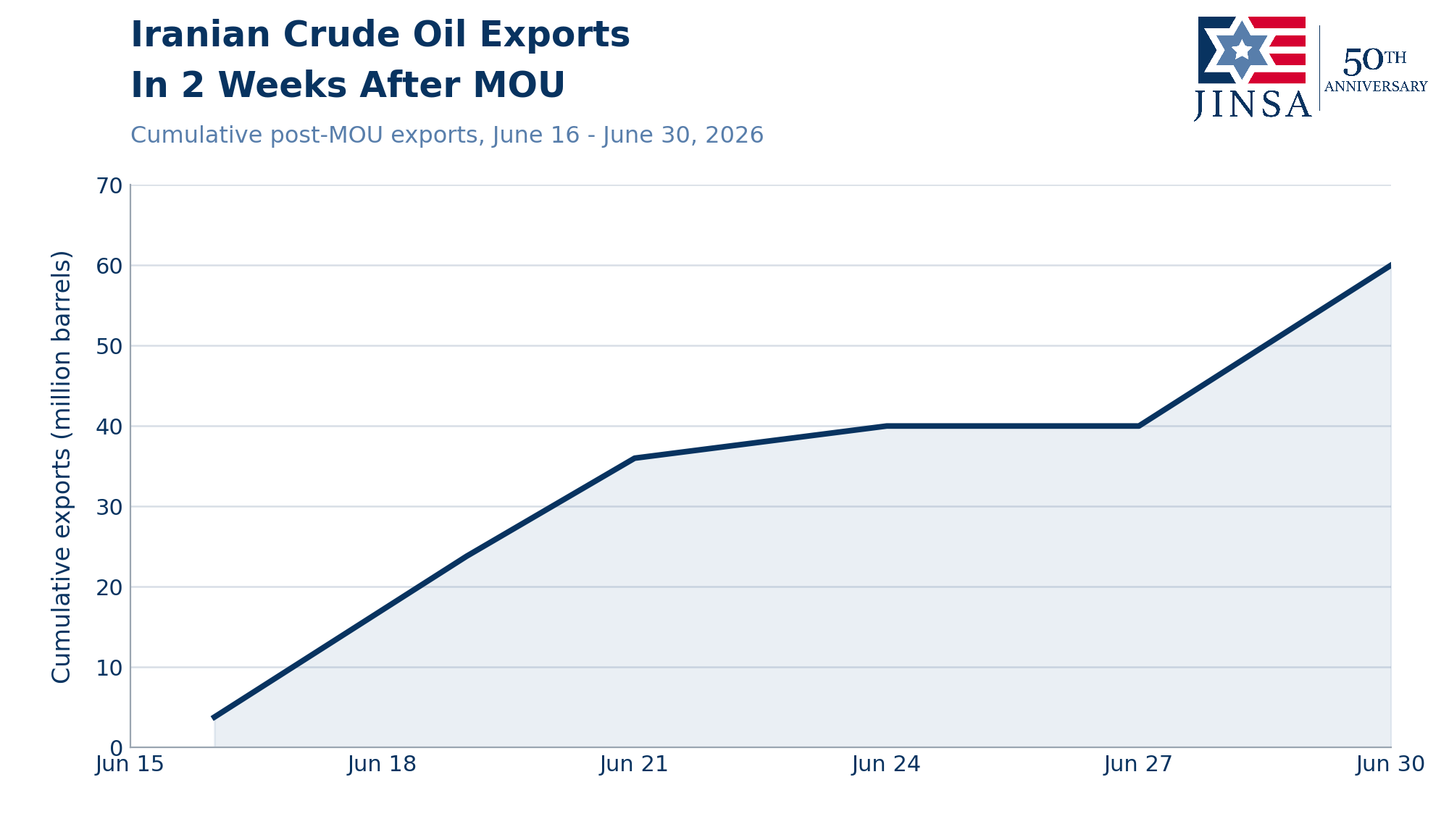
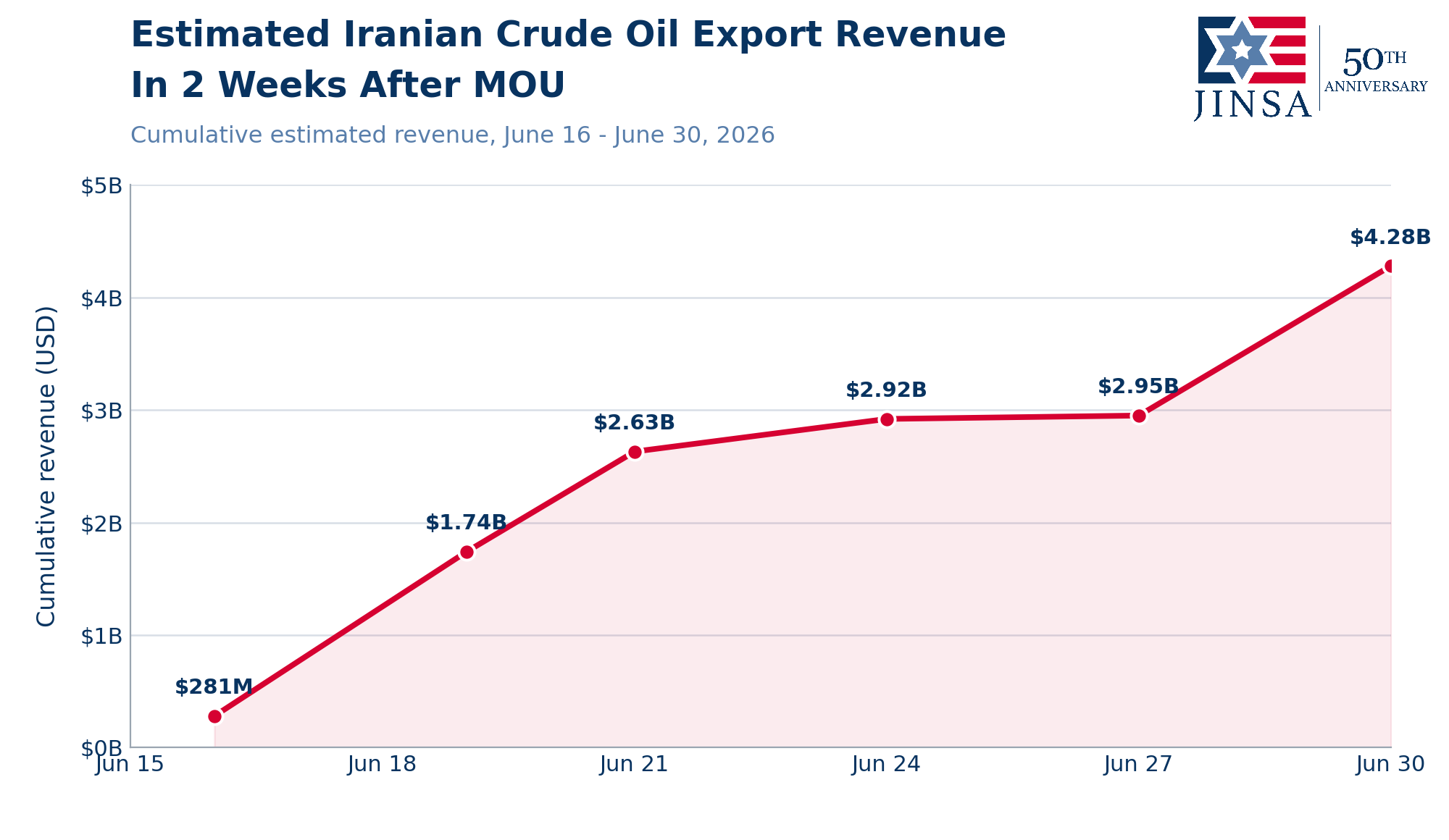
Please click the images above for higher-resolution versions.
Compared to pre-war shipping flows, this export bonanza was a major boon for the cash-strapped Iranian regime. Prior to the war’s outbreak, Iran was able to export an estimated 47-50 million barrels of oil in a typical month—a roughly $3.05 billion value. That means that in the 22 days after the MOU was first announced, Iran generated, based on conservative estimates, 47 percent more revenue from its oil exports than it did in a full month before the war. It’s also worth noting that Iran, prior to the war, was forced to export its oil at a discount compared to energy market prices due to U.S. sanctions on its oil. Yet thanks to the U.S. waiver, Iran spent over two weeks selling crude oil at a relative premium—full market price—increasing the value of its oil exports.
There is good reason, though, to believe that Iran’s current revenue figure is even higher than the above estimates suggest.
Many ships laden with Iranian crude oil had already been in East Asian waters when the blockade entered effect, and in many cases, were unable to offload their oil to leery customers. With the U.S. sanctions waiver in effect for over two weeks, many such ships—including the infamous ghost fleet consisting of constantly-changing ship names, spoofed locations, and shadowy ownership—have apparently offloaded Iranian oil in recent days. At least seven such ships were tracked reaching the Eastern Outer Port Limits (EOPL) area near Malaysia in recent days. The EOPL is a vast maritime area where ship-to-ship oil transfers frequently take place, enabling Iranian oil to reach China without the unwanted visibility of a tanker entering Chinese waters.
Yet all this does not account for another primary source of Iranian funds: taxation. Although Iran is prohibited, under the MOU’s provisions, from charging any fees on shipping for a period of 60 days, Iran is nonetheless reportedly still demanding—and receiving—these extortionary payments in exchange for commercial ships’ safe passage.
According to July 8 reporting from Israel’s Globes outlet, “the Iranians are forbidding ships to pass without permission and without payment …. the Iranian government seeks to collect $2 million from each tanker.” Assuming that estimate is correct, even when discounting those tankers that did not take the “Iranian route” through the Strait, Iran may have generated an additional $300 million from its illicit tolls, according to JINSA’s review of Kpler shipping data.
It is safe to assume that, if the status quo remains in place until after the 60-day period expires, Iranian tolls—those Iran plans to “coordinate” with a far weaker and pliable Omani government—on tankers in nearby waters will go up even more.
In fact, Iran, if permitted to do so by the United States and the international community, will thereafter be able to charge exorbitant tolls so long as importing nations are willing to pay. There is good reason to believe they will be, as East Asian importers continue to feel the crunch from reduced oil supply, increased energy costs, and higher shipping costs due to constrained shipping flows through the Strait of Hormuz.
Iran, in short, has reaped a financial windfall thanks to the MOU and its accompanying inducements to Tehran. It has almost certainly generated close to $5 billion in revenue in under a month—a significant increase over its pre-war revenue rate. Likely, much of it will go to Islamic Revolutionary Guard Corps (IRGC) activity and help fund the regime’s military, proxy, and internal oppression apparatuses.
…While Global Shipping Remains Constrained
While Iranian energy exports through the Strait of Hormuz have shot up, by contrast, for everyone else, energy flows through the maritime chokepoint are significantly down compared to pre-war levels. That scorecard is a bad omen for the future of maritime security in the Middle East—and U.S. deterrence of Iran, or lack thereof, writ large.
Iran’s active threats to shipping, not merely insurers or shipping firms’ abstract risk aversion, remain the cause of diminished energy flows. Iran has insisted that tankers through the Strait on the southern/western route near Oman turn around, and several have. It continues demanding that energy tankers travel near Iran’s shores on the northern/eastern route and reportedly is still extracting tolls from commercial ships.
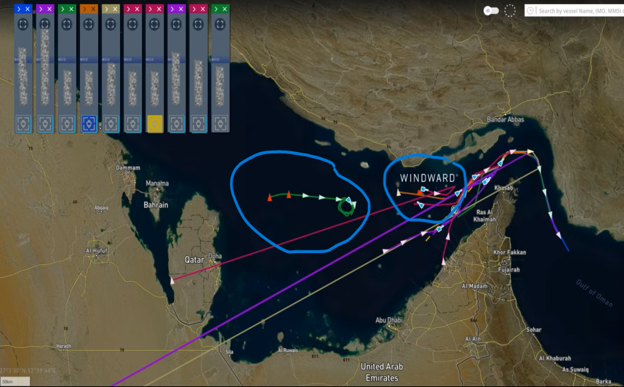
Oil tankers rerouting away from Strait of Hormuz in recent days following Iranian threats. Source: Windward Intelligence
Put simply, Iran is continuing its extortion racket—backed up by force. Following Iran’s July 6 Iranian attacks, the United Kingdom Maritime Trade Operations, a leading global advisory firm, raised the threat level in the Strait to “severe,” its second-highest tier.
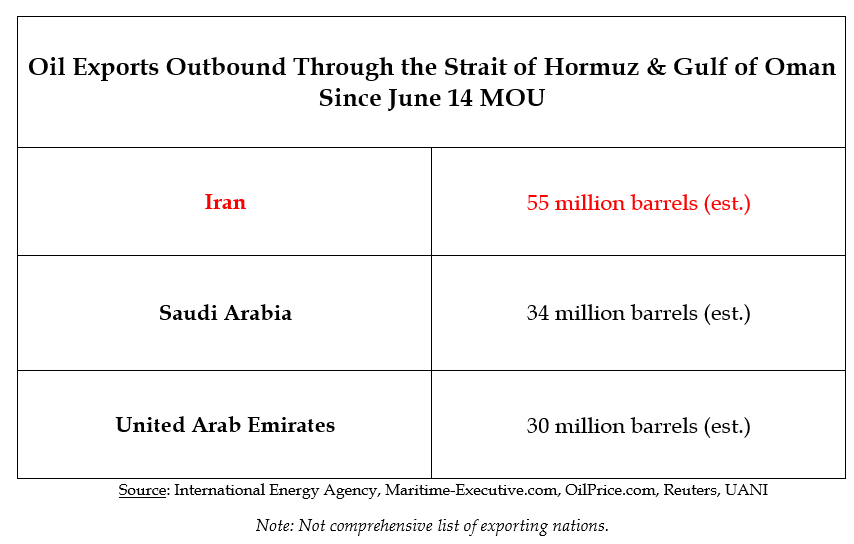
As a result, nearly a month after the MOU was concluded, energy flows through the Strait of Hormuz remain far below pre-war levels. Prior to the Iran war, an average of 15 million barrels of crude oil transited the Strait per day; yet in the entire first week after the MOU was reached, fewer than 35 million non-Iranian barrels of oil passed through the Strait, for an average of 4.8 million barrels of crude oil per day—less than a third of pre-war levels. In that same timespan, by contrast, Iran exported 5 million barrels of crude oil per day.
That overall picture has not improved since then. For example, on July 6, just 23 tankers traveled outbound through the Strait of Hormuz going in either direction. Yet pre-war shipping flows involved an average of 50-60 tankers traversing the Strait of Hormuz each day. That means, per JINSA estimates, there are at least 25 million fewer barrels of crude oil—cumulatively worth hundreds of millions of dollars—being sent through the Strait per day compared to pre-war activity. More concretely, around 23 million barrels of seaborne oil are still stranded inside the Strait.
Two Truths and an Iranian Lie
The vast Iranian revenue stream from its oil exports and Iran’s continued attacks on maritime commercial shipping demonstrates two troubling realities.
First, it conclusively demonstrates that a central notion behind the MOU—that Iran’s ability to receive benefits under the MOU is “performance-based,” as American officials have maintained—is false. On July 7, a senior U.S. official insisted, in a conversation with the Al-Monitor news outlet, that “Iran will only reap benefits if they exhibit good behavior.” In fact, that is not the case, and Iran’s oil exports are a good example of why. The U.S. decisions to terminate the blockade and issue an oil sanctions waiver within days of the MOU being signed provided the Iranian regime with billions of dollars. And it cannot be undone.
That money, simply put, cannot be taken away from Iran now. It can perhaps be extracted from Iran in other ways, but it is money that has entered Iranian regime coffers—or will in the near future, as transactions are finalized. These billions of dollars have been flowing to the regime despite its poor “performance,” in the Strait—namely its attacks on tankers in nearby waters and its strikes on neighboring countries.
These attacks, threats, and tolls are an abject violation of Iran’s agreement, under the MOU, to permit the free flow of shipping through the Strait of Hormuz. Iran has flagrantly violated the MOU with such actions. Moreover, the recent Iranian attacks on commercial shipping are not the first of their kind since the MOU was signed. It is doubtful, absent increased U.S. pressure, that they will be the last.
Second, it proves what many feared when the MOU was signed on June 14—that the Iranian regime never intended, in signing the MOU, to actually permit free shipping flows through the Strait of Hormuz as it had agreed to. Instead, it wanted to ship out its own crude oil—and fast.
After the U.S. blockade—which Iran’s leaders admitted had prevented the country from exporting oil for months—was lifted, and after the United States issued a sweeping oil sanctions waiver several days later, Iran exported near-record levels of crude oil—generating billions of dollars in two weeks’ time. At the same time, the Iranian regime maintains leverage by continuing to hold multi-million-dollar crude oil and liquefied gas shipments at risk.
The question, now, for the United States is how to proceed.
Now What?
The United States’ de facto reimposition of oil sanctions on Iran is a positive and overdue step. Yet it only reverses an unforced error—undue sanctions relief—and does not put the genie of billions of dollars in Iranian revenue back in the bottle. However, other funds that the MOU authorizes for release to the Iranian regime, like reconstruction funds and currently frozen assets, are still under discussion and may yet be released.
Those revenue flows, and Iran’s steady stream of revenue from tolling the Strait, must be undercut. Doing so is necessary to rebuild leverage and give Iran more than a slap on the wrist for repeatedly attacking commercial vessels and its neighbors. Reimposing the U.S. naval blockade is another critical next step to deny the Iranian regime leverage and funds going forward.
In addition, Washington should immediately announce it is suspending all U.S.-Iran direct or indirect talks indefinitely. At a minimum, the United States should put further talks on hold until the Iranian regime allows shipping flows in nearby waters to safely and fully resume in earnest—without any obstacles, threats, or extortionary measures.
Returning to combat remains a viable option for the United States, as President Trump recently noted, and the U.S. military then demonstrated. In response to the latest Iranian attacks on commercial shipping, American forces struck sites in Iran. This has been a pattern in past weeks—Iran strikes ships, the United States retaliates against one or a few Iranian missile sites. But with a significant escalation on July 8—over 80 U.S. strikes on Iranian targets—that dynamic is changing. President Trump has made explicit that further punishment is likely. Moreover, one U.S. official made clear that American use of force is shifting from proportionality to punishment.
That is a clear move in the right direction. After the United States struck 80 Iranian targets—including command-and-control sites, radars, and air defenses—following Iran’s attacks on tankers and neighboring countries, President Trump declared the ceasefire “over” and pledged more U.S. strikes in the future. That type of rhetoric, paired with escalatory action as necessary, is what gets the Iranian regime’s attention. What does not change Iran’s risk calculus is prolonged negotiations and gestures of goodwill. Washington is now seeing that in real time.
The U.S. post-war strategic approach to Iran is also worth re-examining—and revising. On the fundamental question of whether the MOU—particularly its benefits to Iran, like the UNited States agreeing to waive sanctions—is making Iran more deterred or emboldened, the answer is now clear: the latter. The United States should take note, and act accordingly.
Click here to download the JINSA Insight.