Major Success for LEEP Program
By Marsha Halteman
 Since its establishment in 2002, JINSA’s Law Enforcement Exchange Program (LEEP) has supported the American law enforcement community by bringing groups of American law enforcement executives to Israel to study methods and observe techniques used in preventing and reacting to acts of terrorism.
By Marsha Halteman
Since its establishment in 2002, JINSA’s Law Enforcement Exchange Program (LEEP) has supported the American law enforcement community by bringing groups of American law enforcement executives to Israel to study methods and observe techniques used in preventing and reacting to acts of terrorism.
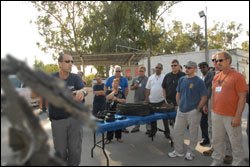
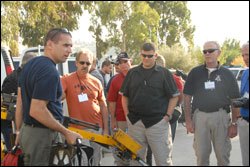
In October 2009, JINSA conducted a specialized LEEP trip to Israel for American bomb squad commanders. Recognizing that the effectiveness of bomb squad commanders in doing their jobs will be one of the determining factors in the final toll associated with any terrorist act, JINSA, in cooperation with the Bomb Disposal Unit of the Israel National Police, designed a program that focused on bombs, IEDs and counter terrorism methodologies. In addition, experts from other Israeli security agencies, such as the Shin Bet, the Mossad and other units of the Israel National Police, briefed the group on various aspects of counter terrorism.
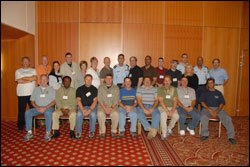
To ensure that the knowledge gained in Israel will be effectively and directly spread to various bomb squad units in the United States, JINSA brought all members of the National Bomb Squad Commanders Advisory Board (NBSCAB) to Israel. Representing over 400 individual police bombs squads, the NBSCAB serves as the leadership of U.S. Bomb Squads. Each member is recognized as the point of contact on all matters related to U.S. Bomb Squads and communicates all training, R&D, strategic plans and recommendations to other Bomb Squad commanders in their region.
NBSCAB, therefore, plays a vital role in developing capabilities and providing American squads with updated information, as well as advocating on their behalf at the national level serving as the “voice” of bomb squad commanders to government agencies.
 In addition to the NBSCAB members, participants also included the Director of the Office of Bombing Prevention, Department of Homeland Security and the Director of the FBI’s Hazardous Devices Center, as well as commanders from several U.S. Police/Sheriff Departments and a member of the Canadian Homeland Security Task Force, RCMP.
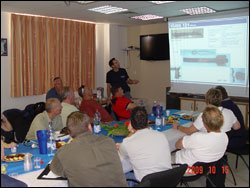
Topics covered during the week-long program included, prevention, post blast examinations and forensics; R&D for the bomb technician; response to a terror scene; structure of units and routine and emergency reaction; the training process; materials/detonators used by terrorists and how they are procured today. Different forms of bombing such as suicide, phone or car bombs were also discussed.
The William H. Donner Foundation was the primary underwriter of this specialized LEEP program.
The Mission of the National Bomb Squad Commanders Advisory Board is:
-
To act in a leadership role for the national bomb squad community, providing guidance and advice on important issues.
-
The Board acts as the liaison to the many federal agencies who are involved in issues related to state and local bomb squads.
-
To promote initiatives to improve bomb squad tactics, techniques, procedures, training and equipment.
-
The Board provides input and direction toward research and development programs affecting the bomb technician profession.
-
The Board is charged with the responsibility to set guidelines and standards for the bomb squad community through its role as the elected representatives for state and local bomb squads.
LEEP was established by JINSA to strengthen American law enforcement counterterrorism practices by facilitating dialogue with and studying techniques used by their Israeli counterparts.
To date more then 11,000 Americans from the law enforcement community have attended nationwide LEEP conferences. Over 100 law enforcement executives on the Federal, State and local level have traveled to Israel for a LEEP program and is viewed within the law enforcement community as a highly valued training program.
In 2008, the world’s largest police organization, The International Association of Chiefs of Police (IACP), honored the Israel National Police during the IACP’s 115th annual conference held November 8-12 in San Diego, Calif. The presentation took place during a luncheon sponsored by JINSA. Since 2002, the majority of the IACP’s leadership has traveled to Israel with LEEP.
For further information about LEEP Click here.
–Marsha Halteman is JINSA’s Director for Law Enforcement and Military Programs.