Blockade Evasion Update – 5/19/26
After five weeks of being in effect, the U.S. naval blockade is being robustly enforced—even more so than JINSA had previously assessed.
Since its May 8 update, JINSA has revised its assessment of the number of ships that have evaded the U.S. blockade downwards due to newly released information that U.S. Central Command (CENTCOM) permitted 15 vessels to transit the blockade line for humanitarian reasons between April 13 and May 13.
JINSA now assesses that 12 eligible ships have made it past the blockade, down from 27 previously, compared to at least 88 ships that have been prevented from violating the blockade. None of the ships that JINSA has tracked evading the blockade were oil or natural gas tankers, despite ongoing, misleading media accounts.
Click here to download JINSA’s update on blockade enforcement.
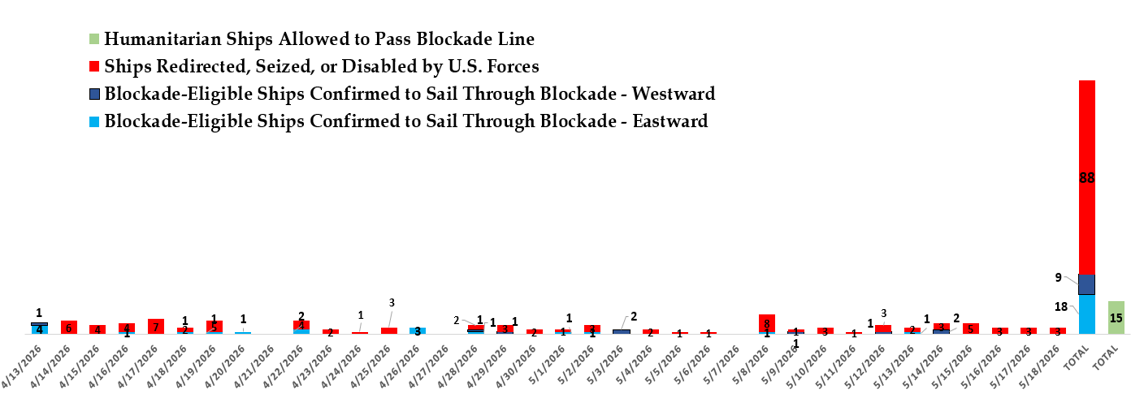
Click here to view a high-resolution version of the above.
Blockade Evasion Updates
JINSA assesses that most ships that tried to evade the blockade were unsuccessful. CENTCOM has disabled, rerouted, or seized 88 vessels since the blockade began. Meanwhile, only 12 ships appear to have successfully evaded the blockade, none of which were energy or oil tankers, and most of which were not large cargo ships.
- U.S. forces have redirected an additional 32 ships since JINSA’s last update on May 8, for a total of 88 ships that U.S. forces stopped from violating the blockade.
- JINSA now estimates that just 12 out of 100 ships that tried to evade the blockade did so successfully. This is a downward revision, from 27 previously, based on newly released information that U.S. forces permitted 15 ships to cross the naval blockade line for humanitarian reasons.
- On May 13, JINSA asked Pentagon officials about why some large cargo ships were seemingly evading the blockade, and whether U.S. forces have allowed any ships to travel to or from Iranian ports under the blockade’s humanitarian exemption clause.
- Following JINSA’s request, CENTCOM’s May 13 blockade update included ships that, for humanitarian reasons, were permitted to cross the blockade line. CENTCOM then contacted JINSA and referred us to the May 13 update.
- According to CENTCOM, 15 different blockade-eligible ships fell into this humanitarian exemption category and were allowed to pass the blockade line. This would account for nearly all large cargo vessels JINSA previously referred to as breaching the blockade.
- As of May 19, JINSA had tracked 27 ships crossing the blockade line, of which we assess that 12 evaded the blockade. None appear to have been carrying oil or natural gas.
- Of these, 24 ships crossed the blockade line as of May 13. Another three ships crossed between May 13 and May 14, and none have done so since.
- CENTCOM did not specify which 15 ships it exempted and let through the blockade, but our assumption is that the 15 were the large commercial vessels that traveled across the blockade line, in either direction, between April 16 and May 12. Most of these ships followed similar routes between Iran and South American countries, primarily Brazil.
- But even if 15 ships were permitted to cross by U.S. forces, that means at least 12 of these ships did evade the blockade.
- All of the ships that JINSA has tracked crossing the blockade line were either large bulk carriers or smaller ships, and none were oil or liquefied petroleum gas (LPG) tankers. Of the 27 total, these include:
- 13 going from Iran to Brazil or from Brazil to Iran;
- 7 going from Iran to Pakistan or from Pakistan to Iran;
- 2 going from Iran to unspecified locations;
- 1 going from Iran to Malaysia;
- 1 going from Iran to China;
- 1 going from Iran to South Africa;
- 1 going from Iran to Oman; and
- 1 coming to Iran from Argentina.
- Of these, 24 ships crossed the blockade line as of May 13. Another three ships crossed between May 13 and May 14, and none have done so since.
- Another ship tracking organization has assessed that Iranian seaborne oil exports have stopped since the blockade began, aligning with JINSA’s estimate.
- The shipping analytics firm TankerTrackers.com said in a May 12 X post that, “to our best knowledge, Iran hasn’t successfully exported any crude oil by sea over the past 28 days.”
Recent Media Claims of Blockade Evasion
The New York Times reported on May 15 that Iran has successfully ferreted some crude oil to East Asia since the blockade began. The Times described three tankers that it said appeared to transport Iranian oil, but solid evidence for this claim is limited, and the Pentagon pushed back on one of the article’s assertions. Other recent media reports about alleged blockade breaches do not claim Iran has exported any oil or gas by sea.
- On May 15, The New York Times reported, “some ships carrying Iranian oil that left around the time or after the U.S. blockade was implemented are now nearing East Asia.” (emphasis added) The Times then listed three such ships, including:
- The Iranian-flagged Huge tanker;
- The Pentagon disputed the claim that the tanker evaded the blockade, stating it left an Iranian port before the blockade began.
- The Comorese-flagged Atomis tanker;
- Language used by the Times suggests the tanker may have departed Iran before the blockade entered effect. The Times claims that “Around April 13, the Atomis … passed the U.S. blockade.” (emphasis added) Elsewhere, the article said the ship crossed the blockade line on April 13, “around when” the blockade began.
- The blockade took effect on April 13 at 10:00am ET, which is 6:00pm local time.
- And the Hong Kong-flagged Salute Legend
- The Times claims the ship spoofed its location, then “likely [loaded] cargo in a ship-to-ship transfer” in the Gulf of Oman before departing for East Asia. It is not clear if this occurred after the blockade went into effect, or if the ship in fact carried Iranian oil.
- The Times asserted, “smaller vessels, often with their location trackers off, have been most likely receiving Iranian cargo in ship-to-ship transfers in the Gulf of Oman,” citing satellite imagery. The article included one satellite image showing two ship-to-ship transfers in the Gulf of Oman on May 2. The Times did not specify why it believed Iran was involved.
- Ship-to-ship transfers are common worldwide and are often conducted for legitimate reasons, including ship owners wanting to avoid long wait times at ports or paying port fees. However, they have been frequently used by Iran to disguise sanctions evasion activity, like illicit oil transfers.
- The Times further claims, “at least eight smaller ships with links to Iran [have] moved from the Gulf of Oman to Asia since the start of the U.S. blockade.”
- However, not all ships with links to Iran, however defined, that cross the blockade line are necessarily in violation of the blockade.
- The Times correctly notes ships crossing the blockade line with Iranian oil received at sea are not, according to the Pentagon, violating the naval blockade. Yet, it omits that the U.S. Navy has said any such ship would be targeted under Operation Economic Fury, of which the blockade is one part.
- On April 16, U.S. Naval Forces Central Command (NAVCENT) announced, “in addition to enforcing the blockade … vessels suspected of carrying contraband [for Iran] … regardless of location, are subject to visit, board, search, and seizure.”
- Contraband, according to the U.S. Navy, includes crude oil and refined petroleum products.
- JINSA has documented three cases of U.S. forces seizing or redirecting ships carrying Iranian oil as part of Operation Economic Fury, despite the vessels not being in the vicinity of the blockade line or Iran itself.
- On May 17, The Maritime Executive and other publications reported that three tankers evaded the blockade in recent days, citing TankerTrackers.com.
- According to The Maritime Executive, “the U.S. Navy’s blockade on Iranian shipping continues to turn back vessels in the Gulf of Oman, but Central Command has not yet sealed up all of its leaks … Three sanctioned tankers in ballast [empty] made it past the Gulf of Oman blockade line.”
- One of these ships, TankerTrackers.com asserted on May 18, did reach Iran and load liquefied gas at Iran’s Kharg Island. JINSA has not been able to confirm this assertion, but if it is accurate, U.S. forces will likely stop the ship before it can export the gas.
- However, there is no evidence the other two U.S.-sanctioned ships—one of which was sanctioned for moving Russian, not Iranian, gas—were Iranian-owned or inbound to Iran. A ship being U.S.-sanctioned does not inherently mean it falls under the naval blockade’s criteria.
- The Iranian-flagged Huge tanker;
Blockade Effects on the Iranian Regime: Recent Developments
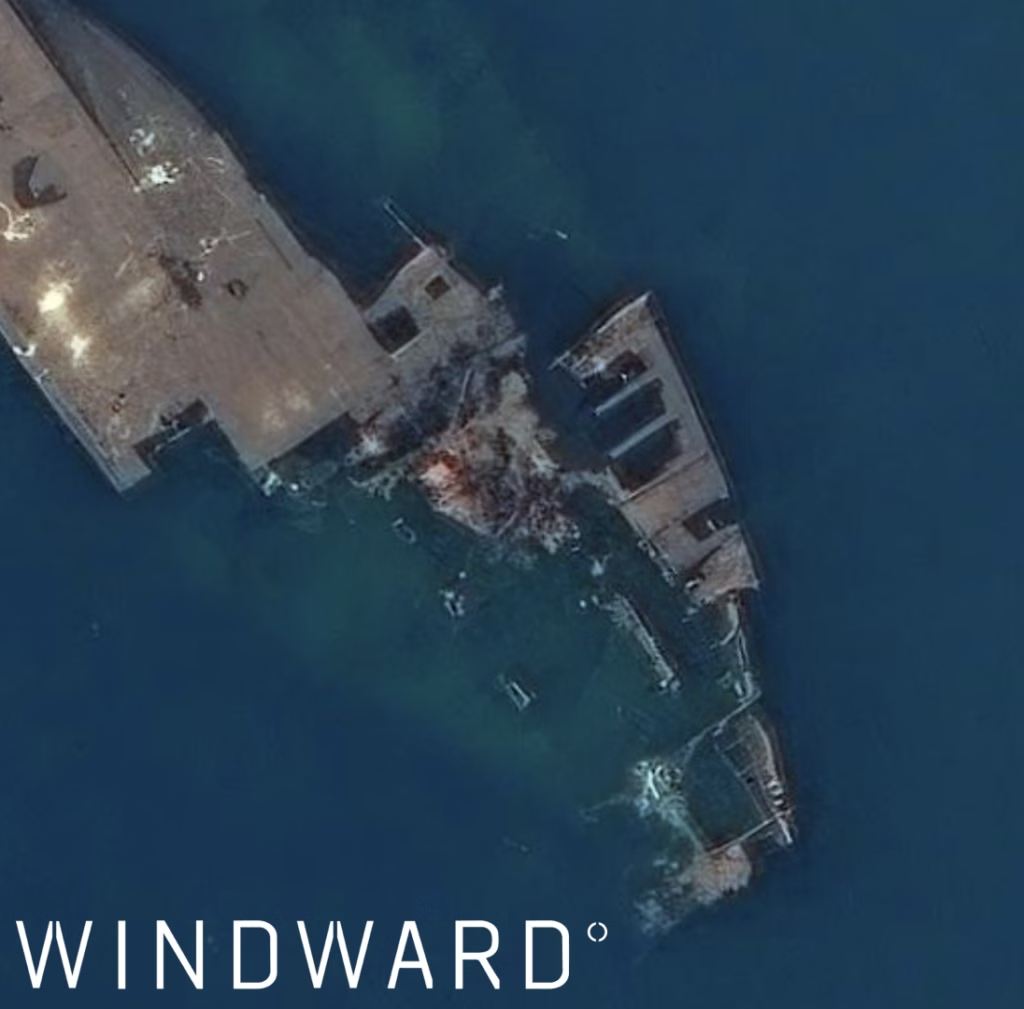
Iran’s efforts to use ships as floating storage have hit a snag in recent days. Iran has loaded just two ships, including one LPG tanker, at its main export terminal of Kharg Island since May 11, and the facility itself has been damaged by an unknown cause. No tankers with oil onboard have left the site since May 10. Moreover, a 20-square-mile oil slick—a fire hazard for ships—emerged nearby on May 8 and remains unaddressed.
- On May 12, The New York Times reported, citing U.S. officials, that “once Iran is unable to store oil, it would have to shut down wells, further pressuring the country’s ailing economy.”
- The head of Windward Intelligence told the Times the blockade “is starting to work” by creating bottlenecks in Iran’s energy storage.
- Satellite imagery from May 12 indicated that Iran’s main oil export site, the Kharg Island terminal, has completely stopped loading oil onto ships.
- Iran had been placing large amounts of oil onto stationary tankers due to low onshore storage capacity. However, it now seems unable to do so.
- Just a single tanker has been loaded with oil at Kharg Island since May 11, and satellite imagery shows that Kharg Island loading infrastructure is severely damaged. A large oil slick is also clearly visible
- The United Against Nuclear Iran (UANI) watchdog estimated on May 16 that due to the Kharg Island bottleneck, Iran has been unable to offload approximately 18 million barrels of crude oil since May 6. Conservatively, according to JINSA estimates, this equals roughly $2 billion in export value.
- The analytics firm Kpler projected on April 30 that, even when factoring in floating storage, Iran had just 22 days’ worth of total oil storage left.
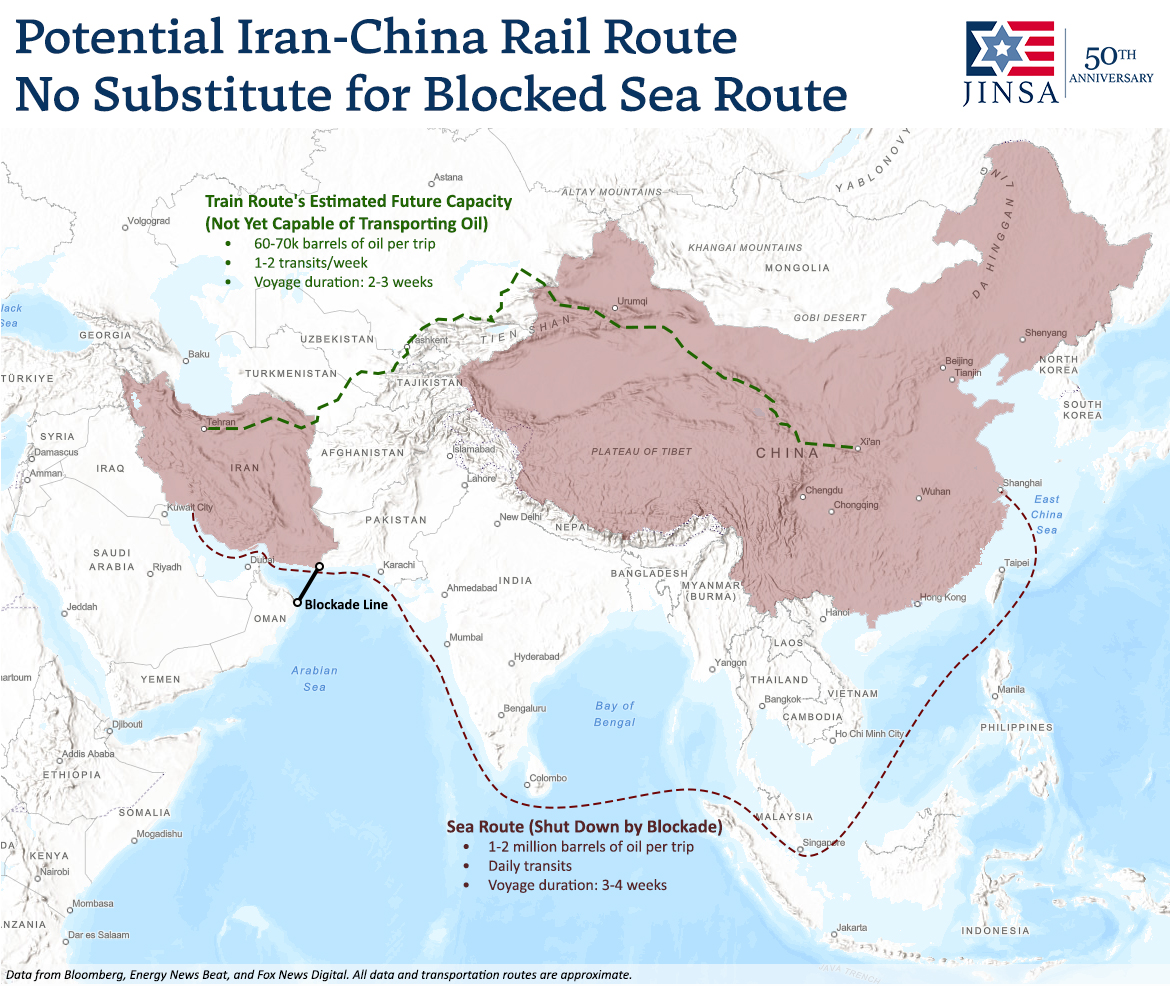
- The Iranian regime is hoping to export large amounts of crude oil to China via the Iran-Kazakhstan-Turkmenistan-China rail corridor, but faces several impediments to doing so, Bloomberg reported on May 8.
- These include:
- Trains on the route reportedly run just twice a week;
- Trains on the route are almost all going from China to Iran, not vice versa;
- Cargo trains on the route are not equipped to carry fuel or petrochemicals;
- Even at full capacity, trains cannot transport nearly as much oil as seaborne tankers can; and
- The route’s freight costs have increased over 40 percent, making this option potentially untenable for the cash-strapped Iranian regime.
Operation Economic Fury Updates
The U.S. naval blockade is just one, though significant, component of the multi-agency effort called Operation Economic Fury. As part of Operation Economic Fury, the Treasury Department has targeted other key nodes in Iran’s illicit energy supply chain.
Since JINSA’s last blockade update on May 8, there have been two major Operation Economic Fury-related developments.
- On May 11, the Treasury Department sanctioned 12 individuals and companies, including four based in Hong Kong and four based in the United Arab Emirates, who facilitated the “sale and shipment of Iranian oil to the People’s Republic of China” on behalf of Iran’s Islamic Revolutionary Guard Corps (IRGC).
- The sanctioned entities facilitated, based on conservative estimates, approximately $100 million worth of Iran-China oil transactions.
- On May 11, the Treasury Department released an 11-page memo providing guidance to financial institutions and the private sector in general about how to avoid inadvertently transacting with the Iranian regime or its front groups.
- In particular, the memo detailed how to spot “oil smuggling-related red flags” that indicate Iranian regime involvement. It also discussed how to avoid being unintentionally involved in Iran-linked shadow banking.
Click here to view the full, detailed list of blockade-evading ships.