JINSA Impact on This Year’s National Defense Authorization Act
Click here to download the JINSA Insight
President Trump’s 2026 National Defense Strategy emphasizes that the United States faces “one of the most dangerous security environments in our nation’s history.” Many of those dangers originate in the Middle East, where tensions with Iran and its terrorist proxies remain high in the aftermath of Operation Epic Fury and more recent U.S.-led military operations against Iran. An important tool for Congress to help address these challenges is this year’s National Defense Authorization Act (NDAA), which both frames U.S. national security policy across a broad spectrum of issues on a bipartisan basis and enables effective congressional oversight of the U.S. Department of Defense (DoD).
Multiple provisions impacting U.S. security interests in the Middle East are under consideration in either both, just the Senate, or just the House versions of this year’s NDAA, many impacted by prior JINSA policy recommendations (noted with a *). This includes proposals to strengthen U.S.-Israel defense industrial base integration; renew pre-existing joint U.S.-Israel programs; and conduct oversight of discrete elements of Operation Epic Fury against Iran.
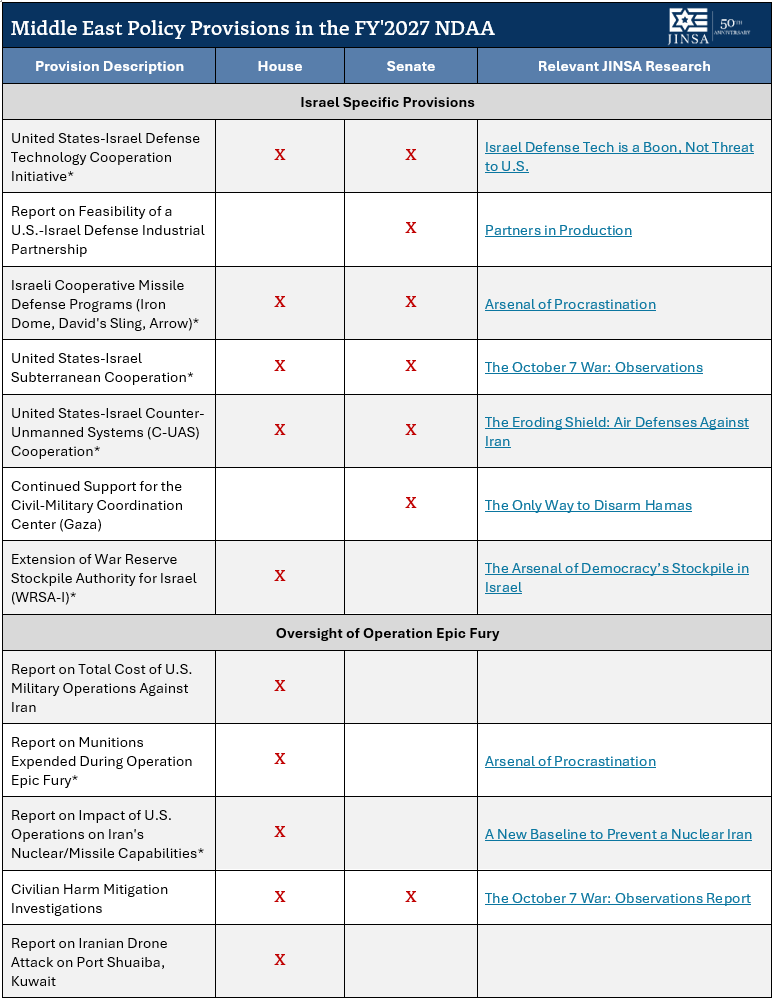
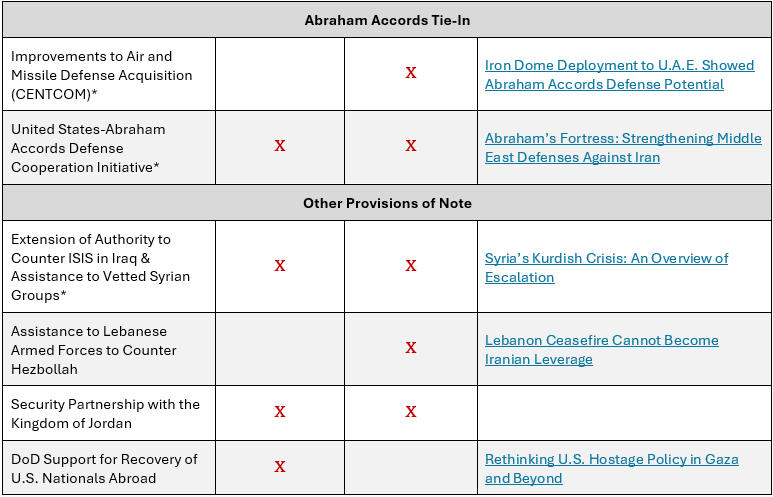
NDAA Provisions of Note Impacting U.S. Security Interests in the Middle East
* Denotes Provision Consistent with Prior JINSA Recommendations
Extension & Potential Expansions of U.S.-Israel Cooperative Defense Programs
United States-Israel Defense Technology Cooperation*
- House Version (R.8800 Sec. 219): Sponsored by Reps. Ronny Jackson (R-TX) and Don Davis (D-NC), this provision requires the Secretary of Defense to establish a “United States-Israel Defense Technology Cooperation Initiative” and designate an executive agent (as defined by DoDD 5101.01) to be responsible for synchronizing, expanding, and accelerating defense cooperative efforts between the United States and Israel.
The agent is directed to identify U.S.-Israel jointly developed or Israeli-origin technologies for potential integration into United States systems and programs of record; facilitate the transition of technologies from research and development into procurement and acquisition pathways; establish frameworks for joint ventures, licensing agreements, and United States-based co-production or manufacturing partnerships with Israeli industry; and promote joint training exercises and information-sharing mechanisms to enhance operational readiness to deploy said jointly developed technologies. Areas of potential cooperation and collaboration identified include areas like counter-unmanned aerial systems (C-UAS), subterranean warfare, air and missile defense, artificial intelligence (AI), directed energy, and cyber warfare, but no specific cooperation on any specific capability is mandated.
- Senate Version (4784 Sec. 1217): Sponsored by Sens. Ted Budd (R-NC) and Kirsten Gillibrand (D-NY), this provision similarly requires the Secretary of Defense to establish an initiative in consultation with the Minister of Defense of Israel but does not specify that an executive agent must lead it. Domains of potential cooperation listed are nearly identical with the House version, with the addition that missile and air defense technology cooperation can also include “Golden Dome for America” programs, in line with prior JINSA recommendations, such as our op-ed earlier this year: U.S.-Israel Defense Collaboration is Essential for Trump’s ‘Golden Dome.’
- Analysis: These provisions are both revised versions of the United States-Israel Framework for Upgraded Technologies, Unified Research, and Enhanced Security (FUTURES) Act of 2026 (H.R. 7540 / S.3855). The FUTURES Act originally included a $150 million annual authorization to support new cooperative programs for the next three years (FY’2027-29), which was not included in either NDAA provision.
These provisions would build on pre-existing joint ventures in missile defense (Iron Dome, David’s Sling, and Arrow), subterranean warfare, and C-UAS, as well as the ongoing work of the U.S.-Israel Operations Technology Working Group (OTWG), previously authorized in the FY’2021 NDAA Sec. 1299M and officially stood up in late 2021, that has focused on areas of potential cooperation to provide cutting edge technology to American warfighters in areas including artificial intelligence/autonomy, directed energy, C-UAS, biotechnology, integrated network systems-of-systems, and hypersonic capabilities. Such endeavors are in line with JINSA recommendations in major reports like Partners in Production and From Partner to Ally, which called for a new 25-year joint R&D partnership MOU focused on next-generation military technologies.
The inclusion of these provisions generated surprisingly hyperbolic commentary in the press and during House debate, such as that they are “akin to a formal defense pact or treaty” with Israel, or “the first step towards shifting aid [to Israel] further into the shadows,” and that “Netanyahu actually wrote to a member of Congress to put this Sec. 224 into the bill,” none of which are accurate. The initiative would be an incremental step towards enhancing oversight of pre-existing joint programs and clarifying the most valuable potential areas of greater defense cooperation in the future that would most benefit American warfighters first and foremost. Any new cooperative programs would have to be approved and funded by Congress just like current joint programs are every year.
HASC Chairman Rogers explained: “Sec. [219] doesn’t create any new programs in the Department of Defense, it simply designates a single senior official to coordinate existing initiatives. Sec. [219] actually improves oversight and accountability of these programs by designating a single official responsible for them. Claims that this provision somehow cedes authority to a foreign government are simply ridiculous.” Ranking Member Smith concurred: “this is not a new framework. It’s not a new framework at all. We have three existing programs where we do military cooperation with Israel to develop technologies. … to say that this is us bowing to Israel on this is completely inaccurate.” He further added: “the reason we have these partnerships with Israel … is because Israel is actually having to fight. They have faced drone attacks and missile attacks. They have had to develop new technologies; technologies that we [the United States] have benefited from.” As a result of this bipartisan support, Rep. Ro Khanna’s (D-CA) amendment to strike the provision during HASC debate failed by voice vote.
For further discussion on this topic, please see JINSA’s recent Insight: Israel Defense Tech is a Boon, Not Threat to U.S.
Report on the Feasibility and Advisability of Establishing a Strategic Partnership on Defense Industrial Priorities Between the United States and Israel
- House Version:
- Senate Version ( 4784 Sec. 845): Requires the Secretary of Defense to submit a report to the Armed Services Committees by March 30, 2027, outlining a plan for a U.S.-Israel defense industrial partnership, including how to ensure market access; increase interoperability through dual-use and emerging technologies; counter adversarial dual-use tech development; in coordination with Israel’s Ministry of Defense on industrial priorities, set tangible goals for defense manufacturers in both nations, help regulatory navigation, streamline joint R&D, enhance pathways to market for defense technology startups, and leverage private capital to augment government funding; and explore mentor-protégé arrangements. The report must include a feasibility assessment to be briefed to relevant congressional committees within 30 days of submission of the plan.
- Analysis: This report requirement is similarly indicative of congressional interest in maximizing the potential value of U.S.-Israel cooperation to support shared defense needs. Given pre-existing partnership pathways like the U.S.-Israel OTWG already exist, and the proposal for the United States-Israel Defense Technology Cooperation Initiative proposal elsewhere in the bills, this provision may end up being dropped in conference as duplicative. For more from JINSA on this topic, also see Partners in Production: U.S.-Middle East Cooperation to Enhance Our Collective Defense Industrial Base.
Israeli Cooperative Missile Defense Programs (Iron Dome, David’s Sling, Arrow)*
- House Version (Budgetary Tables): Authorizes $300M in funding for missile defense programs under the Israeli Cooperative Programs heading, and an additional $150M for Arrow 3 Upper Tier Systems, $30M for the Short Range Ballistic Missile Defense (SRBMD / David’s Sling), and $20M for Iron Dome are funded under the Missile Defense Agency heading.
- Senate Version ( 4784 Sec. 1531): Identical $300M authorization in funding under the Israeli Cooperative Programs heading and $200M for three Israeli missile defense co-production programs under the Missile Defense Agency.
- Analysis: Consistent with the 10-year U.S.-Israel Memorandum of Understanding (MOU) of 2016 on U.S. defense assistance to Israel, which provides $500M in support of cooperative missile defense programs, both versions of the bill fully authorize funding for these systems vital to helping Israel maintain its Qualitative Military Edge (QME, a requirement under U.S. law) and defend civilians from rockets and missiles. As JINSA’s Iran Projectile Tracker outlines, during Operation Epic Fury Iran dispersed its fire, launching roughly 7,600 projectiles—roughly 2,304 ballistic missiles and 5,323 drones —at more than a dozen countries prior to the ceasefire going into effect on April 8. These systems played a vital role in preventing many of these projectiles from reaching their intended targets in Israel and the United Arab Emirates. Despite this success, as JINSA recently explained in “Arsenal of Procrastination: The United States Must Expand Munitions Production, Not Merely Replenish,” the United States cannot expect to deter, fight, and win major conflicts with the arsenals it has and must look to new and innovative ways to expand our production capabilities.
United States-Israel Subterranean Operations Cooperation*
- House Version (R.8800 Sec. 1222): Modifies Sec. 1279 of the FY’2016 NDAA (Public Law 114-92) to extend the authority for the Secretary of Defense to conduct collaborative research, development, testing, and evaluation on anti-tunnel capabilities with Israel through December 31, 2029. This section would also expand the authority to include subterranean threats of all types. Notably, it changes the title of the program from “United States-Israel anti-tunnel cooperation” to subterranean cooperation. The Combating Terrorism Technology Support program includes $100M for Israel Subterranean Cooperation, $20M more than last year’s authorized amount.
- Senate Version ( 4784 Sec. 1215): Similarly raises the authorization cap to $100M and renames the section heading to “Subterranean Operations Cooperation.”
- Analysis: Hamas’s use of tactical and strategic tunnels under Gaza presented serious challenges for the IDF, as detailed in JINSA’s The October 7 War: Observations The report describes how the IDF adapted its tactics to maneuver simultaneously above and below ground and the potential value to American forces adopting the IDF’s latest tactics and procedures to minimize casualties. Building off these insights, JINSA has worked with Congress in recent years to expand the focus on the counter-tunnel program to focus not just on sensing and locating tunnels, but on all elements of subterranean warfare including maneuvering within tunnels, destroying or disabling them, and mapping them. This year’s reauthorization continues to move in this direction.
United States-Israel Cooperation to Counter Unmanned Systems (C-UXS) in All Warfighting Domains*
- House Version (R.8800 Sec. 1223): Modifies Sec. 1278 of the FY’20 NDAA (Public Law 116-92) to extend the authority for the Secretary of Defense to conduct collaborative research, development, testing, and evaluation of technologies to counter unmanned systems with Israel through December 31, 2029. The Combating Terrorism Technology Support program includes $100M for Israel Counter UXS Program, an increase of $30M over last year.
- Senate Version ( 4784 Sec. 1216): Similarly raises authorized funding to $100M compared to last year’s $70M authorization.
- Analysis: JINSA has worked with Congress repeatedly in recent years to strengthen U.S.-Israel C-UAS capabilities, building on insights from reports like The Eroding Shield: Air Defenses Against Iran and Forged Under Fire: Middle East Air Defense After Iran’s 2024 Attacks on Israel. Given the rapid evolution of drone and missile capabilities globally, incorporating lessons learned from recent American-Israeli conflicts with Iran is essential to help strengthen integrated air and missile defense (IAMD) capabilities in the Middle East, Europe, and to defend the U.S. homeland as the President’s Golden Dome Initiative continues to mature. To help understand the full scope of this threat, JINSA has carefully tracked Iran’s drone and projectile launches since October 7, 2023 – for more, please see: Iran Projectile Tracker.
Continued Support for the Civil-Military Coordination Center
- House Version:
- Senate Version (4784 Sec. 925): Authorizes the Secretary of Defense to maintain the existing Civil-Military Coordination Center (CMCC), an implementation body for the Board of Peace overseeing the Comprehensive Plan to End the Gaza Conflict and as a joint civil-military coordination body within DoD, through December 31, 2027. By March 1, 2027, the Secretary must submit to the Armed Services Committees a plan for the Center’s continuing operations aimed at Hamas’s disarmament, exclusion from governance, and resource denial, plus training an international stabilization force, addressing elements like mission structure, staffing, funding, ceasefire enforcement, humanitarian coordination, and the feasibility of permanent authorization. The section also requires recurring reports every 180 days (coordinated with CENTCOM) on personnel numbers, casualties, stakeholder partners, detailed humanitarian aid flows into Gaza (by category, volume, and entry point), Hamas interference/profiteering assessments, the International Stabilization Force’s command structure, mission, rules of engagement, disarmament role, deployment map, and relationship with Palestinian police, submitted in unclassified form with a possible classified annex.
- Analysis: JINSA concurs with this approach. Established in October 2025, the CMCC has continued to play an important role in coordinating humanitarian efforts for civilians in Gaza. As we have urged in research papers like The Only Way to Disarm Hamas, the CMCC should continue to play this helpful role.
Extension of War Reserve Stockpile Authority for Israel*
- House Version (R.8800 Section 1221): This section would extend the existing War Reserve Stockpile Authority for Israel, established by section 12001(d) of the Department of Defense Appropriations Act, 2005 (Public Law 108-287), for an additional two years to January 1, 2029.
- Senate Version: No comparable provision.
- Analysis: JINSA has long supported strengthening and modernizing the U.S. War Reserve Stockpile in Israel (WRSA-I), vitally necessary for U.S.-Israeli wartime readiness to defend against threats posed by Iran and its proxies. JINSA first began raising the importance of replenishing this stockpile in a 2018 report, delved into it in greater detail in our 2020 report, Anchoring the U.S.-Israel Alliance: Rebuilding America’s Arms Stockpile in Israel, and highlighted the unique value of WRSA-I in a Wall Street Journal op-ed by JINSA President & CEO Michael Makovsky and JINSA Vice President for Policy Blaise Misztal, The Arsenal of Democracy’s Stockpile in Israel. For the stockpile to fulfill its purpose as a strategic fallback for Israel, there is an urgent need to update and replenish the weaponry stored there with munitions such as Joint Direct Attack Munitions (JDAMs) and GBU-39 and GBU-53/B small diameter bombs (SDBs), in addition to simply reauthorizing it.
Impact of Operation Epic Fury Against Iran
Report on the Total Cost of U.S. Military Operations against Iran
- House Version (R.8800 Sec.1089E): Rep. Seth Moulton (D-MA) introduced this proposal as an amendment during committee markup, arguing: “The American people deserve to know if this war is worth the about $1,200 per taxpayer it is costing.” It requires a report on the total financial cost to the United States of military operations carried out against Iran beginning with the launch of Operation Epic Fury on February 28, 2026, including: a full inventory and replacement valuation of all United States military aircraft, naval vessels, drones, and other significant equipment damaged or destroyed during such military operations; the total cost and quantity of all weapons, missiles, and munitions expended during such military operations and replacement costs; and a comprehensive assessment of the costs associated with repairing or rebuilding United States military bases and facilities damaged or destroyed during such military operations and the extent to which infrastructure was damaged or destroyed during such military operations.
- Senate Version:
- Analysis: While a perfectly reasonable question, this provision is likely to be dropped as superfluous, given the White House formally transmitted an $87.6B supplemental spending request to Congress on June 24, with the bulk directed toward the “urgent needs related to Operation Epic Fury (OEF),” including $67.1B for the Department of Defense
Report on Munitions Expended during Operation Epic Fury*
- House Version (R. 8800, Sec. 321): Proposed by Ranking Member Adam Smith, requires the Secretary of Defense to report current munitions inventory numbers to congressional defense committees, first alongside the annual budget submission, then quarterly thereafter. The reports must show inventory totals both in aggregate and broken down by individual military branch.
- Senate Version:
- Analysis: Despite Sec. Hegseth’s testimony in May that “there are not shortfalls that exist in our ability to execute the missions around the world,” and White House spokeswoman Anna Kelly claiming: “The United States Military has more than enough munitions, ammo, and stockpiles to serve all of President Trump’s strategic goals and beyond” in June, Congress is unconvinced this is actually true. As noted in JINSA’s The Eroding Shield: Air Defenses Against Iran report, the United States and our regional partners have dipped deeply into our stockpiles of both offensive and defense missiles in support of operations against Iran. Congress shares JINSA’s concerns and is eager to keep a close eye on the situation. JINSA’s Arsenal of Procrastination: The United States Must Expand Munitions Production, Not Merely Replenish provides further discussion on this important strategic issue.
Impact of United States Military Operations on Iran’s Nuclear and Military Capabilities*
- House Version (Rep. Bill Keating, Log 6251 in CM EB 2): Directs the DoD and DNI to deliver a report on the impact of U.S. military operations, specifically Operation Epic Fury, on Iran’s nuclear and missile capabilities. The report must assess damage to Iran’s enriched uranium stockpile, its timeline to a nuclear weapon, its missile forces and command infrastructure, its progress rebuilding after strikes, and whether the operations have influenced Iran’s decision-making on pursuing nuclear weapons. This requirement oddly didn’t make it into H.R.8800 bill text and may have been moved into the as-yet-unreleased House report to accompany H.R.8800 instead.
- Senate Version:
- Analysis: Congress has long been concerned with closely tracking the details of Iran’s nuclear program, such as the stringent reporting requirements on the Iranian nuclear program that were sponsored by Sen. Lindsey Graham (R-SC) in the FY’2024 NDAA (Sec. 7413). This new provision is illustrative of continued concern and deep skepticism regarding whether U.S. negotiations with Iran can secure the elimination of this program. For more, see How the MOU’s ‘Nuclear Status Quo’ Negates a Good Iran Deal, and A New Baseline to Prevent a Nuclear Iran.
Civilian Harm Mitigation Investigations
- House Version (R.8800 Sec.1089G): This section requires the Secretary of Defense to report to congressional defense committees within 30 days of completing its civilian harm investigation into a U.S. strike on Minab, Iran on February 28, 2026, which hit Sharajeh Tayyebeh Elementary School. The unclassified portion of the report must be made publicly available.
- Senate Version ( 354 and Sec. 1046): Sec. 354 withholds 75% of the Secretary of Defense’s travel expenses until the delivery of a number of overdue reports, including unredacted civilian harm investigations and all relevant supporting documents for strikes on the Ras Isa Port in Yemen on April 17, 2025, the Ayn Wadi Barracks Warehouses in Yemen on April 28, 2025, a residence in Yemen on April 6, 2025, and the Minab girls school in Iran on February 28, 2026. Sec. 1046 further requires a report on the overall implementation of Department of Defense Instruction 3000.17, entitled “Civilian Harm Mitigation and Response.”
- Analysis: While the United States takes strong efforts to prevent civilian casualties, an unfortunate reality of war is that we are not always successful, particularly as Islamic terrorist groups like ISIS, Al Qaeda, Hamas, and Hezbollah, and terror states like Iran purposely place military personnel and equipment in schools, hospitals, and religious sites. JINSA’s The October 7 War: Observations Report emphasized: “As part of its exploitation of Gaza’s population, Hamas made extensive use of civilian facilities to store its weapons, stage attacks, and conduct command-and-control operations. Terror cells used apartments to store Kalashnikov rifles and RPGs, retrieve the weapons, and perpetrate sniper or RPG attacks. By early January, the IDF had confiscated over 4,000 Hamas weapons from inside mosques, elementary schools, and residential buildings in Gaza in the less than three months from when the war began. Hospitals were also a frequent location of, or used to shield, Hamas’s weapons stockpiles, command-and-control centers, and access tunnels.” Given the significant negative strategic impact these strikes can have on the public perceptions and legitimacy of U.S. and partner operations, Congressional oversight to help do everything possible to prevent such incidents is warranted.
Report on Iranian Drone Attack on Port Shuaiba, Kuwait
- House Version (R.8800 Sec.1089H): This section requires the DoD to transmit to congressional defense committees the full findings, remedial actions, and investigative details from its investigation into the Iranian drone attack on the U.S. military installation at Port Shuaiba, Kuwait on March 1, 2026. The findings must be submitted in unclassified form, and the unclassified version must be posted publicly on a DoD website.
- Senate Version:
- Analysis: The attack killed six U.S. servicemembers at Port Shuaiba: Maj. Jeffrey O’Brien, 45; Chief Warrant Officer 3 Robert Marzan, 54; Capt. Cody Khork, 35; Sgt. 1st Class Nicole Amor, 39; Sgt. 1st Class Noah Tietjens, 42; and Sgt. Declan Coady (posthumously promoted from Specialist), 20. The success of the attack raises serious questions about the extent to which DoD has implemented best practices from recent combat operations in places like Ukraine to protect American servicemembers. It also underlines the value of joint U.S.-Israel research and development on C-UAS and other capabilities to counter these threats.
Abraham Accords Tie-In
Improvements to Air and Missile Defense Acquisition*
- House Version:
- Senate Version ( 4784 Sec. 1538): Requires the Secretary of Defense, in consultation with the Secretary of State, to complete within 180 days of enactment an assessment of U.S. and foreign partner air and missile defense systems and interceptors within CENTCOM’s area of responsibility, and to submit a report covering current systems and interceptors, inventory/production rates, deployments and interceptors expended since October 7, 2023 (disaggregated by U.S. and partner), systems damaged or destroyed since that date, and cases where U.S. industry cannot fulfill partner orders. Within the same 180-day window, the Secretary must also submit a strategy to deepen cooperation with foreign partners on integrating air and missile defense systems and acquiring interceptors, addressing replenishment and transfer efforts, the feasibility/cost of a CENTCOM-area stockpile, joint ventures and co-production partnerships, accelerating lower-cost interceptor solutions, legal/economic/policy analysis of closer acquisition partnerships, and lessons learned from Ukraine, the Middle East/North Africa, the Caucasus, and the Horn of Africa, while protecting intelligence sources and sensitive information; the strategy must be unclassified with a possible classified annex.
- Analysis: This provision reiterates and builds directly on recent NDAA requirements JINSA helped draft in partnership with the House and Senate Abraham Accords Caucuses, such as the report in the FY’2026 NDAA’s Joint Explanatory Statement and the FY’2023 NDAA ( 1658) to improve American air and missile defense cooperation with our allies and partners. Given the rapid evolution of drone and missile capabilities globally, incorporating lessons learned from the 12-Day War and Operations Epic Fury/Roaring Lion is essential to help strengthen IAMD capabilities in CENTCOM, as well as similar efforts in Europe, the Indo-Pacific, and North America (such as Golden Dome).
United States-Abraham Accords Defense Cooperation Initiative*
- House Version (R.8800 Sec.1707): Authorizes, but does not require, DoD to establish a United States-Abraham Accords Defense Cooperation Initiative aimed at deepening military ties between the U.S. and countries that signed or sought to join the Abraham Accords, including any Arab or Muslim-majority nation that has pursued normalization with Israel since 2020. The Initiative’s objectives include deterring Iran and its proxies, coordinating with existing regional security agreements, and building practical military cooperation across areas like counter-drone systems, air and missile defense, ISR, special operations, and joint exercises. Within six months of establishment, the Secretary must submit a strategy report to congressional defense committees detailing how each objective will be achieved.
- Senate Version ( 4784 Sec. 1204): Makes establishment of the Initiative mandatory rather than discretionary. The Senate provision accelerates and expands the reporting requirement, with its report due 60 days after enactment of the NDAA and requiring an estimate of the amount of funding necessary to carry out the Initiative. The Senate version further urges seeking matching funds from participating Abraham Accords countries.
- Analysis: This idea is directly in line with recommendations included in recent JINSA reports like Abraham’s Fortress: Strengthening Middle East Defenses Against Iran urging the United States to accelerate its efforts to foster a collective, mutually beneficial, and innovative multilateral approach to regional defense. That means Washington will need to invest not just resources, but time and effort, to stimulate trust multilaterally. The United States is uniquely qualified and positioned to provide the exquisite command-and-control capabilities, and political leadership, to spearhead a comprehensive and inclusive multilateral approach to regional security. Key areas of potential collaboration should include boosting collaboration and transparency, streamlining technology transfers, and improving public and private sector fusion in the acquisition process.
Additional Middle East Provisions
Extension of Authority to Provide Assistance to Counter the Islamic State of Iraq and Syria (ISIS)*
- House Version (R.8800 Sec. 1215-6): Sec. 1215 extends the authority under Sec. 1236 of the FY’2015 NDAA (Public Law 113-291) to provide support to partner forces in Iraq to counter the Islamic State of Iraq and Syria through December 31, 2027. Sec. 1216 restricts disbursement of 75% of the funding for the Iraqi Security Forces until the Secretary of Defense certifies that the Government of Iraq has taken credible steps to reduce the influence of Iranian-aligned militia groups and actors within the Iraqi Security Forces.
- Senate Version ( 4784 Sec. 1213-4): Sec. 1213 extends authority under Sec. 1209 of the FY’2015 NDAA to provide assistance to vetted Syrian groups until the end of 2027, while barring expenditure of funds for cooperation with the Government of Syria until the Secretary of Defense certifies to the congressional defense committees that Syria has taken credible steps to remove and disarm foreign fighters/jihadists, monitor them to prevent attacks, deny travel documents to security threats, counter al-Qaeda and successor groups, integrate the Syrian Democratic Forces into Syria’s military, and prevent attacks on Kurds and Druze.
The same extension of the counter-ISIS program through the end of 2027 as the House version, but updates how the funds can be utilized, removes the goal of helping secure the territory of Iraq, and adds supporting joint C-UAS efforts. Similarly restricts disbursement of funds to Iraq pending certification that Iraq has taken credible steps against Iranian-backed attacks against U.S. forces and interests, investigated and held accountable Iraqis responsible for such attacks, and brought militias under the control of the Iraqi Security Forces. Further directs the Secretary to establish a contingency process for direct support to Kurdish Peshmerga forces if such certification fails, exempting Iraqi Counter Terrorism Service and Peshmerga funding from the cap, and mandating that at least 50% of funds go to Kurdish Peshmerga forces.
- Analysis: This provision continues Congress’s strong interest in ensuring that ISIS remains subdued in Iraq and Syria and hedges against renewed Iranian influence moving forward. Post-Assad Syria presents many opportunities for progress in the region, but the country remains unstable, and thousands of ISIS prisoners were moved from Syria to Iraq to prevent their escape from custody in light of concerns about a weak or indifferent Damascus under Sharaa. Violence during the July 2025 Suwayda crisis also laid bare the deep tensions between Syria’s new government and the country’s Druze community. JINSA strongly supports the U.S.-led Countering ISIS Coalition and has advocated for a long-term framework to counter Iran in Syria. With Iran significantly weakened in the aftermath of Operations Epic Fury and Midnight Hammer, Congress is clearly frustrated with the Iraqi government’s lack of action to prevent attacks against U.S. forces in Iraq. For more on recent attack trends, see: Iran Projectile Tracker.
Assistance to Lebanese Armed Forces for Countering Hezbollah and Other Terrorist Groups*
- House Version: Nothing
- Senate Version ( 4784 Sec. 1211): This provision authorizes the Secretary of Defense to provide training, equipment, and sustainment (capped at $36 million) to vetted Lebanese Armed Forces (LAF) divisions, prioritizing special operations units, to counter Hezbollah and other terrorist groups in Lebanon and to build LAF capacity to fully disarm Hezbollah, with 95% of relevant Counter-ISIS Train and Equip Fund money withheld until the Secretary certifies Lebanon has outlawed Hezbollah’s military activities and the LAF is actively pursuing disarmament, denying Iranian support, and preventing cross-border attacks. Starting March 31, 2027, and every 90 days thereafter, the Secretary must submit detailed unclassified quarterly reports on vetting, LAF capability and willingness to disarm Hezbollah, the amount of weapons seized, Hezbollah’s degradation, Iranian support, threats to Israel/Syria, troop and recruitment data, and assistance provided. If a report finds the LAF capable but unwilling to act against Hezbollah, the Secretary must suspend support and notify Congress within five days; the section disclaims authorization for hostilities and terminates December 31, 2027.
- Analysis: To fully eliminate Hezbollah’s threat to Israel’s northern border, the LAF must increase their capabilities. With funding conditioned to this extent, patience is clearly running thin on Capitol Hill with the Lebanese government. For additional insights from JINSA, see Lebanon Ceasefire Cannot Become Iranian Leverage and our prior Suppressing Iran’s Ring of Fire in Lebanon
Security Partnership with the Kingdom of Jordan
- House Version (Chairman’s Mark Directive Report Language): Directs the Under Secretary of Defense for Policy to provide a briefing to the House Committee on Armed Services not later than December 1, 2026, on opportunities to expand defense cooperation with Jordan, including on IAMD, border security, cybersecurity, and C-UAS.
- Senate Version (4784 Sec. 1201): Authorizes the Secretary of Defense to provide assistance (training, equipment, logistics support, supplies, stipends, services, and sustainment) to Jordan’s military forces through December 31, 2027, for securing Jordan’s territory and borders, increasing regional stability, countering threats from Iran and its proxies, and bolstering Jordanian military capacity and interoperability with U.S. and allied forces. At least 15 days before providing such assistance, the Secretary must notify the congressional defense committees in writing.
- Analysis: Similar to 1643 in last year’s NDAA urging enhanced support for Jordanian air and missile defense capabilities, which played a key role defeating Iranian missile attacks against Israel and U.S. bases in the past two years, these provisions are indicative of continued interest in strengthening Jordan’s security services. The need for such assistance was underlined by the recent deaths of U.S. personnel due to Iranian missile strikes.
Modifies Directive Report Language “Department of Defense Support for Recovery of United States Nationals Abroad” to Include Comparison to Partner Force Doctrine for Recovery of Nationals
- House Version (Rep. Abe Hamadeh, Log 5792 ISO EB 1): This provision, to be included in the pending House report to accompany H.R.8800, modifies a report requirement on DoD support for recovering nationals abroad by inserting a new section before the existing classified portion. The new section requires an assessment of how allied militaries handle recovery and repatriation of their own citizens, and whether the U.S. should adopt a similar formal doctrine across operations, budgeting, detainee policy, and interagency coordination.
- Senate Version: Nothing
- Analysis: This provision has the potential to further increase deterrence by enhancing American capabilities to rescue wrongfully detained American citizens. JINSA’s groundbreaking Rethinking U.S. Hostage Policy in Gaza and Beyond report, which called for tougher penalties and international coordination to curb hostage-taking, and briefings to Congress in 2024 to create a new “State Sponsor of Wrongful Detention” designation for countries like Iran, led directly to passage of the Countering Wrongful Detention Act in last year’s NDAA.